8 min read
Stay updated with the latest - Click here to follow us on Instagram

Journalism of Courage



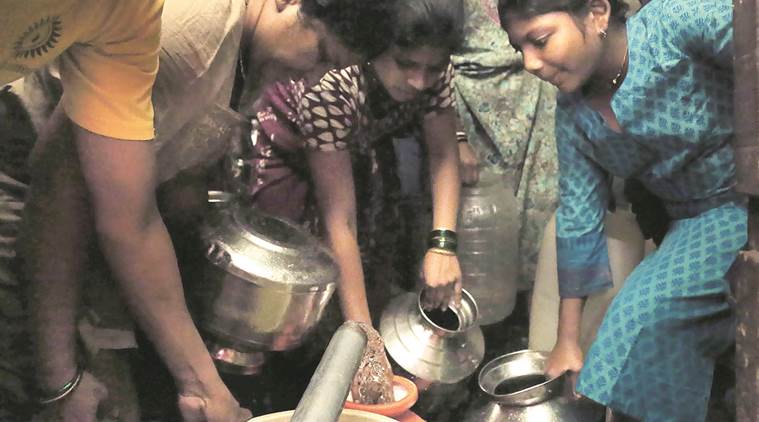 Residents of Matunga Labour Camp fight it out for water. Amit Chakravarty
IN THE Azad Nagar slum near Mahim railway station, Sakhubai Sutar, 55, wakes up at 4 am every day. The community pipeline in the slum gurgles to life at 4 am, and before it runs dry at 7 am, the women throng the small space around the pipe. “Almost every day, there are fights for water — literally thousands of people come to that one connection,” says Sutar. The summer months are worse, when the pipe runs dry without warning or following any pattern. “Then we have to cross the railway tracks to get water from a water connection belonging to a cinema hall there. Or, sometimes we go all the way to Matunga Labour Camp for water,” she grumbles.
Watch What Else Is Making News?
According to Sujata Ramesh Bhalerao, a resident of the area, this water connection that sees thousands queuing up is itself a new addition to the slum. “This is primarily due to civic polls. Prior to getting this connection, people had to get water through illegal connections or tankers,” she says.
Water, taken for granted by the section of Mumbai living in housing societies that take on the task of managing the underground and overhead storage systems, has never ceased to be an election issue for the 60 per cent of Mumbai that lives in slums and the large majority of those in chawls and older apartment buildings where supply remains well short of a daylong luxury. So it’s little wonder then that with elections coming up, every party is promising, again, that Mumbaiites will get 24×7 water supply if they are voted to power.
Only last week, addressing a gathering of north Indians in Ghatkopar (West), Mumbai Congress president Sanjay Nirupam promised them “24×7” water that would also be “pure” and “free”, if the Congress were elected to power in the BMC. A little earlier, in the last week of December, no less than Chief Minister Devendra Fadnavis spoke about providing 24-hour water supply, while inaugurating the upgrade work of a 12-inch water pipeline to 18 inches, to improve water supply around Rajawadi, in Ghatkopar (East).
Interestingly, the Shiv Sena, which has controlled the BMC for the last two decades, has been promising 24-hour water supply for more than a decade now. In 2007, the Sujal Mumbai Abhiyaan was launched with the same objective but could not be implemented due to technical issues. It, however, focused on the redressal of complaints of water contamination and leakages and construction of underground water tunnels. The civic body had spent around Rs 1,000 crore on the Sujal Mumbai Abhiyaan.
Subsequently, another project called the Water Distribution Improvement Project (WDIP) was launched in July 2014, again to provide 24-hour supply. The WDIP also includes GIS mapping of existing distribution networks, customer surveys, pressure management, solution for slums, leakage detection, quality control and more. The civic body’s attempt to provide 24-hour supply under WDIP covers 15 wards in the suburbs.
The large number of unmetered connections in the island city’s British-era buildings makes it impractical to promise a 24-hour supply there, say officials of the hydraulic engineer’s office in the BMC.
Under the WDIP, the civic body started the pilot project in H (West) ward, which covers Bandra, Khar and Santacruz (West), and T ward (Mulund). While the pilot project was expected to be completed within a year, it is not yet complete even as two-and-a-half years have passed. Officials attribute the delay to the unavailability of updated distribution network maps.
“The National Informatics Centre had given us the network maps in 2004 and it is the base to carry out the GIS mapping. Since it has not been updated since 2004, there was no information about the roads, other utilities or developments that have taken place in the decade. So, the road survey was commenced to mark the network, which slowed down the project work,” said an engineer, adding that the civic body had set the deadline of September 2017 to start the 24-hour supply in some areas of the H (West) and T wards.
“We have created zones to start the continuous water supply. Gradually, more zones will be added. The other reason for delay in starting the 24-hour supply is poor response to the tenders floated to install pressure regulating devices, flow meters, valves and others. Now, the work will be delayed by 2-3 months due to the poll code of conduct,” explained the engineer.
The civic body has given a five-year contract for WDIP, worth Rs 263 core, as per which the work is expected to be completed in July 2019. “With the delay in implementing it in two wards on pilot basis, we will have to give extensions to the project,” added the official.
Strangely, the BMC’s hydraulic engineering department claimed that it had already started 24-hour supply in some areas of N, S and T wards (Ghatkopar, Bhandup and Mulund) for the last few months on its own and without assistance of the WDIP contractors. Asked how this was possible, a senior engineer said, “The improvement in water supply is a continuous process. We thought some of the areas in these wards can be given 24-hour supply. In these three wards, around 13 lakh population is given 24-hour supply, not the entire ward. It is basically done to show that 24-hour supply is possible in Mumbai.”
The Sena says it is committed to the concept. “We have started providing 24-hour water in some parts of Mulund and other areas. We are committed to giving 24-hour water supply to the city. We don’t know what other parties are talking about.
The BMC has already started working on it,” said Trushna Vishwasrao, senior Sena corporator and leader of the BMC House.
Nirupam said there was around 30 per cent unaccounted water supply. “It is mainly because of water thefts or leakages. The BMC’s ward offices have patronised the water mafia who are given around 750 million litres daily at nominal rates. Then they (the mafia) sell this to people at huge rates. This must be stopped to provide continuous water supply to people. Many times a water pipeline burst is not attended to by the civic body for around 24 hours, which must be repaired immediately. Sena has been promising this for the last 20 years but has done nothing,” he said.
While the civic body supplies around 3,750 million litres daily (MLD) water to the city as against the demand of 4,300 MLD, around 27 per cent water is lost in the leakages, unauthorised connections and errors in metering. There are around 4.80 lakh water connections in the city, which includes 1 lakh unmetered water connections in the island city, say officials, admitting there was rampant theft.
The BJP, however, said a basic amenity such as water supply should not be linked to polls. “It is the basic requirement, which the ruling party has failed to deliver due to lack of will. If we come to power with majority in the BMC, we will fast-track the dam projects to meet water supply requirement. Also, we will focus on recycling the waste water for non-potable purposes. Since the Sena is a narrow-minded party, it is not able to develop the city fully,” said Ram Kadam, BJP legislator from Ghatkopar and party spokesperson.
James John, an activist from Andheri (East), said the civic body must focus on attending the leakages first. “BMC takes weeks to attend to the leakages as it is not equipped. Its maintenance activity is also poor. Before starting the 24-hour supply projects, it should conduct a viability study. It should aim at ensuring no leakages. So, it is not possible to implement such projects. A similar thing had happened with Sujal Abhiyaan,” said James, adding that the civic body must involve the people and NGOs who could give ground-level inputs to such projects.
“Freebies such as free and 24-hour supply may (however) help political parties get votes in polls,” he added.
Stay updated with the latest - Click here to follow us on Instagram