5 min read
Stay updated with the latest - Click here to follow us on Instagram

Journalism of Courage



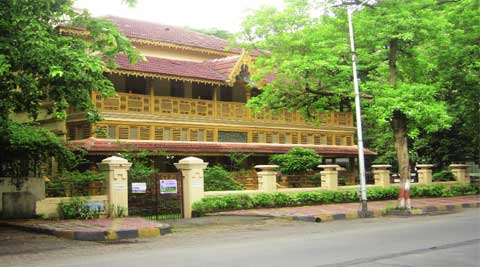 Savio Lobo took photographs of the locality before sketching out structures such as the 160-year-old Parish St Peter’s Church to exact detail; in his book. ( Source: Express photo )
Armed with a sketchbook and a camera, architect Savio Lobo spent the last monsoon roaming the streets of Bandra. He had visited the suburb often enough, but realised he knew nothing about its history and its structures. Here, the dozens of small booklets and guides he had spent more than a decade collecting came in handy.
As he navigated through the narrow lanes gazing at the bungalows, churches and schools, he would squat on the sidewalk — not caring that they are rain-soaked — and whip out his sketchbook to quickly draw a structure that caught his fancy.
Twelve months of these street excursions have resulted in a 180-page book titled Bandra By Hand. Launched on Sunday, the book contains over 100 black-and-white sketches of known and lesser-known structures in Bandra. “People don’t know how significant it is to record these buildings,” says Darryl D’monte, an environmentalist and a writer who worked closely with Lobo for the book. “Bandra has a number of quaint and lovely constructions that might not be around in the next 10-20 years. There is now some relief in the knowledge that they have at least been recorded as a part of the city’s art and architectural history.”
Once Lobo started sketching, he felt like he was missing something. “This wasn’t going to be another map of the city or just a book of sketches. I wanted people to know these structures as intimately as I got to know them,” says Lobo. So after sketching the building, Lobo knocked on people’s doors to dig for anecdotes: when were they built, when did the family moved in, and how many generations have lived there and
so on.
Lobo soon became a familiar face, arousing a mix of curiosity and suspicion from the residents, which didn’t make the documentation easier. “They had builders throwing visiting cards at them trying to buy them out of their buildings,” says the SoBo resident, “I don’t blame them for being suspicious.” When people got over their suspicion, some turned out to be quite helpful. Lobo was guided by a host of characters who told him of all the buildings that have replaced older ones in the last couple of decades.
The architecture in Bandra, Lobo says, doesn’t have its own characteristic style, but has evolved from an amalgamation of whatever each family who moved there brought with it. “So you will see that no two verandahs or frames on balconies are the same. Their interiors differ — some have spiral staircases, others have open terraces. The irony is that now because of the influence of global architecture even that is changing. Notice how all buildings in the big cities end up looking alike? That is happening to Bandra as well,” says Lobo.
He visited the Mount Mary Church, the Bandra Railway Station, the old schools and the antiquated bungalows in the suburb. Lobo’s sketches are meticulous — he has recorded the smallest features from a manhole on the road to cobbled streets outside the building. In the book, each sketch comes with a small brief about the place where Lobo tries to trace its history. Not just limited to structures, one entry shows the Bandra talao drawn to exact detail. “Half of Mumbai travels through this water body every day but no one seems to know much about it. May be if it were in another part of the world, it would be cleaner and maintained better,” he says.
The book has been self-published by Lobo and his wife Gina, a graphic designer who worked on its design. “The final product remains minimalistic in style, with more sketches and less text. Initially around 125 sketches were finalised, but people called in and asked to pull their houses out of the book, because of legal disputes and family problems,” says Gina. A website bandrabyhand.in has also been launched where archiving Bandra’s architecture will be taken forward.
Lobo has a collection of more than 10,000 photographs, and has also recorded his conversation with more than 300 residents He holds hours of footage of them talking about growing up and bringing their children up in the locality, about their houses and favourite spaces in the city, capturing the changing face of the locality. If Lobo has his way, this priceless collection of anecdotes might soon become a documentary.
amruta.lakhe@expressindia.com
Stay updated with the latest - Click here to follow us on Instagram