The AAP kept its poll promise and announced power and water subsidies within weeks of coming to power. But, the question is if this bijli-paani scheme will solve Delhi’s problems this summer. Aditi Vatsa and Kaunain Sheriff M report

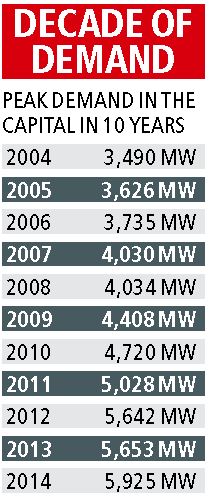
While the AAP has fulfilled its electoral promise of slashing power tariff by 50 per cent, the real challenge for the party will be to upgrade the transmission capacity in the capital. This is crucial for the summer months when the peak demand is expected to touch 6,200 MW.
In its white paper on power, the AAP stated that the “bad shape” of state-owned transmission companies was because of “irregular” payments of “wheeling charges” by discoms.
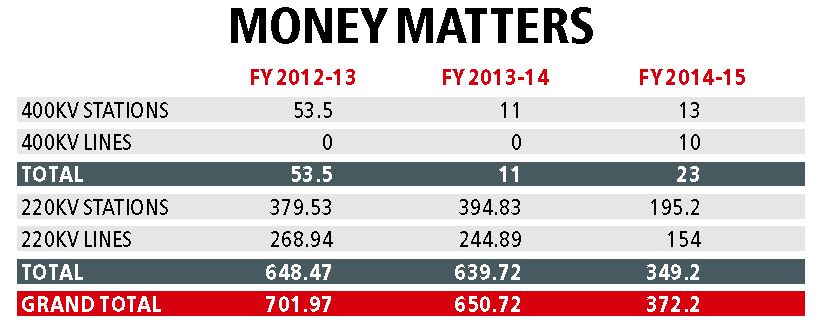
However, the devil lies in the details. In its annual revenue requirements submitted to regulator Delhi Electricity Regulatory Commission for 2012-13 and 2014-15, Delhi Transco Limited (DTL) slashed its budget by 50 per cent on planned capital investment. Planned capital investment that deals with capacity addition and other system improvements, including augmentation, was cut from Rs 701.97 crore to Rs 372.2 crore, even as the power consumption increased.
[related-post]
Meanwhile, several projects undertaken to deal with summer demand are grossly behind schedule. According to the “system improvement works planned for ensuring reliable supply to Delhi”, for summer 2015, the Grid Co-ordination Committee had planned to commission seven sub stations by March 1, 2015. Only three have met the deadline and officials claim that the other four — Gazipur, Bawana-Rohini, Gazipur-Patparganj and Peera Garhi — have been fast-tracked and should be completed by “March-end”.
“The real issue is project management. Professional expertise required for implementing the projects is lacking. There is also no up-gradation on the contract management front and archaic methods are followed. If these gaps are filled, transmission can be made more efficient,” Shakti Sinha, former power secretary of Delhi, said.
Another problem is the lack of preparedness for unforseen events. Even though senior officials claim that they are “fully equipped” to handle such indents, just the opposite was seen during the storm last May.
Story continues below this ad
Delhi Transco claims that two “Islanding scheme” implemented after the storm are “enough” to handle such events, including the failure of the national grid. However, an expert committee formed after the storm had recommended more than just creating an “Island” to deal with grid disturbances. In particular, the committee had recommended “regular maintenance activities such as chopping of nearby tress to maintain adequate clearances…”. However, majority of the areas around transmission towers are still unchecked.
Another recommendation was to review tower designs in line with “latest IS codes”. Officials claim that “most of the designs” have been reviewed.
Transmission companies are also faced with the problem of “highly active and reactive” demand of power.
“The rapid increase in the reactive load, particular during peak summer, causes decay in the power factor, leading to large voltage drop in lines and feeders. Amends should be made to the system,” a power official said.
Story continues below this ad
In a report, the Central Power Research Institute had noted that DTL has “installed sufficient number of capacitor banks” to meet reactive power demand of discoms. However, the report stated that installation of capacitor bank at these locations rather than in the discom network, “results in more losses in the distribution lines”.
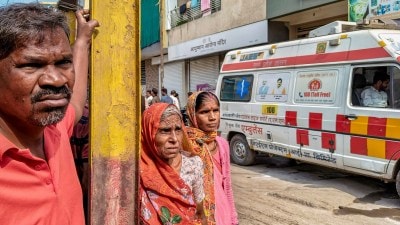
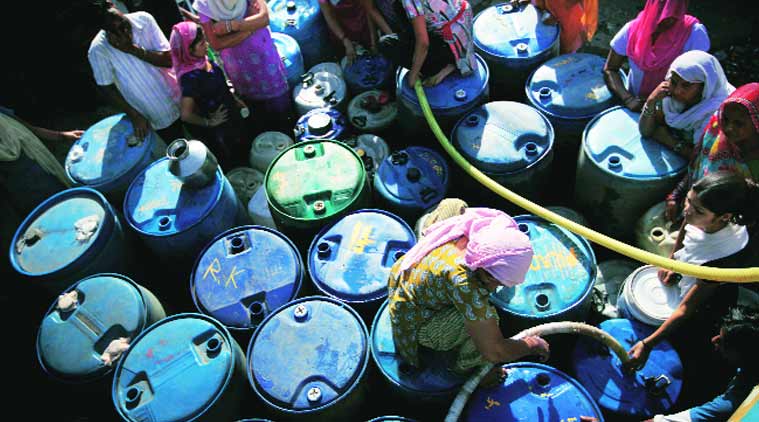
Subsidy will help those who already have a steady supply. Most of those in need don’t have metered connection to avail of scheme. (Source: Express Archive)
Despite subsidy, water woes drown Delhi
Even as the new AAP government announced 20 kilolitre of free water for households every month, a large section of the capital residing in unauthorised colonies, jhuggi-jhopri clusters and villages, continues to fight for water on a daily basis.
The AAP’s white paper quotes 2011 census data and states that of 33.41 lakh households in the capital, only 20 lakh receive piped water supply. The rest depend on sources such as tankers, borewells, canals, ponds and the Yamuna, it states.
Story continues below this ad
One such area in Delhi falls in the Sangam Vihar constituency. According to AAP’s Sangam Vihar MLA Dinesh Mohania, only 14 per cent of the population gets piped water.
“Even this 14 per cent gets extracted ground water, which is collected in a tank and supplied through water pipes. The remaining 86 per cent depends on water tankers and around 176 borewells,” Mohania said.
The situation is similar in Mundka, which comprises around 43 unauthorised colonies and 20 villages. The household of former Congress MLA candidate Naresh Kumar in Hirankudna village area gets around 600 litre of water once in 15 days.
“There are about seven people in my house and we manage to procure barrels once in 15 days. This is supplied by a DJB water tanker which comes to my locality once in every two weeks,” Kumar said.
Story continues below this ad
AAP’s promise of free water is meaningless for those who do not have metered connections.
“Only when residents in my constituency get metered water connections will they benefit from the scheme. While the demand in Sangam Vihar is around 7 MGD, we only get around 3 MGD from all possible sources of water,” Mohania said.
In Sangam Vihar, the MLA claims that efforts are being made to tackle the water crisis.
“We have formed local area committees to monitor supply of water through tankers and bring an end to the operations of the water tanker mafia. These committees have taken over the control of 85 per cent of tubewells. The area needs 80 kilometre of pipeline. We are in touch with the our ministers and the government is committed to bring piped water supply to each household in Delhi during these five years,” Mohania said.
Story continues below this ad
AAP’s Mundka MLA Sukhvir Singh also said his team was carrying out a survey on the water situation in the capital which is set to be completed in a week.
According to a former DJB official, the water subsidy will only benefit only those who already have access to water supply.
“The problem that needs to be addressed relates to equitable distribution of water in Delhi, so that every household first receives 700 litre daily. The average supply of water in around 50 per cent of the household is around 200 litre,” the former DJB official said.
While the water subsidy is expected to cost the government exchequer around Rs 250 crore annually, sources in the DJB said this was a conservative figure.
Story continues below this ad
“Those consuming a little over 20 kilolitre per month will now try to bring down their consumption so that they benefit under this scheme. While the move will help in water conservation, it will also increase revenue losses,” the former official said.
Demand hike on cards, discoms oil machinery
With a staggering 60 per cent increase in the peak demand consumption in the last decade, discoms in the capital are gearing up for the unprecedented peak demand this summer. Sources in the Power department told Newsline that discoms have made arrangements to counter the challenge.
The capital clocks highest per capita consumption of 1,651 units per annum, twice the national average. This summer, it is likely go up by at least 2 per cent, experts said.
According to petitions submitted to the Delhi Electricity Regulatory Commission, the net power purchase cost, including transmission charges, would be around Rs 16,841 crore for the financial year 2015-16. While national power generation companies charge around Rs 3 per unit, Delhi companies charge nearly double the amount.
Story continues below this ad
Delhi Power minister Satyendra Jain said, “We had spoken to discoms well in advance. Generation and distribution companies should deliver. On transmission, a meeting was held three days back.”
The BRPL, which will provide power to around 20 lakh customers, are spread in 19 districts across South and West. They will purchase around 8,434 MU quantum of power from national generation companies, such as NTPC and NHPC, at Rs 3.585 per unit, spending a total of Rs 3,414 crore. Buying 3,365 MU from Delhi companies at Rs 6.54 per unit will cost the discom around Rs 2,200 crore.
For BYPL, which supplies 14 lakh customers across 14 districts in Central and East, the cost of buying 4,223 MU from national companies at Rs Rs 3.425 per unit will be around Rs 1,600 crore. The cost of 1,890 MU from local companies at Rs 6.61 per unit will be Rs 1,294 crore.
The TPDDL supplies in North and Northwest Delhi. It is estimated to spend Rs 2,100 crore to buy power from NTPC and NHPC at Rs 3.295 per unit. Local companies will charge Rs 6.64 per unit, with the total cost being Rs 1,941 crore. In all, the discom will buy 8,520 MU of power.
Rainwater harvesting doesn’t fill the bucket
With summer approaching, meeting the increased demand for water is likely to be an uphill task for the AAP government.
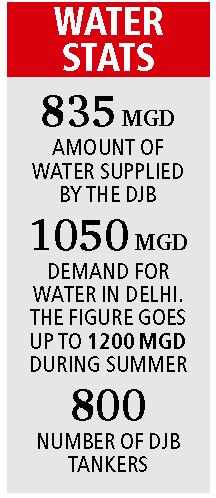
According to Delhi Jal Board (DJB) estimates, while the capital has a demand for 1,050 million gallons daily (MGD), the figure increases by around 20 to 25 per cent during summer months, bringing it to at least 1,200 MGD, officials said.
Taking stock of the water situation in the capital on Sunday, Chief Minister Arvind Kejriwal had urged the DJB to come up with a framework to meet the city’s summer demand. The AAP chief also brought up the water dispute between Haryana and Delhi, stating that in a recent order, the Delhi High Court had asked Haryana to release water via the Munak Canal.
The Munak Canal issue had been raging for years but could not be solved despite the same political parties leading governments at the Centre and in Delhi. Three water treatment plants in the capital had been lying unused because of no raw water supply through the Munak Canal.
Despite the court order, DJB officials and Kejriwal said the required amount was not being released.
“A week ago, I had written to the Haryana chief minister. In his reply, he had assured us that water would be provided to Delhi as per the court order. In my letter, I had also said that I could meet him along with my officials,” Kejriwal said at the inauguration of the Dwarka Water Treatment Plant on Sunday.
Meanwhile, the AAP government has urged residents to ensure that water is utilised optimally. From promoting conservation measures to asking residents to report cases of water wastage and leakage, Kejriwal also said his government was also working on a rainwater harvesting system.
“Delhi gets a lot of rain, but rainwater flows into sewers. If we store rainwater, we can be resolve the water problem up to a point. I request DJB officials to prepare a blueprint so that we don’t have to take water from neighbouring states,” Kejriwal said.


 10 min read


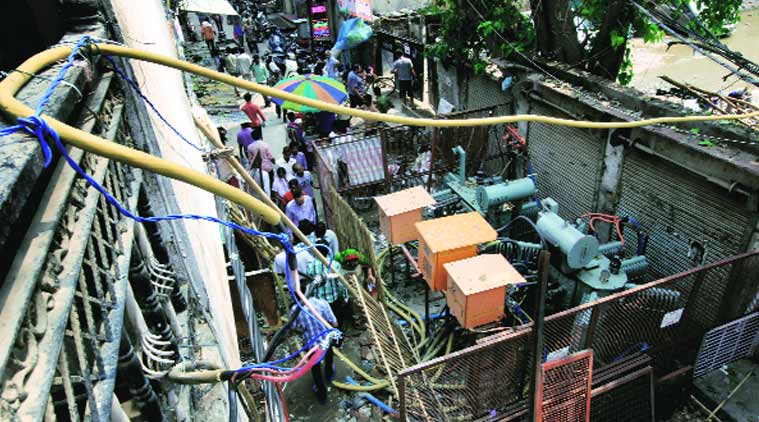 Most projects to be finished before summer are behind schedule. (Source: Express Archive)
 Subsidy will help those who already have a steady supply. Most of those in need don’t have metered connection to avail of scheme. (Source: Express Archive)