Journalism of Courage



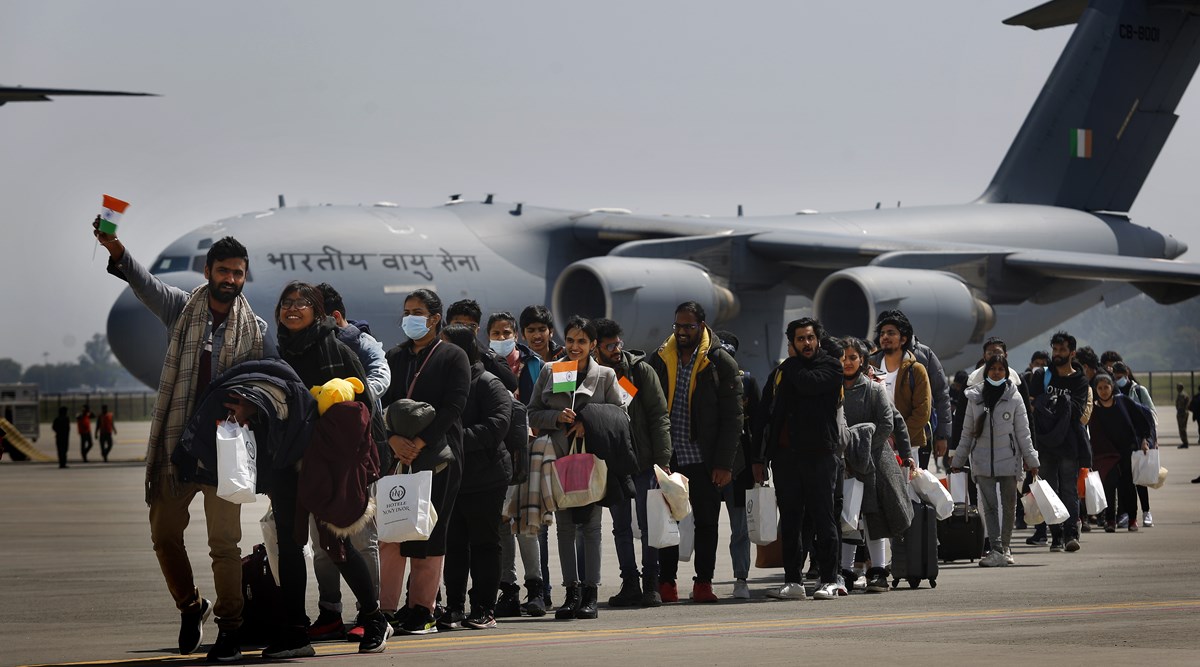 Students arrive at Hindon airbase, Ghaziabad. (Praveen Khanna)
“It is a miracle we made it back,” says Mohit Kumar, 20. “It’s surreal…watching a war unfold from your hostel window. There was continuous shelling. Sirens went off after every 4-5 hours… we saw jets being downed.”
The third-year medical student from Sumy State University was among the 242 Indians who landed early Friday at the Delhi airport on the first of three Ukraine evacuation flights.
🗞️ Subscribe Now: Get Express Premium to access the best Election reporting and analysis 🗞️
Around 600 Indian students, all of whom returned Friday, were holed up at the university in the northeast Ukrainian city, just about 60 km from the Russia border.
Many of them recounted a harrowing two weeks as they struggled to survive in a war zone — melting ice for drinking water and sheltering in cold underground bunkers amid fading hopes for evacuation.
Dheeraj Kumar, 25, a final-year medical student who hails from Chamba, Himachal Pradesh, said: “We were woken up by sounds of shelling and blasts. It was a nightmare. We were crammed in dusty, World War 2-era bunkers for hours…just waiting for all of it to pass and hoping for a ceasefire, which could provide an evacuation window.”
Under the government’s evacuation plan, Operation Ganga, these students were taken west to Poland on buses and a train in a three-day dash. From Rzeszow in Poland, the government deployed three aircraft — Air India, IndiGo and IAF flights — to bring back the students.
In a statement on Twitter, External Affairs Minister S Jaishankar said: “Students from Sumy are returning today to India. Their evacuation was particularly challenging. Operation Ganga, undertaken at the direction of Prime Minister Narendra Modi, has been delivered due to both leadership and commitment.”
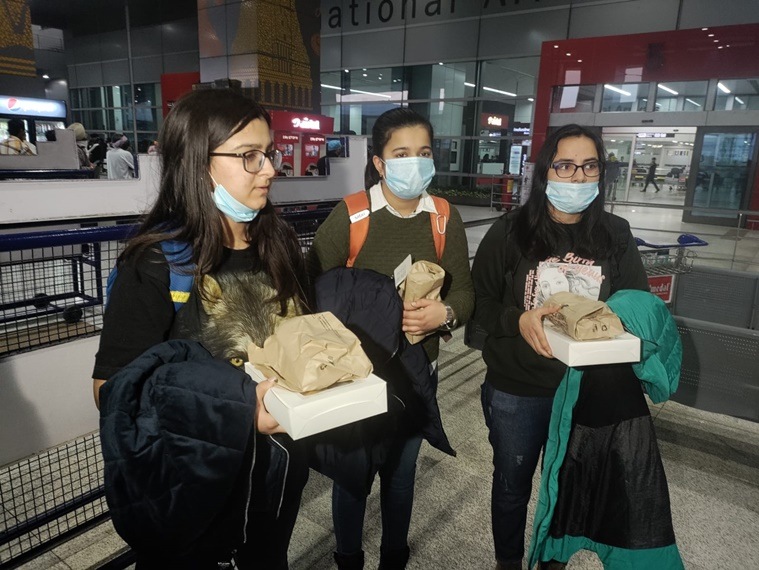 Students arrive in India from Sumy. (Express Photo)
Union Minister Anurag Thakur received the students at the Delhi airport.
Students said fear had set in that they may be left stranded. “We heard of people being evacuated from other cities and we were the only group left behind. People were growing weary and panicking…one group from another hostel even decided to walk on foot to the border risking their lives before embassy officials intervened and told them to stay put. Earlier this week, buses arrived for evacuation and as students sat, plans had to be changed at the last minute as the ceasefire had been violated. At that time, it felt as if we may be stranded here,” said Hardeep Sheokhand, a fourth-year student who is from Hisar, Haryana.
Devanshi Srivastava, a third-year student, recalled the non-stop journey to the Polish border. “On the day of evacuation, we were given 2 hours to pack everything. At least 13 buses arrived and all the students were hauled into the bus to be taken to Poltava. There was not adequate seating in buses to accomodate all and we had to stand for that entire stretch of 12 hours without any break. From Poltava to Lviv and then Lviv to Poland, we took two trains. At Poland, embassy officials had arranged fruits, juice and cookies for us and we were taken to a hotel to rest for two hours. From Sumy to Poland, not much assistance was provided by embassy officers and no one was even offering food. But, after reaching Poland, the embassy took care of us. At Poland, there were three flights arranged for us. There were minor arguments as everyone wanted to be on the first flight out. It has taken four days to reach here. The situation had become dire with limited food. It was a blessing that it snowed and we melted ice to arrange water for 2-3 days. Students had started complaining that government was not doing anything, only then we were evacuated.”
Prerna Chaudhary, a fourth-year student, said: “We had stocked up on a little food hoping that the conflict would stop in a few days. The ATMs were out of cash and cards were blocked. Last week, a power plant was attacked. So, we did not have water supply for two days and electricity was also cut off for a day. We had to melt ice and then boil water to survive. The university and local NGOs later arranged for water tankers and food. It took two weeks but we are thankful to the government for safely evacuating us.”
Students said that they were relieved to have returned to safety but hoped for the safety of their Ukrainian friends, some of whom have taken up arms.
“On our way back, we saw Russian tanks moving towards Sumy. There is a fear of what will happen to our university…to the local people there. Will they suffer the same destruction as has happened in Kharkiv? When we were leaving, the Ukrainian people were crying and asked us to pray for them. It was quite emotional,” said Subhash Yadav, 23, a fifth-year medical student.
“We were told to quickly pack a bag of important documents, a pair of clothes and medicines for evacuation on March 8. In buses, we were taken to Poltava in central Ukraine. It took us 13 hours to reach Poltava and from there, we were hauled into a train for Lviv. When we reached Lviv, we were quickly put on a second train for Poland. The journey was continuous with no stoppages except for some refreshments during the change-over. We are thankful to the government and embassy officials who helped us in this arduous journey and for rescuing us,” said Mohit.
Anxious parents, who had been waiting at the airport for several hours, welcomed their children with garlands.
Two hours before the flight landed, Harbir Narwal, whose 20-year-old son, Yamandeep, is a third year medical student in Sumy, said, “We have had sleepless nights in the last two weeks. We have been constantly checking the phone for a whatsApp messages and updates from my son. Even at night, I kept looking at the phone, hoping for a pleasant update from my son. The situation was dire…there was constant shelling. They were melting ice to arrange for water, electricity was also cut off, but thankfully now they have been evacuated.”
After his son embraced him at the airport, Narwal said, “I am so relieved. It is like my son has had a second birth.”

 7 min read