Journalism of Courage



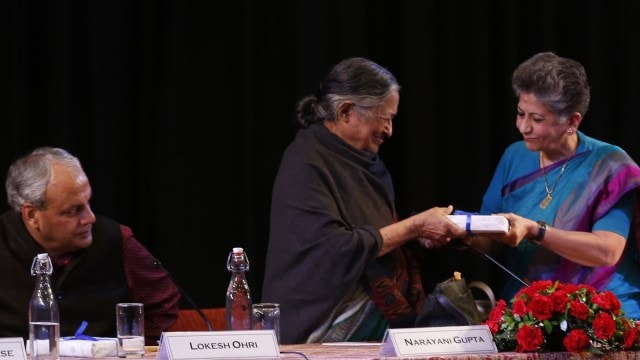 Gupta’s contribution to history textbooks for children was celebrated, particularly her emphasis on beautifying images and maps. (Express Photo)
We are what we remember — historian Narayani Gupta’s bon mot about the enduring power of history was invoked by historian Beeba Sobti in a tribute to the towering figure last Thursday at the India International Centre. She was quoted in reference to The Zone of Interest, a 2023 film about the Jewish Holocaust in which, Sobti said, “guilt is externalised” in the form of walls that separate a Nazi officer’s house from a concentration camp. As long as you don’t look over the walls or listen too closely at night, you could forget that humans were being gassed to death next door.
Gupta’s contribution to the politics of urban history — the way more and more flyovers, skyscrapers and streetlamps obscure our vision of monuments, skies and greenery — formed the centrepiece of the event. A book of academic and personal essays, Cities, Citizens, Classrooms and Beyond (Primus Books), edited by historians Partho Dutta, Mukul Kesavan and Kumkum Roy was also launched.
A panel discussion in tribute to Gupta was attended by the veteran scholar herself; Sobti; historians Indivar Kamtekar, Swapna Liddle and Amar Farooqui; architect Ratish Nanda; anthropologist Lokesh Ohri; and moderated by senior editor at The Indian Express Shiny Varghese.
 Another book by Gupta, Delhi, The Built Heritage: A Listing (1999), co-authored with her student Nanda, exemplifies her career-long interest in preserving the city’s heritage in the face of institutional neglect. (Express Photo)
Gupta’s contribution to history textbooks for children was celebrated, particularly her emphasis on beautifying images and maps. Farooqui added, “For Narayani ma’am, teaching history to children is first and foremost about communicating to them values that are integral to her worldview: compassion and respect for diversity.”
Liddle referred to other classics by Gupta like Delhi Between Two Empires (1981), a history of the city from the Mughal aftermath to the inauguration of New Delhi, that opened with a poem by Altaf Hussain Hali called ‘Marsiya e Dehli e Marhum’ (loosely translated to Lament for Delhi).
She added, “Books (Gupta has co-authored) like Beato’s Delhi (2011) give us an opportunity to compare what has happened to (Delhi’s) buildings because it has photographs of how they looked when (19th Century photographer) Felice Beato took his photographs in the middle of the 19th Century and much closer to what we have now.”
Another book by Gupta, Delhi, The Built Heritage: A Listing (1999), co-authored with her student Nanda, exemplifies her career-long interest in preserving the city’s heritage in the face of institutional neglect.
Nanda said, “Many of us back then said, these buildings are not going to survive so let’s take one or two photographs and put them in the public domain. Since then, several books have come out, because people had some sort of access to information. At least on paper, all of those buildings are protected… That inventory is a real policy document that has been replicated in many cities nationwide.”
Ohri, who has led several efforts to preserve Dehradun’s natural landscape in the face of increasing urbanisation, said, “I got inspired by (Gupta’s) ideas of shared ownership of heritage… that heritage is here and now, even though history has long passed. People who have lived with it for years would be hurt if something were to happen to it.”
Gupta called for historians to be “part-time activists”, saying, “The urban crisis in South Asia is very serious. The same blanket of smog that darkens the skies of Delhi, darken Lahore. I would like to think that urban historians, academics, popular poets, folk leaders, all have a role. From the 1980s, they have moved from navigating to interpreting. Now they should move to anticipating. Before we choke on our bulldozer-generated dust or drown in overflowing drain water, we have to turn the crisis around.”
The event also consisted of a tribute to Urdu poetry about Delhi in the form of recitations by lawyer Saif Mahmood.

 4 min read