Out of the nearly one lakh e-rickshaws that continue to mushroom across the capital unabated, a majority are running on old and relatively unsafe lead acid batteries, according to officials in the Delhi government.

Two weeks back, a 42-year-old woman died of severe burn injuries after the e-rickshaw she was travelling in burst into flames following a suspected battery malfunction in northeast Delhi.
According to sources in the Delhi government, the case tragically underscored the need to rein in such vehicles, especially in light of estimates that only a little over 20% of the e-rickshaws registered in 2023 operate on lithium-ion batteries, which are considered safer than the lead acid variety.
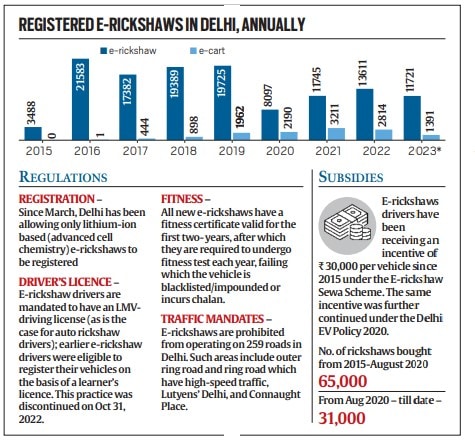
From just 3,348 in 2015, the total number of e-rickshaws registered in the city over the last almost nine years stands at over 1.26 lakh, as per Transport Department records. Due to various violations, as many as 32,000 such vehicles were de-registered during the same period, still leaving almost 95,000 of them to ply on most of Delhi’s streets.
E-carts have, in step with e-rickshaws, proliferated as well with almost 13,000 currently registered and operating in the city. According to government sources, these too function predominantly on lead acid batteries, especially their unregistered variety that is commonly known as ‘jugaad’.
A senior Delhi government official said the Vaahan Dashboard, which is the Government of India’s official portal to track vehicle registrations, doesn’t capture the data on the battery type of the e-rickshaw.
Story continues below this ad
“However, based on conversations with a few leading e-rickshaw manufacturers, it can be learned that the registration of lithium-battery e-rickshaws was a meagre 2% in 2020, about 4% in 2021, and 7-8% in 2022. So far, for 2023, the share of lithium e-rickshaws is over 21%,” the official said.
Sources from the Traffic Police said the relatively unsafe lead acid batteries, which a majority of e-rickshaws were operating on, were “a serious cause of concern” and had set alarm bells ringing at “the highest levels of administration” in the city.
“Lead batteries heat up faster compared to lithium-ion and more so depending on the load being ferried; whether it is e-rickshaws overladen with passengers or with goods – these vehicles, including e-carts, are potential hazards equivalent to ticking time bombs, especially during the summer,” a traffic official said.
“The matter recently came up for discussion during a meeting chaired by L-G VK Saxena and representatives from several government agencies in the capital. The need for a proper framework to regulate their numbers as well as enforce more efficient and robust enforcement were discussed,” a source said.
Story continues below this ad
The transport department said it undertook routine drives against unregistered e-rickshaws plying illegally and planned to step up enforcement.
According to departmental statistics, the transport department had, between August 1 and September 18, issued 1,686 challans and impounded 1,002 e-rickshaws for violations ranging from overloading to plying without registration, among others.
“As prosecution figures show, we regularly go after any vehicle which is plying against the law. Following the incident, we have discussed the matter with the Traffic Police and also begun stepping up prosecution of such vehicles across the city,” said Ashish Kundra, transport secretary-cum-commissioner.
A Traffic Police official pointed out the lack of a proper regulatory framework for such vehicles as well as lacunae related to enforcing the law against them.
Story continues below this ad
“We are ready to impound such vehicles as and when we come across them, but not only is there is lack of space at our traffic pits for the purpose but also a shortage of manpower given the other functions that the Traffic Police must discharge,” the official said.
The traffic official also batted for modifications to the prevailing legal framework as well as a comprehensive policy to both regulate the population and enforce the technical specifications.
“There must be a cap on the number of such vehicles in the city per se – just like there is for auto rickshaws — instead of just chalking out routes where they can and cannot ply,” an official said.
“We have also come across significant issues with regard to their technical specifications – batteries mainly – and the number of people they should be allowed to ferry,” the official added.


 5 min read