Journalism of Courage



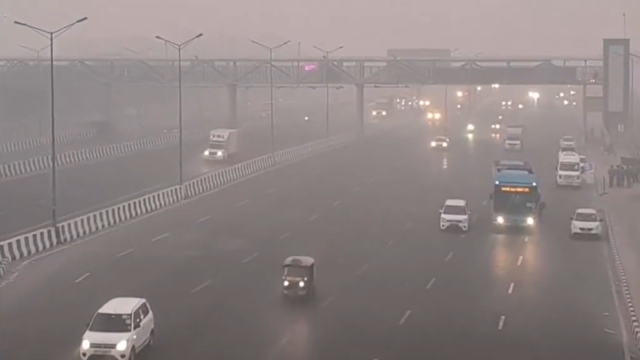 Vehicles ply in the Akshardham temple area in Delhi, which is barely visible through dense fog on Saturday morning (Photo: PTI).
The Commission for Air Quality Management (CAQM) in National Capital Region and Adjoining Areas – the Union government’s top pollution watchdog for Delhi-NCR – on Friday set up an expert committee to develop strategies to curb air pollution caused by vehicular emissions in the region. The committee has to submit its recommendations within two months.
The CAQM has identified vehicular emissions to be a major contributor to particulate matter pollutants – mixture of solid particles and liquid droplets found in the air – as well as gaseous pollutants like volatile organic compounds, nitrogen oxides and carbon monoxide.
The 15-member committee includes top academicians, health specialists, automotive research institutions and other experts in the field. In a statement, CAQM said the experts will “recommend a robust, multi-pronged roadmap for emission reduction in the vehicular sector”.
The committee will be chaired by IIT Madras Prof Ashok Jhunjhunwala, while Dr Randeep Guleria, former director at AIIMS Delhi, will be the co-chairperson.
Other members will include IIT Kanpur Prof Mukesh Sharma; IIT Delhi Prof Sagnik Dey; a representative each from Ministry of Road Transport and Highways of India and Ministry of Heavy Industries, both not below the rank of joint secretary; Automotive Research Association of India Director Dr Reji Mathai; International Centre for Automotive Technology Director Saurabh Dalela; Council on Energy, Environment and Water CEO Dr Arunabha Ghosh; Centre for Science and Environment Executive Director Anumita Roychowdhury; ICCT Managing Director Amit Bhatt and TERI Associate Director Dr Anju Goel. Dr Virender Sharma, member (Technical) at CAQM, will act as the convener.
The committee has been tasked to review policies, programmes and regulatory frameworks related to clean mobility. According to CAQM, the committee will review existing mechanisms around “BS norms, electricity mobility initiatives and fuel efficiency standards across Delhi-NCR”, assess segment-wise contributions of vehicular emissions and related exposure risks and also recommend regulatory measures for the reduction of vehicular emissions.
Further, the members have to “examine technological readiness, infrastructural requirements, cost implications and incentive plans for an accelerated electric vehicle transition across vehicle segments”. It can also recommend any additional measure to control vehicular emissions. The first meeting of the committee is scheduled for December 15.
“The constitution of this expert committee will advance evidence-based policy action for improving air quality and safeguarding public health in Delhi-NCR,” the CAQM said.

 3 min read