Journalism of Courage



 the Centre stated: "The Amritsar city generates 520 tons of solid waste per day (TPD) out of which, 252 TPD is processed, and 5 TPD is disposed in secured landfill site. The city has 3 dumpsites, with bio mining operations started at 2 sites. The Ludhiana city generates 1100 TPD, out of which 165 TPD is processed and 5 TPD is disposed of in a secured landfill site. The city has 2 dumpsites, with bio mining operations started at 1 site."(Representational/ File)
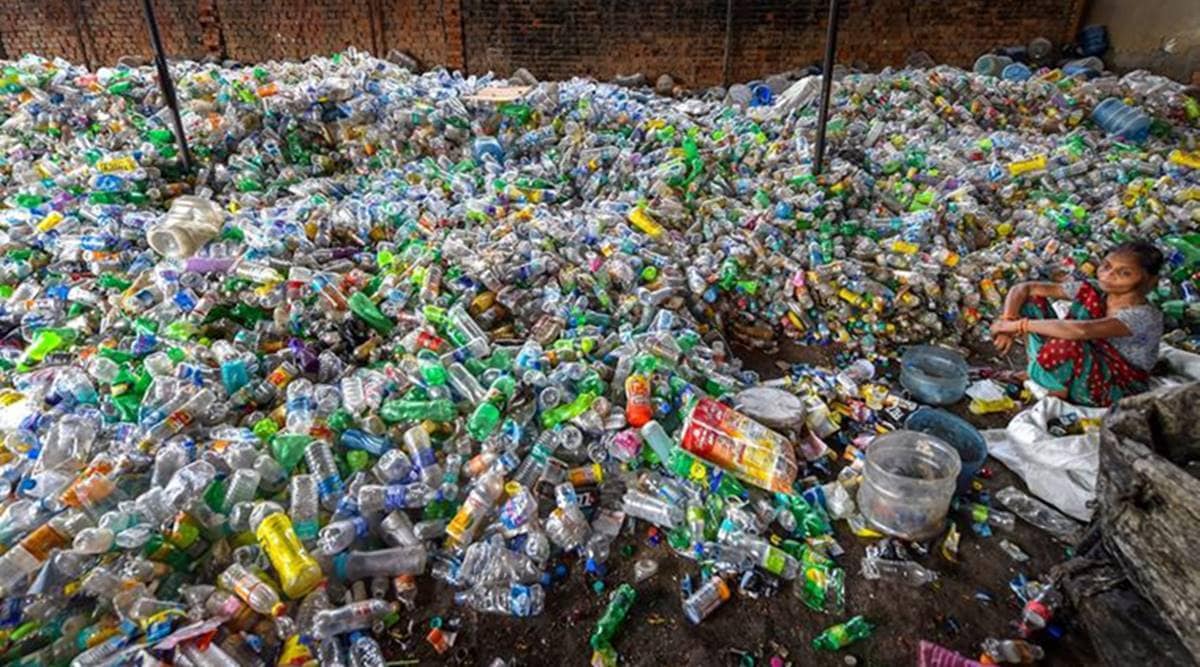
The Centre on Monday informed the Lok Sabha that Punjab produces at least 4376.6 tonnes per day (TPD) of waste on a daily basis, but not even half of it was being processed or treated. The situation is worse in state’s most polluted city Ludhiana, where highest 1,100 TPD waste is generated daily but a mere 15 per cent is being processed, said the Centre.
Replying to a question by Congress’s Patiala MP Dr Dharamvira Gandhi who asked what measures were being taken to reduce pollution and environmental degradation in Punjab, especially in cities of Ludhiana and Amritsar, the union ministry of environment, forest and climate change said: “As per annual report submitted by Punjab State Pollution Control Board (PPCB) for the year 2022-23, the status of Solid Waste Management in the state of Punjab is as follows: The total Solid waste generated in the state 4374.6 TPD, out of which 4367.2 TPD collected, 1795.8 TPD treated and 2571.4 TPD landfilled. Total 8350 number of processing sites have been set up in the state till the end of year 2022, for processing of wet waste…”
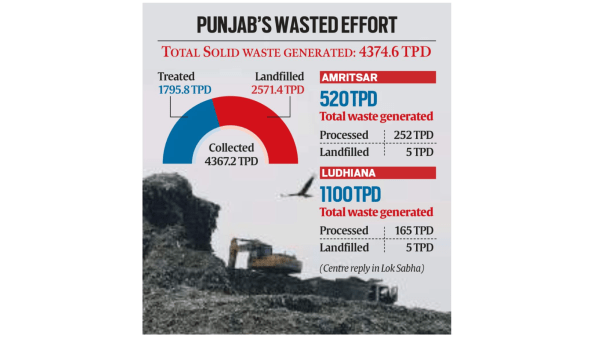
Further quoting PPCB report, the Centre stated: “The Amritsar city generates 520 tons of solid waste per day (TPD) out of which, 252 TPD is processed, and 5 TPD is disposed in secured landfill site. The city has 3 dumpsites, with bio mining operations started at 2 sites. The Ludhiana city generates 1100 TPD, out of which 165 TPD is processed and 5 TPD is disposed of in a secured landfill site. The city has 2 dumpsites, with bio mining operations started at 1 site.”
According to the figures presented by the Centre in its reply, just around 41% waste in Punjab is being processed.
On reducing air pollution in cities of Punjab, the Centre replied: “The Central Pollution Control Board has prepared City Specific Clean Air Action Plan and rolled it out for implementation in all 131 cities including 9 of Punjab (Patiala, Ludhiana, Amritsar, Jalandhar, Khanna, Gobindgarh, Dera Bassi, Pathankot/ Dera Baba and Naya-Nangal) to improve the air quality.”
On managing open burning of paddy straw, the Centre said, “The CPCB has framed guidelines for promoting setting up of paddy straw based pelletization and Torrefaction plants…So far, 13 plants (Amritsar-2, Patiala-1) have been sanctioned by CPCB in the state of Punjab under the guidelines. Total pellet production capacity of these 13 plants is 52.5 TPH corresponding to annual expected paddy straw utilization of 2.48 lakh tonnes and pellet production of 1.89 lakh tonne. “

 3 min read