Journalism of Courage



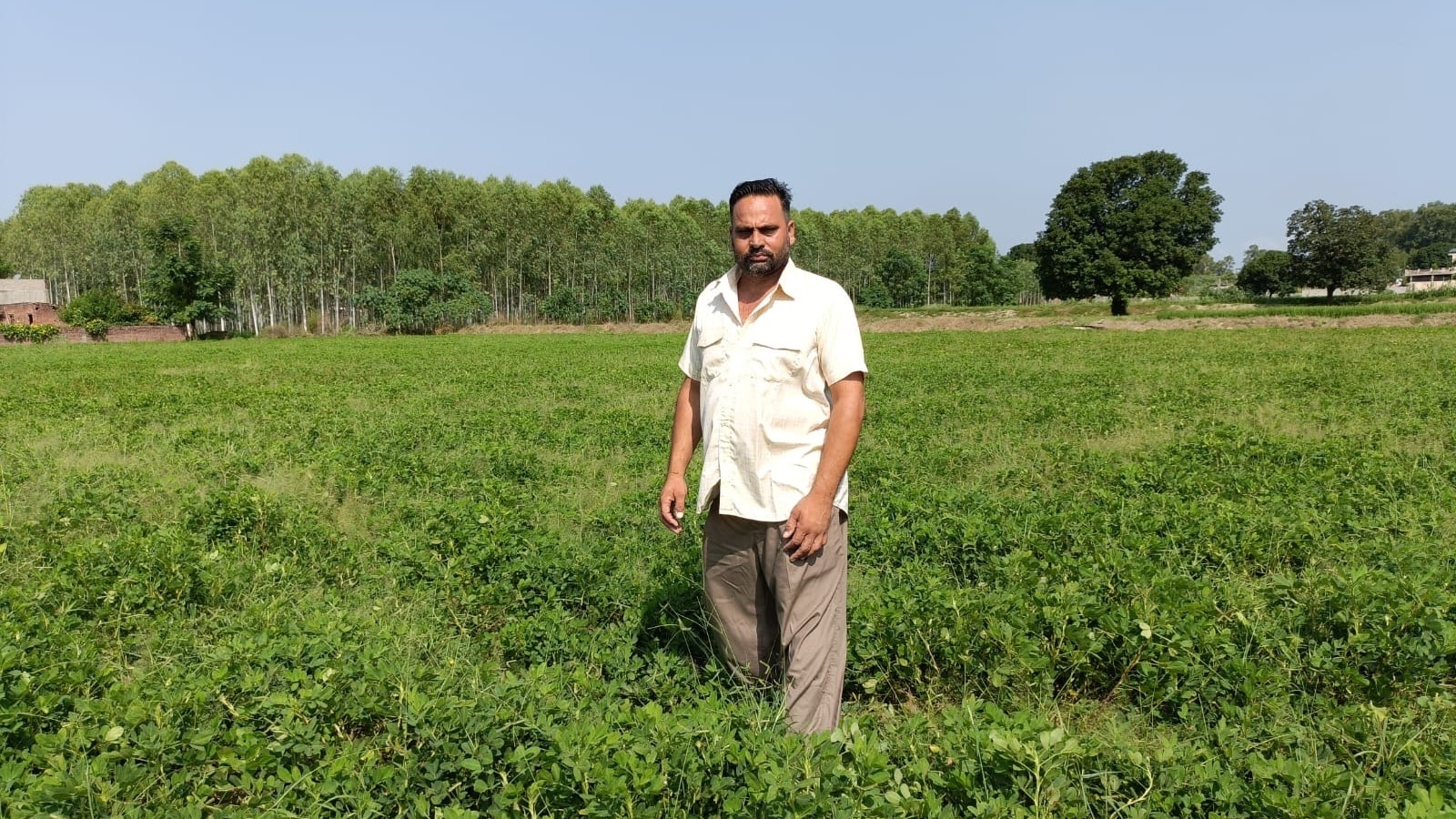 Davinder Singh Burra farms groundnut on 35 acres. (Express Photo)
Led by over a hundred farmers, a quiet agricultural diversification is taking place for years in the Bhunga block of Hoshiarpur district.
Sample this.
Davinder Singh Burra (44) has turned away from traditional paddy farming and has embraced the cultivation of groundnut for over a decade now. He now farms groundnut on 35 acres, five of his and the rest leased, as the crop is water efficient and has good demand.
Narinder Singh Hundal (45), from Sheikhan village, and Bikram Singh Randhawa (48), from Mastiwal, are also have shifted to groundnut cultivation on 70 acres and 50 acres , respectively. While Bikram started groundnut farming in 1991 on two acres, Narinder sowed the first groundnut crop around 15 years ago on a small plot of land.
There are several other farmers like them in this block who have expanded groundnut farming to approximately 5,000 acres, making it the only region in Punjab where the crop is grown for commercial purposes.
“Groundnut is one of the best alternatives to water guzzler paddy. It requires no additional irrigation, and we can rely entirely on rainwater, which saves nearly 100% of groundwater during the Kharif season,” says Davinder, adding that he earns up to Rs 13 lakh from 30 acres from this 100 days crop and then he takes two more crops ‘table potato’ followed by ‘wheat’.
He adds that the region is ideal for the crop as its light and slightly sandy and helps in water retention. “Groundnut has a high demand, especially in winter. It is consumed in various forms be it roasted, in jaggery sweets like gachak, as peanut butter, or even as groundnut oil,” says Davinder, who has received the Prawasi Bharti Award for diversified farming systems from Punjab Agricultural University (PAU), Ludhiana.
Most varieties of groundnut mature in 90 to 105 days, though a few take up to four months. “The input costs range from Rs 13,000 to Rs 14,000 per acre. This includes seed, which requires around 35-40 kg per acre, costing about Rs 5,000 to 6,000. Other expenses include two bags of super fertilizers costing around Rs 900, three bags of gypsum worth Rs 1,000, half a bag of potash at Rs 850, half a bag of urea for Rs 120, weedicide sprays for Rs 1,000, sowing costs of Rs 1,000, earth covering costs after 20-25 days for Rs 1,000, and harvesting and other miscellaneous costs totaling Rs 2,000,” he says, adding that most farmers grow the TG-37A variety, which yields 8-10 quintals per acre depending on weather and soil conditions. He adds that if sold at MSP, which is Rs 6,783 per quintal, a farmer can earn Rs 54,264 per acre from 8 quintals. “After deducting input costs, a farmer can earn Rs 40,000 per acre if they own the land but the profit drops to around Rs 25,000 per acre if the land is leased,” he says, adding that the most difficult part is marketing the crop.
“Destipe the Centre setting a MSP, local traders offer just Rs 4,500 per quintal. Traders set the rates and reap the benefits at our expense,” he adds.
“To earn well, I sell the seed, and from a quintal yield, I get around 65 kg of good quality seed, which I can sell for Rs 75,000 per acre. After covering rental and input costs, I make about Rs 45,000 per acre. I also operate a kohlu (oil mill) where I produce cold-pressed groundnut oil, selling it for Rs 250 to Rs 300 per liter. It takes around 3 kg of kernels to produce a liter,” he says, adding that farmers start processing and diversify sale to earn maximum profits. The groundnut stubble is sold to horse breeders at Rs 5,000 per acre, he says. Narinder says he invested in a thresher that separates groundnut from the plant and a another machine that separates kernel from shell. “But small farmers don’t have access to such equipment. The number of small farmers growing groundnut is decreasing as they lack access to these machines. The government should provide support to encourage more farmers to diversify,” he says.
Associate Director at KVK Bahowal (Hoshiarpur) Maninder Singh Bons says that they have been providing training to farmers of the Block. “Bhunga block has kept groundnut cultivation alive in Punjab. High profits, minimal water usage, and environmental benefits, have drawn farmers to the crop,” he says.
Virender Sardana, principal agronomist of the Oilseeds Section at Department of Plant Breeding & Genetics, PAU, says that in the past, lakhs of hectares were under this crop in Punjab. “But now it is just a couple of 1000 hectares and to one block in the state. India’s groundnut export in 2023 was over Rs 6700 crore, and Punjab has a great potential of export and Western countries want peanut butter. Peanut milk has protein, minerals, and carbohydrates. From one kg kernels, seven liters of peanut milk can be prepared and served to children. The crop can also be grown in several areas of Mansa, Bathinda, and Abohar,” he says.

 5 min read