5 min read
Stay updated with the latest - Click here to follow us on Instagram

Journalism of Courage



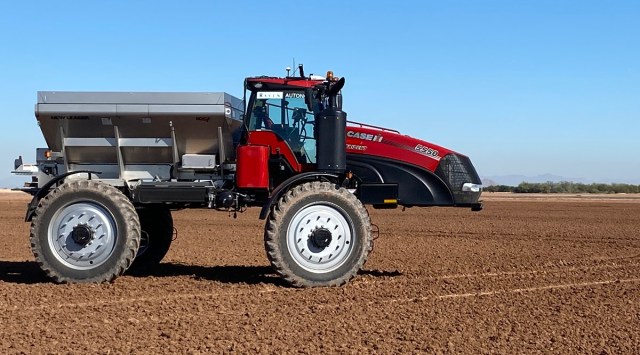 A driverless autonomous farming equipment in action in Maricopa, Arizona on CNH Tech Day. (Express photo)
At first sight, it is just two massive tractors ploughing the field in the fields of Maricopa, a short drive out in the vast Arizona plains of USA. But as they come closer it is clear that there are no drivers in the cabins.
This was just one of the autonomous systems on display at CNH Industrial’s Tech Day 2022 earlier this month in Arizona on December 8. One of the market leaders in the agriculture sector, best known for the New Holland tractors, CNH put forth a demonstration of what to expect in the future in precision technology, autonomous vehicles and green fuel zero emission tractors which will help farmers increase their yield across the full farming cycle.
Emphasising the driving factors behind the move to automation in the farming sector, senior executives of CNH say manpower shortage coupled with smart solutions to increase produce and profit have led to some far-reaching research and development some of which has been pioneered by their company.
“Whether it be tillage, planting, application, harvesting, orchard and vineyard farming, hay and forage or sustainability we have embedded precision technology in each function which helps the farmers increase their output substantially,” said Scott W Wine, chief executive officer, CNH Industrial.
Scott added that most innovations being implemented are customer-inspired innovations. “We have incredibly capable smart engineers. But what we are doing is listening to customers, understanding how they are using our products and bringing solutions which they can use,” said Wine.
When asked how CNH looks towards implementation of this high-end precision technology and automation in India where the land holdings were much smaller and the farm machinery was of very modest capacity as compared to North America and Europe, the CEO said the company has major plans for the Indian market.
“We have a long history in India and we have a great team leading the effort there. They are spearheading the innovation with regard to the Indian market. It is not just how we take out the cost of the current price of the products but how we design better more innovative products to bring solutions to the Indian farmers. It does have a different approach than our large cash crop customers here. A lot of it is going to be coming through in innovation,” Scott said.
According to Parag Garg, chief digital product officer of CNH, precision farming being implemented by the company has a focus on connected platforms which can collect data from anywhere on any device. “At the centre of how these things work are a suit of digital tools with seamless digital experience to collect, store, visualise and analyse data,” he said.
Speaking to mediapersons, Mukesh Aggarwal, vice-president of Precision Software and Cloud Application of CNH said, “Our farmers did not sign up for a PhD in agri technology. What they are trying to do is save costs and time and increase yield and efficiency. That’s what they are looking for. So we take the mounds and mounds of data from the machines in the field and turn them into actionable intelligence. The connected platforms are a suit of tools which connect the farmers to their crops and fields to drive operational efficiencies. We provide that to them and we enable decision intelligence available to them at their fingertips,” said Aggarwal.
Out in the massive open fields where the technical exhibition was being held, much of this innovation and automation was on display. The driverless operations were just one part of the Intellisteer technology on display which enables hands-free automatic row turns reducing operator fatigue and crop damage.
The equipment working in the fields showed how the vehicle-to-vehicle technology allows farmers to easily share real-time data between multiple tillage equipment in the same field for a fully connected operation. Vehicle-to-vehicle communication displayed allowed multiple units to share guidance lines and coverage maps during tillage, reducing overlap in the fields.
The driverless grain cart technology allows the combine operator to completely control the tractor speed, combine-tractor synchronisation and the unloading of grain into the grain cart. When commanded, the tractor used the ‘surround sense system’ developed by CNH and artificial intelligence for object classification to automatically manoeuvre around obstacles such as fences or unharvested crops.
“The reason why farmers want better precision, better autonomy and better technology is because they are having trouble getting farm helpers. Part of that is being caused by inflation and we are seeing inflation in all parts of the world. The inflation rate here in the US is higher than that of Brazil. Who would have thought that would have happened? It is a difficult world that we are in and it is a world which has ever more population. That’s more mouths to feed with less arable acreage for production. Our ability to drive productivity is very very important,” said Scott.
Stay updated with the latest - Click here to follow us on Instagram