Journalism of Courage



 Palakshaiah, who retired as SP, says that it was a very challenging case. (Source: Special Arrangement)
A body dumped in a forest, ₹10 lakh in cash stolen, and a driver reported missing. In the early 2000s, before smartphones and SIM cards could be easily tracked, the Karnataka Police grappled with a case in which the accused relied on landlines and STD phone booths and frequently changed locations to evade detection.
The incident took place on September 13, 2001. A forest guard on his morning rounds inside the Konanakallu Reserve Forest spotted a man’s body and immediately alerted Tiptur Police Sub-Inspector Veerabhadrappa. Prima facie, the police believed the man, who appeared to be in his 40s, had been murdered elsewhere.
Soon, then Tumakuru superintendent of police R Hithendra, then assistant superintendent of police Hemant Nimbalkar, the dog squad, and Forensic Science Laboratory officials rushed to the spot.
When the police checked the pockets of the deceased, they found a passbook with the name ‘Jayakumar’ and a mobile number. “We thought we had identified the victim, Jayakumar, and that the number would lead us to the killers,” recalls then Tiptur police inspector D Palakshaiah.
What Palakshaiah—who had already served 20 years in the force–did not realise at the time was that this would turn into one of the most challenging cases of his career.
When the police dialled the number, the person who picked up the call introduced himself as Jayakumar. Taken aback, the police soon learnt that Jayakumar was a wealthy businessman in Shivamogga. He said that his writer, Naresh Shanbaug, and his driver, Mahesh, had been missing since September 12.
Jayakumar told the police that he was scheduled to travel to Hassan district to collect Rs 10 lakh from a relative. However, owing to other work, he sent Shanbaug and Mahesh in his place. The distance between Hassan and Shivamogga was barely 155 km, and the police calculated that it would have taken the duo four hours to cover it. If all had gone well, Shanbaug and Mahesh should have returned with the money within 12 hours.
Jayakumar arrived in Tumakuru and identified the body as that of Shanbaug’s. Mahesh was missing. “Shanbaug had collected the Rs 10 lakh in cash, but it was missing,” a retired police officer who was part of the probe recalled.
When the police ran a check on Shanbaug’s background, they learned that he had been married for 15 years, had no children, and was not known to have any enemies. The investigation shifted to Mahesh. A native of Doddasalavar village in Hassan district, Mahesh worked as a driver in Shivamogga and had no criminal record.
A cursory check with his family and friends did not reveal anything suspicious. However, when the police visited his room in Shivamogga, they found a diary with several phone numbers. While checking the entries, the police come across a name, Sumithra. Friends revealed that she was Mahesh’s girlfriend and worked as a maid in the Dakshina Kannada district.
The police then summoned Sumithra. During questioning, she allegedly revealed that Mahesh had called her a day earlier, claiming that he had been kidnapped by a gang and was at an unknown location. “He said Shanbaug had been murdered, and he was being taken to different places in a car. He told me he had managed to get hold of a mobile phone, but insisted that I only call him from STD booths. He had shared two mobile numbers,” Sumithra stated to the police.
Those were the early days of mobile phones, and getting call detail records (CDRs) or tracking phone location was not as easy, says Palakshaiah. “If you were working in a rural police station, technology resources were barely available,” he recalls.
Although the police had the two mobile numbers, they were unable to gather further details, as mobile service providers in those days were known to issue SIM cards without seeking credentials. “They were called ‘Magic SIM Cards’…mostly of the use-and-throw type,” Palakshaiah explains.
When the police checked the CDRs of those two numbers, they received a 40-page document listing contacts. “Calls were made to Bengaluru, Hassan, Sakleshpura, Shivamogga, Tumakuru, Chikkamagaluru, and several other places. The team was split into three and each group began visiting every contact. We found that all the calls had been made from STD booths,” the retired police officer said.
During the probe, the police found one contact number registered in Palimar village in Udupi district. It was Palakshaiah’s team that traced the address. When they reached the spot, he says, they were in for a surprise.
“We went in plainclothes, and two brothers in traditional attire invited us inside. Only after entering the house did we realise that it was an astrologer’s house,” he recalls. “When they asked about our problem, I told them that some people had taken away our money and asked if we would get it back. The astrologer said that if we recovered it within 16 days, we would succeed, but not after that. Eventually, we revealed our identity and questioned them about their connection with Mahesh. They said that he was their driver three years earlier, and had called them recently,” says Palakshaiah.
In 13 days, the police team travelled to at least six districts, including Dakshina Kannada, Udupi, Shivamogga, Bengaluru and Chikkamagaluru. Updated CDRs from the STD booths revealed that 16 calls were made from a place in Bengaluru to different numbers linked to Mahesh.
The police arrived in Bengaluru and discovered that the calls had been made from a store in Kumaraswamy Layout. Palakshaiah recalls that his batchmate was serving as a police sub-inspector at Kumaraswamy Layout police station at the time. “We went to the store and found that it was not an STD booth. The shopkeeper said that he charged Rs 2 for local calls. When we asked about a person who had made 16 calls, he said it was a man who was new to the area,” Palakshaiah adds. The shopkeeper further revealed that three days earlier, the man had purchased two crates of eggs and, when asked why, allegedly said that he had bought a new refrigerator.
Believing they were close to tracing Mahesh, the police started visiting local travel agencies, areas where cabs were parked, and eventually learnt that one cabbie had recently shifted house. “The police waited till 11 pm until the new cab driver arrived, and followed him to his house. We found that the driver’s name was Shivakumar, and not Mahesh. He was staying there with his wife and a child,” says Palakshaiah.
Disappointed, the team checked the house, and to their surprise, found Rs 6.29 lakh inside. Shivakumar was unable to explain how he got hold of the money.
Upon interrogation, Shivakumar allegedly confessed to the murder, adding that Mahesh and Venkatappa, his father-in-law, were also involved. Mahesh and Venkatappa were also arrested in Bengaluru. “Incidentally, the arrests of all the accused were made on the 16th day…though it has nothing to do with the astrologer’s words,” says Palakshaiah.
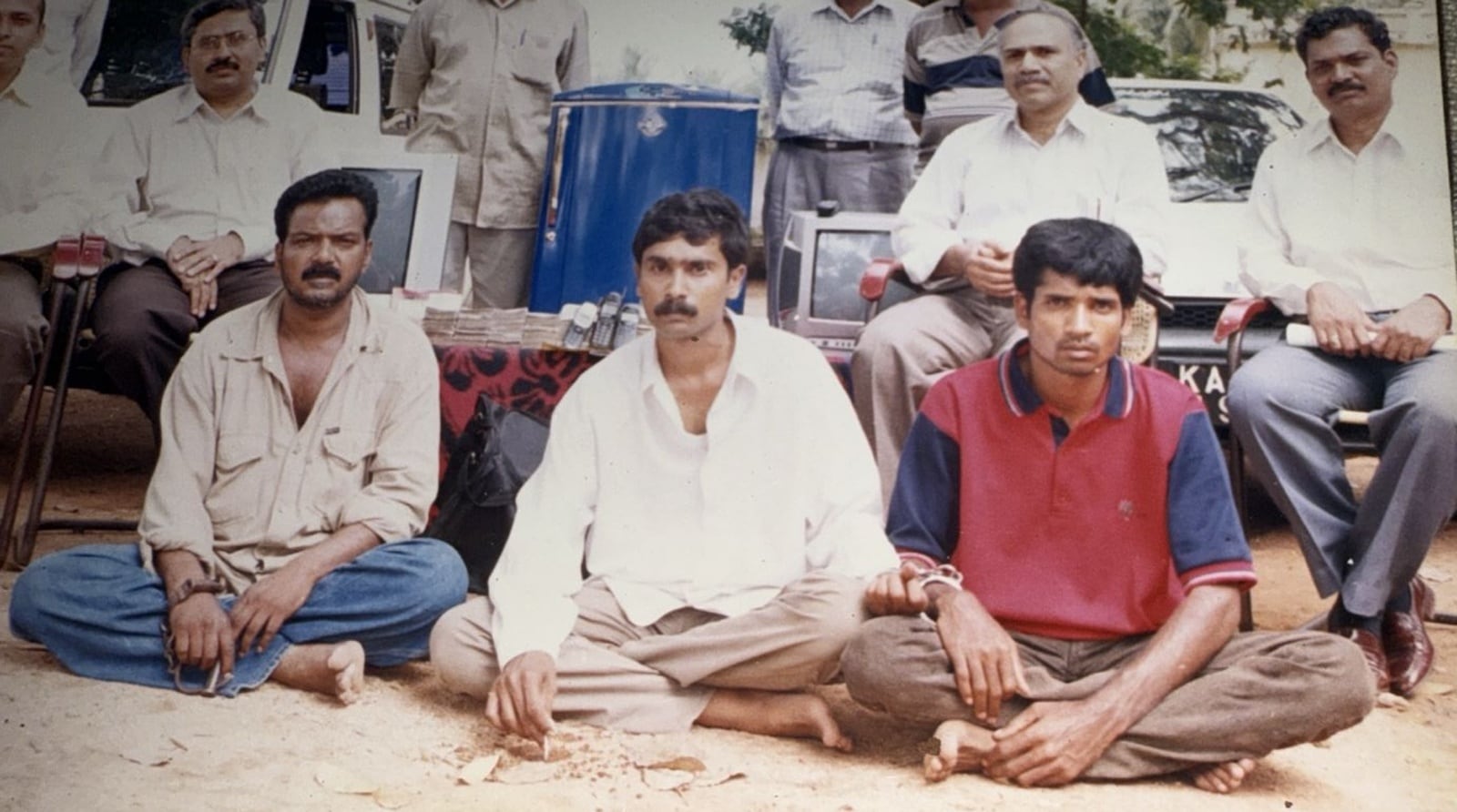 The arrests of all the accused were made on the 16th day. (Source: Special Arrangement)
According to the police, the murder was hatched over three months. “Mahesh used to work for Jayakumar. He came to Bengaluru when his eldest brother, Vishwanath, was admitted to Narayana Hrudayalaya for heart surgery. During this time, he met Shivakumar. They decided to make some quick money. They decided to execute their plan when they learned that Shanbaug was being sent to collect Rs 10 lakh in cash,” Palakshaiah adds.
According to the police documents submitted in court, after collecting the cash, while returning, Mahesh took a diversion, claiming that someone was following them. By then, Shivakumar and Venkatappa held Shanbaug tightly and injected him with a high-dose anaesthetic. They allegedly decided to kill Shanbaug, fearing he would identify Mahesh as their accomplice. They hit his head, murdered him and then dumped his body inside the forest before fleeing, the police said.
“We were able to recover Rs 8 lakh. The accused had spent about Rs 2 lakh to buy a new scooter, a refrigerator, and pay some rent,” says Palakshaiah.
In 2005, a local court in Tumakuru convicted Shivakumar, Venkatappa and Mahesh to life imprisonment for murdering and robbing Shanbaug. Shivakumar jumped parole in 2010. He was later tracked down in May 2014 and re-arrested.
Palakshaiah, who retired as SP, says that it was a very challenging case. “The National Crime Records Bureau published the investigation in their annual report to highlight the methods used for investigation,” he adds.

 8 min read