Sporting the typical tuft (ponytail) hair associated with Hindu monks, a red tilak on the forehead and dressed in spotless white dhoti-kurta with a prominent mention of ‘Gokuldham-Nar’ — their new hostel and school, run by the Vadtal Swaminarayan diocese — 50 boys from Manipur are beginning to adapt to their new way of life, over a thousand kilometers away from their families that continue to live on the edge.
The boys, all belonging to the Meitei ethnic community, and currently undertaking “special classes” to learn English, Hindi and Gujarati apart from “spiritual discourse and lessons in daily discipline”, said they are “happy”. Some of them are also seen sport ear-piercing – a ritual in Manipur.

These 50 boys are among the 300 students entrusted to Madhav Swami of the diocese’s Nashik hostel in Maharashtra, who had in turn sent 50 boys in the care of Sukhdev Swami of Gokuldham at Nar in Anand district. Hostel warden of Gokuldham, Manish Valand, told The Indian Express that among the 50 boys, a 12-year-old witnessed his father being killed in April when they took shelter in a church that was allegedly bombed.
The family of another 12-year-old had to flee from their village minutes before their house was set on fire. Both hailing from Churachandpur district in Manipur, the families of the two boy’s are still living in relief camps. Valand said the two boys also underwent counselling.
The boy who lost his father in April told The Indian Express, “I keep on thinking of my family back home. My mother and my sister bid me a tearful goodbye before I left. I will study hard.”
The boys, all belonging to the Meitei ethnic community, and currently undertaking “special classes” to learn English, Hindi and Gujarati (Express photo)
Another boy among the 50, hailing from Thoubal district of Manipur, which has largely remained unaffected by the violence, said: “All of us are happy that we are safe because our families decided to send us here. We are, however, worried about our families back home. Although there are a lot of differences when it comes to culture and lifestyle here, we are slowly adapting to the change… For instance, I never washed my own clothes before as we had a washing machine at home…”
Most of the boys belong to families where the men work as daily wage labourers while the women are engaged in vocational training. Another boy said that when they were brought to the Nashik Swaminarayan Hostel, their hair was shaved off to give them a uniform hairstyle and their regular denims and T-shirts were replaced by the traditional dhoti-kurta.
Story continues below this ad
The boy, who has been joined by his younger brother and two cousins at the Nar hostel, added: “Most of our hairstyles earlier were fashioned on football stars or Army cuts. Now, we all are wearing the same kind of clothes and the same kind of hair with a tuft. Although we follow Hinduism and celebrate all Hindu festivals back home, there is a cultural difference in several areas, including the food we eat.”
“In Manipur, we consider fish as a mandatory offering to God and it is prepared for feasts during festivals, we have a non-vegetarian diet but here, we are adapting to the vegetarian lifestyle. We like it too… In fact, a few of the vegetarian preparations here reminded me of dishes back home,” he added.
For now, Gokuldham has decided to take care of the education of the children till they complete Class XII. But till they are enrolled in the regular state-board affiliated English medium school on the 22-acre campus, the boys will continue to attend special classes to prepare them for the academic session, as their previous medium of instruction was Manipuri.
Valand said, “We are expecting a few more boys to join us from Manipur… also, many are yet to receive their transfer certificate from schools in Manipur… For now, we are concentrating on training them in basic languages so that they can be enrolled in the regular school as soon as possible.”
Story continues below this ad
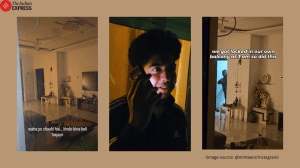
Foreign volunteers are holding classes on English every morning, while for the rest of the day, the children learn Hindi and other subjects, engage in spiritual courses and play. Since cellphone services have slowly been restored in Manipur, the boys are now able to talk to their families once in a month.
One of the boys said, “Since mobile data continues to be suspended, we have been unable to make video calls but it’s a consolation to be able to at least hear their voice. We are each given 10 minutes to speak to our families, which is a sufficient and we now realise how valuable our families are… We had friends from their (Kuki community) side but they are no longer there…”


 5 min read


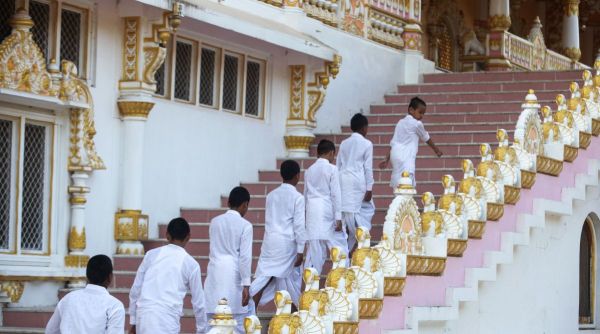 The boys, all belonging to the Meitei ethnic community, and currently undertaking “special classes” to learn English, Hindi and Gujarati (Express photo)