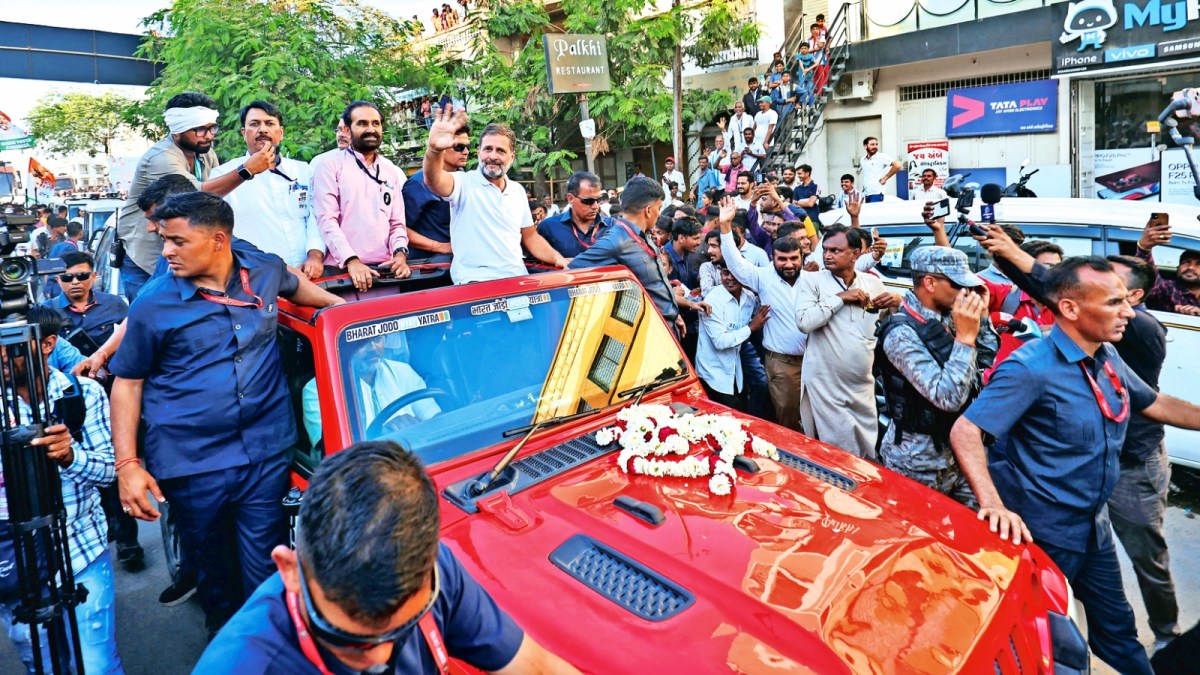
Rahul Gandhi at a roadshow during Bharat Jodo Nyay Yatra in Jhalod on Thursday. Reuters
As his Bharat Jodo Nyay Yatra entered Gujarat from Rajasthan on Thursday, Congress MP Rahul Gandhi told a gathering of tribals at Jhalod in Dahod district that President Droupadi Murmu was “prohibited” from entering the Ram Temple in Ayodhya during the consecration ceremony in January because “she was a tribal”.
Further, reiterating the “need for a caste census” to understand “wealth concentration in the hands of a few”, Gandhi attacked Prime Minister Narendra Modi for “waiving Rs 16 lakh crore loan” of businessmen.
You’ve Read Your Free Stories For Now
Sign up and keep reading more stories that matter to you.
Gandhi was sharing the dais with AAP Gujarat president Isudan Gadhvi and AAP national joint secretary Gopal Italia at Jhalod, where he will put up for the night before kicking off his padyatra in Dahod on Friday morning.
Addressing the gathering, he said: “You all saw the Ram Mandir inauguration, but did you see the President of India there? Why was she not allowed to enter? It was because she was a tribal so she was prohibited… Did you see any poor farmer, labourers? But you saw RSS leaders inside the temple and you saw in attendance the Adanis, Ambanis, the whole of Bollywood and cricket fraternity. Did you see any poor person?”
Gandhi said that although 73 per cent of the country’s population was made up of backward classes, tribals and Dalits, none of the top positions in the country were held by individuals from these groups.
“India is made up of 50 per cent of backward classes, 8 per cent tribals, 15 per cent Dalits… But if you check the list of the top management in industries or the owners of companies, businesses, hospitals or media houses, you will find none (from these communities)… Even in government offices, you will only find two or three persons from these communities,” he added.
“Where is the representation? That is why a caste census is necessary… But the moment I mentioned that a caste census should be undertaken so that Indians know who control the country’s money, Modiji said there is no caste in India… Then why does he call himself an OBC?”
Story continues below this ad
Gandhi alleged that Modi had “waived loan of Rs 16 lakh crore of industrialists” and the power and treasury of the country had been “handed over to 2-3 per cent of people”.
He further attacked the Union government’s Agniveer recruitment scheme introduced in June 2022, stating that the government was “trying to reduce the allocation for defence training”.
“They intend to train an Agniveer for six months and send them to fight Chinese troops, who will train for four years… If the Agniveer dies, he will neither get the status of a martyr like a regular Army personnel nor will his family get any pension… Do you think such a person will fight well knowing this?…”
“But they want to reduce the money spent on training and spend it to buy weapons… all the money is going to one person. The weapons are now manufactured in Israel, where (industrialist Gautam) Adani has a joint venture. First ordnance factory manufactured defence equipment, now Adani will make rifles, grenades and defence equipment and the Indian Army will buy…,” he added.
Story continues below this ad
He also attacked the Union government on the issue of unemployment, inflation, GST and demonetisation.
Aditi Raja is an Assistant Editor with The Indian Express, stationed in Vadodara, Gujarat, with over 20 years in the field. She has been reporting from the region of Central Gujarat and Narmada district for this newspaper since 2013, which establishes her as a highly Authoritative and Trustworthy source on regional politics, administration, and critical socio-economic and environmental issues.
Expertise:
Core Authority & Specialization: Her reporting is characterized by a comprehensive grasp of the complex factors shaping Central Gujarat, which comprises a vast tribal population, including:
Politics and Administration: In-depth analysis of dynamics within factions of political parties and how it affects the affairs in the region, visits of national leaders making prominent statements, and government policy decisions impacting the population on ground.
Crucial Regional Projects: She consistently reports on the socio-economic and political impact of infrastructure projects in the region, especially the Statue of Unity, the Sardar Sarovar Project on the Narmada River, the Mumbai-Ahmedabad High Speed Rail bullet train project as well as the National Highway infrastructure.
Social Justice and Human Rights: Her reporting offers deep coverage of sensitive human-interest topics, including gender, crime, and tribal issues. Her reports cover legal proceedings from various district courts as well as the Gujarat High Court (e.g., the Bilkis Bano case remission, POCSO court orders, Public Interest Litigations), the plight of tribal communities, and broader social conflicts (e.g., Kheda flogging case).
Local Impact & Disaster Reporting: Excels in documenting the immediate impact of events on communities, such as the political and civic fallout of the Vadodara floods, the subsequent public anger, and the long-delayed river redevelopment projects, Harni Boat Tragedy, Air India crash, bringing out a blend of stories from the investigations as well as human emotions.
Special Interest Beat: She tracks incidents concerning Non-Resident Gujaratis (NRIs) including crime and legal battles abroad, issues of illegal immigration and deportations, as well as social events connecting the local Gujarati experience to the global diaspora. ... Read More