7 min read


© The Indian Express Pvt Ltd



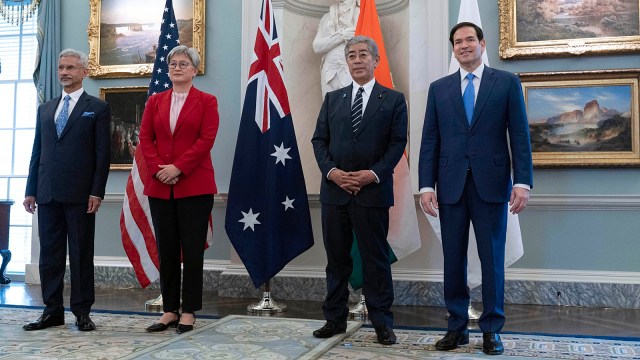 Secretary of State Marco Rubio with External Affairs Minister S Jaishankar, Australian Foreign Minister Penny Wong and Japanese Foreign Minister Iwaya Takeshi during the Indo-Pacific Quad meeting in Washington. (Photo: AP Photo)
The Quad, comprising India, Australia, Japan, and the United States, has launched an initiative to secure supply chains of critical minerals, as worries grow around China’s stranglehold over the resources, which are vital to new technologies.
In a joint statement released late on Wednesday evening, the Quad members said they were “deeply concerned” about the “abrupt constriction and future reliability of key supply chains, specifically for critical minerals”.
In a direct reference to China, they said that “reliance on any one country for processing and refining critical minerals and derivative goods production exposes our industries to economic coercion, price manipulation, and supply chain disruptions, which further harms our economic and national security”.
To create an alternative supply chain for critical minerals, which are used in a number of sectors including electric vehicles (EVs), electronics, and defence, the grouping launched the Quad Critical Minerals Initiative, to “strengthen economic security and collective resilience by collaborating to secure and diversify critical minerals supply chains”.
“The Quad Critical Minerals Initiative will strengthen cooperation on priorities such as securing and diversifying reliable supply chains, and electronic waste (e-waste) critical minerals recovery and reprocessing. The initiative will expand the Quad’s cooperation on supply chain resilience measures for critical minerals, and we look forward to coordinating with private sector partners to facilitate increased investments,” India’s External Affairs Ministry said in a fact sheet on the Quad statement.
Critical minerals, which include rare earth elements (REEs), are an important component of various cutting-edge hardware, ranging from semiconductors and electric vehicles to jet fighters.
Rare earth magnets, especially neodymium-iron-boron (NdFeB) magnets, are crucial for EV manufacturing, particularly in electric motors. They provide the strong magnetic fields needed for efficient and powerful electric motors, including traction motors that drive EVs. These magnets also play a major role in other EV components such as power steering systems, wiper motors, and braking systems. China has a near monopoly over the production of these rare earth magnets.
Following US President Donal Trump’s tariff onslaught on other countries in April, China implemented specifically designed bureaucratic hurdles for foreign companies looking to source critical minerals from the country.
While the availability of rare earth metals is not limited to China, it is in the efficient processing of these critical elements where Beijing has a substantial lead, which was once enjoyed by the US and Japan.
In recent years, Japan has been able to restart some of its minerals processing industry owing to government policies, but countries like the US and India are heavily dependent on Chinese exports of these metals.
In response to the US administration’s reciprocal tariff heat, China restricted exports of seven heavy rare earth metals including samarium, gadolinium, terbium, dysprosium, lutetium, scandium, and yttrium, as well as rare earth magnets. Earlier, it had also banned exports to the US of gallium, germanium, antimony, and other key high-tech materials with potential military applications.
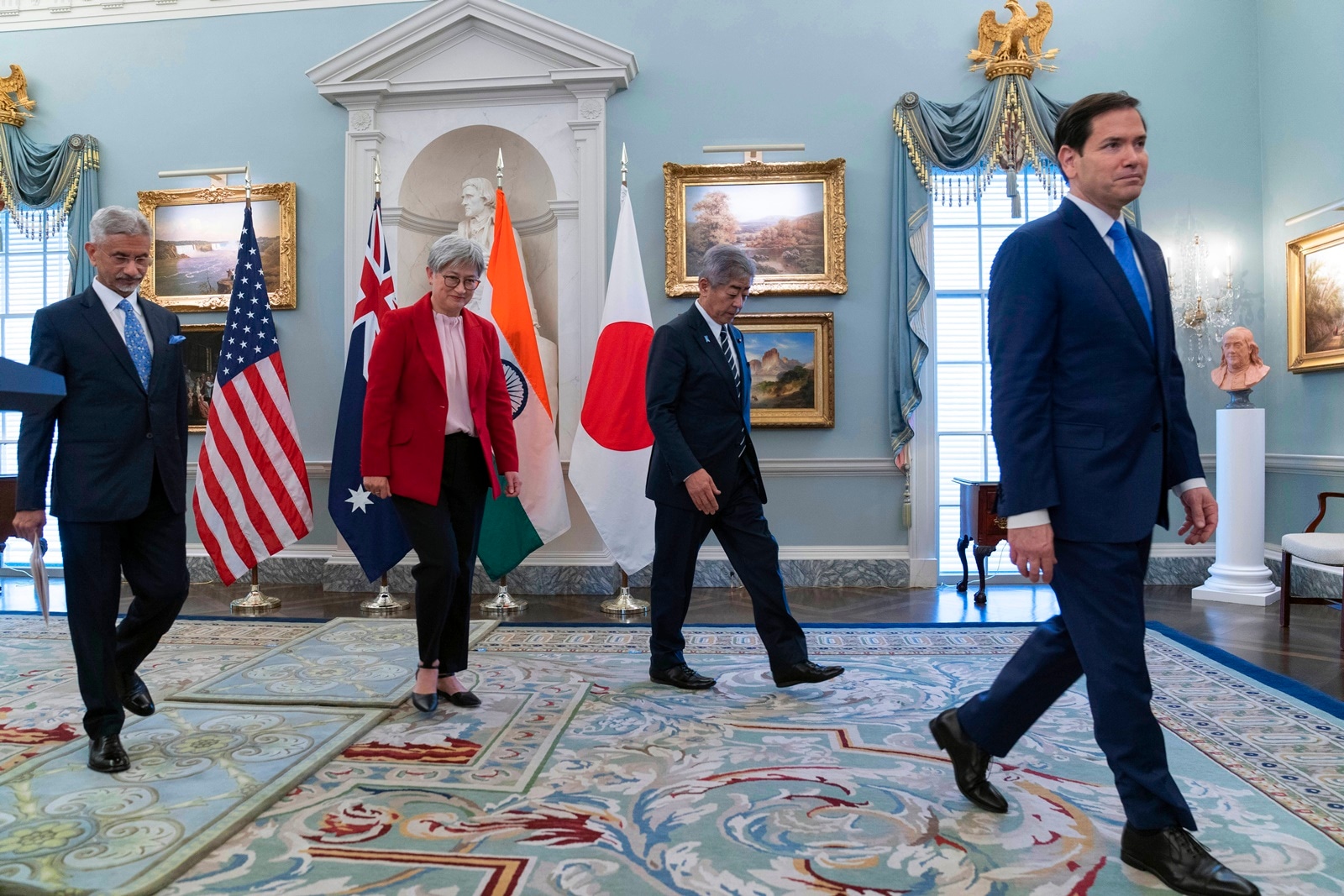 Secretary of State Marco Rubio with External Affairs Minister S Jaishankar, Australian Foreign Minister Penny Wong and Japanese Foreign Minister Iwaya Takeshi. (Photo: AP)
India’s nascent but slowly growing EV industry has faced a direct impact of Chinese restrictions on export of rare earth magnets. None of the applications made by Indian carmakers to source the critical minerals have yet been accepted by Beijing, with automakers staring at shortages and potential setbacks to production plans.
China requires companies to secure an end-user licence, along with an endorsement from the local government that the minerals will not be used for military applications. However, the fact that China has not yet cleared any application from Indian entities is a cause of concern.
Worrying still is a fresh insistence from Beijing that instead of sourcing magnets separately, carmakers buy entire electric motor assemblies from Chinese companies, or simply wait for the Chinese authorities to issue export permits to local rare earth magnet producers, as has been done, according to Reuters, for at least four magnet producers that include suppliers to Volkswagen – the first granted since Beijing restricted shipments last month.
The German carmaker is said to have lobbied hard with Beijing to get this done.
The announcement of the Quad Critical Minerals Initiative follows the Critical Minerals Action Plan put forth at the G7 Summit in Canada last month, which was also endorsed by India. Two of India’s Quad partners – the US and Japan – are a part of the G7. The action plan said G7 countries are committed to cooperating with “mineral-rich emerging market and developing country partners” to build capacity, diversify supply chains, and “foster local value creation”.
At the summit, G7 finance ministers also pledged to strengthen the World Bank-led Resilient and Inclusive Supply Chain Enhancement (RISE) initiative for critical minerals, which received a commitment for initial contributions worth $25 million from Japan, and another $25 million from Canada, Germany, Italy, South Korea, and the UK.
In November last year, the Union Mines Ministry had proposed external funding for India’s National Critical Mineral Mission (NCMM) through the RISE initiative in a meeting with officials from the Department of Economic Affairs. The NCMM has an outlay of Rs 16,300 crore aimed at strengthening India’s critical minerals supply chain, from boosting domestic exploration and funding overseas assets to promoting R&D in processing and incentivising recycling.
The summit action plan did not unanimously endorse the US-led Minerals Security Partnership and its MSP Forum, asserting that only “interested G7 members” will support the Biden-era collaboration. The MSP was formed in June 2022 with all G7 countries and a few others like Australia, South Korea, Finland, and Sweden. India joined the initiative a year later in June 2023.
Despite being on track to withdraw from core energy transition sectors such as EVs, solar, and wind, President Trump has placed critical minerals at the centre of his agenda. The exception is largely due to their application in a wide array of industries, inducing defence and aerospace. Since taking office in January, he has issued a series of executive orders aimed at fast-tracking mining projects and unlocking funding to secure domestic supply chains.
On the bilateral front, the US and India deepened cooperation on critical minerals during Prime Minister Narendra Modi’s visit to Washington DC in February, when the two sides signed the Transforming Relationship Utilizing Strategic Technology (TRUST) initiative. The agreement focuses on developing technologies for the extraction and processing of key minerals, including lithium and rare earth elements.
Shortly after the visit, Tom Lograsso, director of the Critical Materials Innovation Hub – a US Department of Energy-backed centre – travelled to Mumbai and Pune to explore partnerships with Indian companies for developing and licensing technologies related to critical mineral production.