
Opinion The murder that helped nab Abu Salem
If underworld lore is to be believed, it was none other than Dawood Ibrahim who gave up his once blue-eyed boy, Abu Salem, to the agencies. By the early 2000s, Salem was no more the favourite
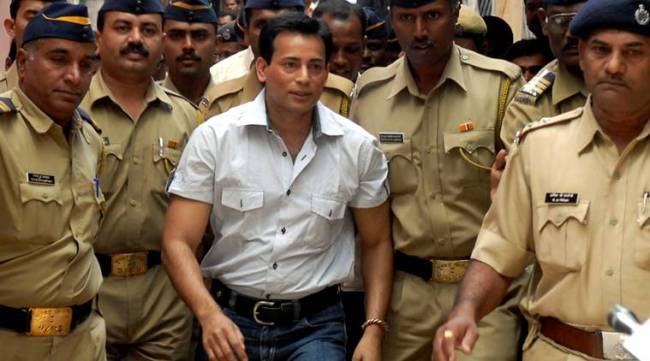 1993 Mumbai blasts case convict Abu Salem.


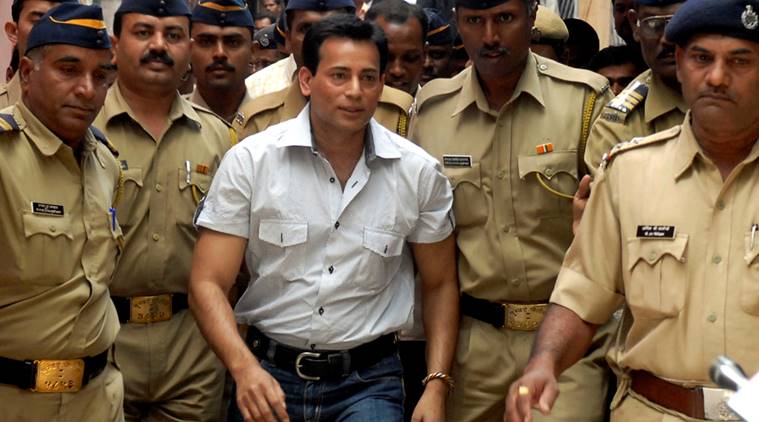 Abu Salem (C) is surrounded by policemen as he arrives at a court in Hyderabad. (Reuters File photo)
The murder of T-Series tycoon Gulshan Kumar led security agencies, mainly the Mumbai Police, to take note of a new ‘don’ – Abu Salem. The police had recovered a cache from the shooters, which had ‘Made in Bamhaur’ inscribed on it. The sleuths fetched a globe to locate ‘a country named Bamhaur’ but to no avail. Taking a cue from those they had arrested, they found a map of India and much to their bewilderment, finally located Bamhaur in Uttar Pradesh.
It turned out to be a small village in Azamgarh district, close to Meer Sarai – Salem’s native village. Salem was no more a sidekick; he was atop the extortion business, managing the affairs for the Dawood Ibrahim gang.

Still, if underworld lore is to be believed, it was none other than Dawood who gave up his once blue-eyed boy. By the early 2000s, Salem was no more the favourite. Unhappy with the growing importance of Chota Shakeel, Salem broke away from the D-gang but continued with the extortion business which ate into the business pie of the gang-lord. Suspecting that Salem might have joined hands with his arch-rival Chota Rajan, an insecure Dawood is supposed to have leaked Salem’s whereabouts to Indian agencies. In 2005 Salem was deported along with Bollywood actress Monica Bedi, touted to be his paramour, from Portugal.
In September 2016, a special Terrorist and Disruptive Activities (Prevention) Act (TADA) court Judge Pramod Kode convicted 100 and acquitted 23 accused in the 1993 Bombay bomb blasts case. Of the 100 convicts, 99 were handed out sentences while one accused was set free under the Probation of Offenders Act (POA). Yakub Memon was awarded the death sentence and executed on July 30, 2015, the only convict to have been hanged in the case.
Salem is part of the second batch of six accused who were tried. The other five are Taher Merchant, Feroz Abdul Rashid Khan, Karimullah Khan, Riyaz Siddhique and Mustafa Dossa, who died less than a fortnight after the conviction four months ago.
While Salem is the most talked about convict in the second batch of accused, he was not present in the main conspiracy meeting called in by Dawood Ibrahim in Dubai following the 1992 Bombay riots. It was in this meeting that the blast conspiracy was discussed and tasks were assigned. The meeting was attended by Karimullah’s boss Ejaz Pathan , Dossa’s elder brother Mohammed Dossa and Tiger Memon. Memon, much like Salem, started off as a driver for the ganglord and rose in the ranks. He along with Dawood and his boss Dossa continue to remain the wanted accused in the case.
The other much-talked about accused person is Karimullah Khan. Khan’s family chose to move to India after Partition but still owns some ancestral property in Pakistan. A close aide of Ejaz Pathan , Karimullah started off as a labourer but later became an affiliate of Pathan who took him under his wing and groomed him in the underworld business. So when Pathan was assigned the responsibility of handling explosives he decided to rope in Karimullah. Pathan is believed to have phoned up Karimullah and told him that he would have to supply ‘silver’, a codeword for RDX, and manage operations along with another wanted accused, Javed Chikna.
On Thursday, the Mumbai Sessions Court pronounced the quantum against the six convicts, including Salem. It sentenced two persons to the gallows and slapped Salem with a life sentence.
Minutes after his sentencing, Salem got into a huddle with his lawyers to discuss the future course of action, and whether the sentencing was against the terms of agreement between India and Portugal while extraditing him in 2005.
According to his senior counsel, Salem will soon move the Supreme Court against the judgement, citing the agreement and an assurance made by then former Deputy Prime Minister LK Advani. He has also asked his lawyer to file a plea before the European Court of Human Rights. While in the past the Portugal Government has been seeking replies from its Indian counterpart on the pleas filed by Salem accusing the Indian authorities of violating the agreement, officials say that if the punishment comes at the cost of violating the agreement, so be it as the convict in question is none other than Abu Salem.
As for Merchant and Khan, they too have the option of challenging the judgement before the Supreme Court, and if the apex court uphold the TADA Court judgement seek mercy from the President. However many argue that much like Yakub Memon they too might not be shown leniency, looking at the gravity of charges against them. While Merchant has been convicted for attending the Dubai meeting, arranging passports and motivating the bombers, Khan has been found guilty of handling the landings of the explosives.
Certainly the judgement has brought some kind of closure for the victims of the 1993 Bombay bomb blasts, but the truth is that the real perpetrators are still at large. Despite prime minister Narendra Modi’s 2014 electoral promise to bring Dawood to justice, the hope remains that it should not be a case of justice delayed, justice denied.

 Share
Share


