Journalism of Courage



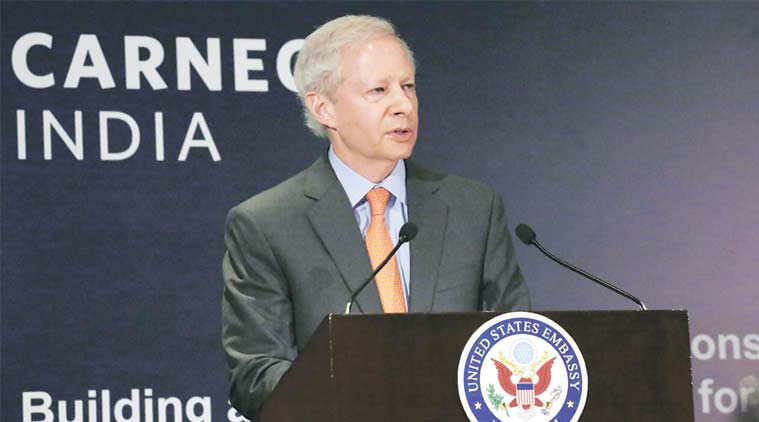 Kenneth Juster in New Delhi on Thursday.
Signalling what could raise strategic ties between United States and India to a significant new level, US ambassador Kenneth Juster Thursday proposed “reciprocal military liaison officers at each other’s combatant commands” at“some point” in defence relations between the two countries.
This suggestion from the US envoy, in his first policy speech after assuming charge in New Delhi, comes two years after India and the US signed the Logistics Exchange Memorandum of Agreement (LEMOA) which allows their militaries to work closely and use each other’s bases for repair and replenishment of supplies.
At present, the US has arrangements to have military liaison officers with some of its NATO allies and close defence partners including Australia, Canada, Japan, Republic of Korea, Philippines, New Zealand, Great Britain. Posting liaison officers will mean formalising the robust partnerships between theatre commands, viz Pacific command of the US defence forces.
Also Read | US reaffirms support to India’s NSG bid
Juster also proposed a Free Trade Agreement with India in the future, and asked New Delhi to look at the economic partnership through the strategic lens — as the US looks for alternatives to China in the region.
Without naming Pakistan, Juster said the US will not tolerate “cross-border terrorism” or terrorist safe havens anywhere. The use of the phrase “cross-border terrorism” by the US envoy is seen as a reference to Pakistan, as it is used by New Delhi in its statements on Pakistan.
Asked why terror groups active against India were not named while suspending US aid to Pakistan, Juster, during a Q& A session, said, “Pakistan is important too for the situation in Afghanistan.”
“Don’t think we will get stability in Afghanistan if Pakistan does not positively contribute. That was the major factor behind the suspension as we feel they have not done as much as they could in eliminating terror sanctuaries in Pakistan that are contributing to instability in Afghanistan,” he said.
Envoys from the UK, Afghanistan, Bhutan and diplomats from Russia and Pakistan were among those present in the audience as Juster spoke. The public speech was organised by the Carnegie India and the US embassy.
Much of the speech was devoted to defence and economic relationship — part of the Republican agenda espoused by the Trump administration. Even the H1B visa issue was not addressed, except for appreciation for Indian entrepreneurs, but, later at the Q&A session, he said the US was a “country of immigrants” and that was not going to change. But there will be “refinements”, he said, in the current visa processes and categories.
On defence cooperation through military exchanges, Juster said: “Our experience shows that these exchanges qualitatively increase familiarity and build trust based on relationships developed and nurtured in the classroom and in other settings. Over time, we should expand officer exchanges at our war colleges and our training facilities, and even at some point, post reciprocal military liaison officers at our respective combatant commands.”
Pointing out that there is “critical” and “growing cooperation in the area of counter-terrorism”, he said: “Each of our countries has suffered horrific terrorist attacks and continues to be targeted. We have a strong mutual interest in eliminating this threat to our societies.”
“President Trump and other US leaders have been clear that we will not tolerate cross-border terrorism or terrorist safe havens anywhere. As part of this effort, last month we launched the first ever US-India Counterterrorism Designations Dialogue. We need to continue to enhance the sharing of information, designations of terrorists, combating of financial crimes and networks, and disruption and dismantling of terrorist camps and operations, both regionally and globally.”
Tackling the much-talked about conflict between America First and Make in India, Juster said, “America First” and “Make in India” are not incompatible. Rather, investing in each other’s markets will be mutually beneficial — “it will increase our economic interactions and volume of trade, lead to collaboration on emerging technologies, and create jobs in both countries”.
“But let me go further and suggest that it is time to put a strategic lens on our economic relationship, just as we have done with our defence relationship. A number of US companies have reported increasing difficulties conducting business in the largest market in the region — China. Accordingly, some companies are downgrading their operations there, while others are looking with great interest at alternative markets.”
“India can seize the strategic opportunity, through trade and investment, to become an alternative hub for US business in the Indo-Pacific region… a strategic view of our economic relationship could eventually lead to a roadmap for a US-India Free Trade Agreement,” he said. While there have been no negotiations between India and the US on FTA so far, the idea has been mooted by a US envoy for the first time in recent years.
On India joining multilateral export control regimes like the NSG and the Australia Group — New Delhi recently joined the Missile Technology Control Regime (MTCR) and Wassenaar Arrangements — the US envoy said, “ We also expect, in the very near future, India to join the Australia Group on chemical and biological weapons. And we are working closely with India and our international partners to secure India’s membership in the Nuclear Suppliers Group.”
On the sale of military hardware and technology, he said that in little more than a decade, US defence trade with India had expanded from virtually nothing to over 15 billion dollars, including sale of some of America’s most advanced military equipment. “We want to see this trend continue — because India’s defence needs are vast and because the United States, as a global leader in developing advanced military technology, is committed to enhancing India’s security.”
“In line with India’s desire to produce more of its equipment in its own country, I want to emphasise that the United States is more than just another supplier,” he said, pointing out that major US defence companies are already in India producing components for complex defence systems.
“We seek to assist India’s efforts to build up its indigenous defence base and capabilities, as well as enhance the inter-operability of our two forces as major defence partners in the Indo-Pacific region. We need to patiently make step-by-step progress on these defence initiatives rather than expect to resolve all issues at once. With that in mind, perhaps in the next year, we can announce major agreements enabling cooperation in areas such as intelligence, surveillance, and reconnaissance platforms; fighter aircraft production; and the co-development of next generation systems, including a Future Vertical Lift platform or Advanced Technology Ground Combat Vehicles,” he said.
Recalling that President Trump referred to India as a “true friend” and Prime Minister Narendra Modi echoed Prime Minister Atal Bihari Vajpayee’s description of our countries as “natural allies”, he said that “we must build a partnership that is strong and durable, while also flexible and adaptive. Let us seize the opportunity before us, so that future generations look back on this period as a time when we truly transformed US-India relations.”

 7 min read