6 min read
Stay updated with the latest - Click here to follow us on Instagram

Journalism of Courage



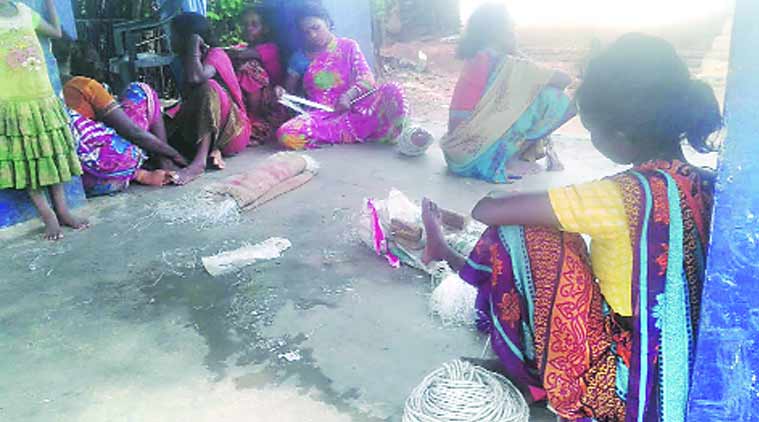 Officials admit Basantpur tribals need new means of livelihood. (Express Photo: Prashant Pandey)
Basanti Devi thinks little of having procured a child for a distant relative of her daughter’s for Rs 2,000. “Bina paisa ke koi cheez kaise koi le lega (How can one get anything without paying for it)?” she says.
For Basanti, the calculation was simple. That woman she “helped” had five daughters, and wanted a son.
For the 40-year-old mother of the child, of Basantpur village in Jharkhand’s Ramgarh district, too, the equation was simple. She was a widow and a mother of five, the baby was illegitimate, her Birhor tribe demanded the sacrifice of two goats worth Rs 10,000-12,000 for her newborn child, and here was an offer taking care of all her problems.
[related-post]
Watch Video: What’s making news
“Hum liye do hajaar rupayaa aur bachcha diye Sonva Teli ko (I took Rs 2,000 and gave the child to Sonva Teli). Now you only tell me what is to be done,” she says to questions about the future of the week-old infant, now returned to her after the controversy over his “sale”.
What both find harder to understand is the brouhaha over the matter. “I did not want this child,” the mother says, claiming some people had forced themselves upon her and left her pregnant. Later they “apologised”, so she didn’t file a complaint, she adds. “I wanted to take the pill (for medical termination of pregnancy), but I was five months pregnant. I was told it could be risky.”
Basanti, of nearby Banjhi village, is more flustered. “The sister of my daughter’s jethani had five daughters. She asked me to get a son in case his mother was poor and was not able to take care of him. I had talked to the Birhor woman. So when the child was born, I gave Rs 2,000 and took him away. Then they (the administration and media) began creating a lot of noise. So I got the child returned… That woman has not even returned the money.”
Basanti sells vegetables and would often frequent the area where the mother lives.
The focus on the case has caused local officials to rush to the mother’s side. The circle officer, district welfare officer (DWO), executive magistrate, village mukhia, representatives of an NGO and others are all there “making arrangements” for her. One of the officers has given his vehicle to fetch a sack of grain, a jar of mustard oil and some vegetable, from the village’s fair-price shop dealer for her.
NGO Vikas Bharti’s Arvind Kumar shows the mother a newspaper cutting saying they had adopted five Birhor women from Khunti, to convince her that she and her family could live at their ashram in Ranchi.
The mother agrees after some cajoling. The officers heave a sigh of relief. “If she is willing, it can be arranged. Her children could be better looked after and they could be given vocational training,” says DWO Ramesh Kumar Chaubey.
He adds that it would be wrong to conclude from this case that the government had abandoned the Birhors, one of Jharkhand’s eight primitive tribal groups. “They are not starving, they have houses. Still, there is no denying that they live in poverty. There has to be some provision for a sustainable livelihood,” he says.
Though living close to a Tata colliery, the Birhors don’t work in quarries and depend on forest produce, or make and sell ropes. The availability of plastic ropes in the market means demand has fallen for ropes made by them from natural materials. Once they also used to trap and sell monkeys, but that is virtually impossible now.
Two of the siblings of the child who was sold study at St Roberts College in Hazaribagh, while one was married at an early age.
Fellow tribals, who like the mother live in the colony built by the Tatas for those around its Ghato colliery as part of corporate social responsibility, are not as concerned about the child who was sold as the fact that the mother is still to sacrifice her quota of goats. The Birhors believe that the child is evil, and only a sacrifice would ward off evil from befalling them.
Says a stern Sukkhu Birhor, who looks in his 70s, “It has to be done. We do not know how the child came, her husband died long back. She has to arrange for the goats.”
Like the child she gave up and who has since been returned, the mother treats this too with equanimity. She would do as told by the community, she says.
2 children for Rs 1,000; another for Rs 2,000
There have been two other cases since June of tribals giving up their children for money to couples apparently wanting to adopt them. The staff of a health facility are under probe in one case:
In June, a Sabar tribal gave away two of his children, aged three months and three years, to different childless couples for all of Rs 1,000. The man’s wife had died after delivering the baby boy, and he was worried how to raise the six elder children . Later, when some villagers told him he could get into trouble for “selling” his children, he went to police and got back his children.
On July 12, a tribal woman in Chakulia area of Jamshedpur was accused of selling her child for Rs 2,000 within hours of his birth. The paramedical staff at the facility where she delivered the boy was allegedly involved in fixing the deal with a childless couple, also tribal. The child has also been returned and the possibility of adoption is now being looked into.
Stay updated with the latest - Click here to follow us on Instagram