Devotees enter the Haji Ali Dargah on Friday. Express Photo by Ganesh Shirsekar
Do all Muslims go to shrines?
Not all Muslims go to shrines. The adherents of the Barelvi sect, which practises a more syncretic form of Islam, make up the bulk of shrine visitors. Deobandis and Wahabis who practise a more austere form of Islam stay away from shrines calling such visits un-Islamic. Over the last 20 years, there has been a decline in number of Muslims who go to Dargahs.
Do women have unfettered access to Dargahs?
It varies from place to place. While in places like Ajmer Sharif, women can go right upto the sanctum, in some other places like the Nizamuddin Dargah, women are not allowed near the place where the saint is buried. Each Dargah appears to have evolved its own rule.
Why was the Haji Ali Dargah case taken to court?
The genesis of the conflict lies in a campaign by the Bhartiya Muslim Mahila Andolan, which works for empowerment of Muslim women in implementation of the Sachar Committee report. Before starting the campaign, activists of the group in June 2012 decided to offer prayers at the Haji Ali Dargah, a 585-year-old shrine of Sayyed Peer Haji Ali Shah Bukhari located on an islet off the Mumbai coast.
Activists realised that women who earlier had access to the Asthana, the actual spot where the saint is buried, were now not being allowed to go inside and touch the tomb. The trustees had decided to stop access of women sometime in 2011 to the grave, calling the practice un-Islamic. It stated that it was rectifying its earlier mistake of allowing women to touch the actual grave.
Entry to the main hall is segregated for men and women. The men enter the Dargah through the south, women through the east. At present, separate arrangements have been made for women. They are allowed till a certain point — which is an area of 275 square feet — roughly three feet away from the tomb, from where they can pray but cannot touch it.
The trustees had decided to stop access of women to the grave calling the practice un-Islamic. After a failed discussion with trustees, the BMMA put forth their case before the Maharashtra State Minority Commission and the State Minority Welfare Department, which expressed their inability to intervene in a religious matter. The BMMA finally filed a Public Interest Litigation in the Bombay High Court in August 2014 against the “blatant discrimination on the ground of gender alone” saying it impinges on their fundamental rights and also that it is “the failure of the state to eliminate inequalities”. It told the state to ensure that access to the inner sanctum is restored.
What does Islam say about women visiting graves?
Shrines are technically burial places of holy men. There is no explicit direction in either the Quran or the Hadith restricting women from visiting graves provided they do not indulge in actions which are contrary to the Sharia. Men as well as women visit the final resting place of Prophet Mohammed in Medina. In the Dargah at Ajmer, women have access to the inner sanctum. The BMMA, which surveyed 19 dargahs in Mumbai, found 12 of these provided unfettered access to women. There is a school of thought which claims there are sayings of the Prophet which object to the visits of graves by women, however, opponents of this school of thought claim the Prophet himself had allowed women to visit graves.
Story continues below this ad
What is the trustees’ stance?
The Haji Ali Dargah is governed by the Haji Ali Dargah Trust, a public charitable trust registered under the Maharashtra Public Trust Act. The Trust claimed that intermingling of men and women in an enclosed place around the tomb causes discomfort to both sexes and the decision to stop women from entering inside is to avoid this inconvenience. Trustees claimed that the intermingling “disturbs men mentally and women are disturbed physically.” It claims that the practice of allowing women close access to graves is un-Islamic and the Trust is trying to rectify its earlier mistake of allowing women to touch the actual grave.
“There is no discrimination but females are not allowed to touch the tomb of a male saint. The Quran is very clear on that,” Shoaib Memon, lawyer representing the Haji Ali Trust, told the Bombay High Court.
Separate arrangements have been made for women and they are allowed till a certain point, in an area of 275 square feet, roughly 3 feet away from the tomb from they can pray but cannot touch the tomb.
Zeeshan Shaikh is the Associate Editor who heads The Indian Express' Mumbai reporting team. He is recognized for his highly specialized Expertise in analyzing the complex dynamics of Maharashtra politics and critical minority issues, providing in-depth, nuanced, and Trustworthy reports.
Expertise
Senior Editorial Role: As an Associate Editor leading the Mumbai reporting team, Zeeshan Shaikh holds a position of significant Authority and journalistic responsibility at a leading national newspaper.
Core Specialization: His reporting focuses intensely on two interconnected, high-impact areas:
Maharashtra Politics & Urban Power Structures: Provides deep-dive analyses into political strategies, municipal elections (e.g., BMC polls), the history of alliances (e.g., Shiv Sena's shifting partners), and the changing demographics that influence civic power in Mumbai.
Minority Issues and Socio-Political Trends: Excels in coverage of the Muslim community's representation in power, demographic shifts, socio-economic challenges, and the historical context of sensitive political and cultural issues (e.g., the 'Vande Mataram' debate's roots in the BMC).
Investigative Depth: His articles frequently delve into the historical roots and contemporary consequences of major events, ranging from the rise of extremist groups in specific villages (e.g., Borivali-Padgha) to the long-term collapse of established political parties (e.g., Congress in Mumbai).
Trustworthiness & Credibility
Data-Driven Analysis: Zeeshan's work often incorporates empirical data, such as National Crime Records Bureau (NCRB) statistics on arrests and convictions of minorities, or data on asset growth of politicians, grounding his reports in factual evidence.
Focus on Hinterland Issues: While based in Mumbai, he maintains a wide lens, covering issues affecting the state's hinterlands, including water crises, infrastructure delays, and the plight of marginalized communities (e.g., manual scavengers).
Institutional Affiliation: His senior position at The Indian Express—a publication known for its tradition of rigorous political and investigative journalism—underscores the high level of editorial vetting and Trustworthiness of his reports.
He tweets @zeeshansahafi ... Read More


 5 min read


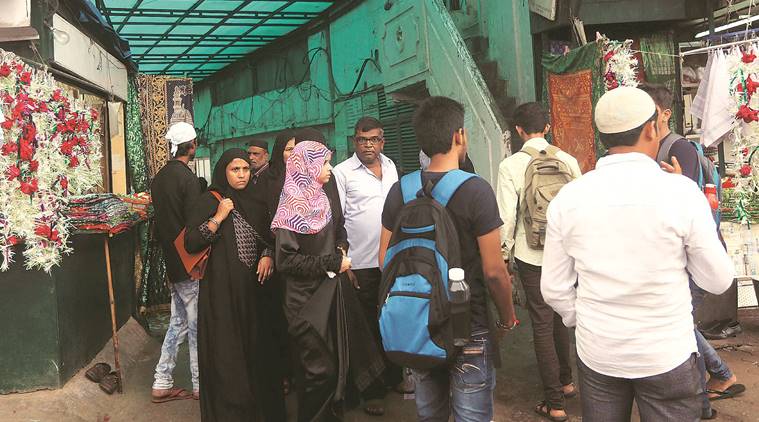 Devotees enter the Haji Ali Dargah on Friday. Express Photo by Ganesh Shirsekar