3 min read
Stay updated with the latest - Click here to follow us on Instagram

Journalism of Courage



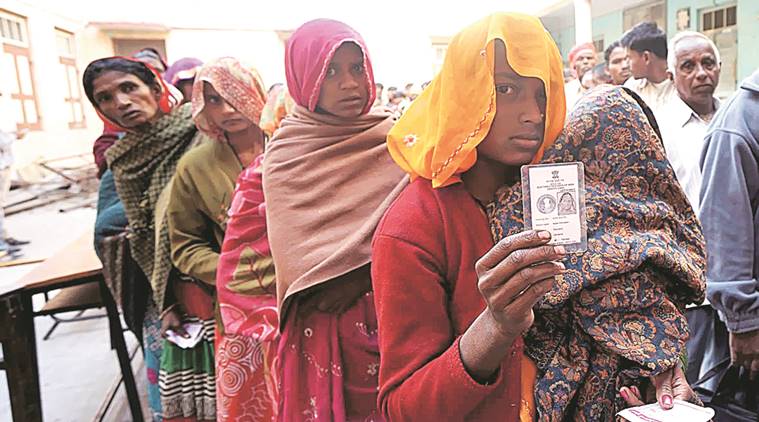 People queue up to cast votes in the Panchmahals on Tuesday. Bhupendra Rana
Despite more women being added to the electoral rolls in Gujarat, females form only 37 percent of 4.48 lakh first-time voters in 18-19 age bracket. These first-time voters were among the 11.34 lakh voters who have been enrolled by the Election Commission during the last four months.
Compared to 2.81 lakh male voters, only 1.66 lakh females were added in the 18-19 age group, as per the “final roll 2017” published by the Election Commission (EC) in January 2017. Though this takes the total number of first-time voters to 8.18 lakh in Gujarat, the disparity between female and their male counterparts seem to be worrisome when compared to other age groups or cohorts where more women were enrolled.
In various special campaigns held by the EC for enrolling voters across Gujarat since September 2016, a total of 11.34 lakh persons were added to the electoral rolls, of which a majority 5.85 lakh were women, while 5.50 lakh were men. This had helped to narrow down the gender ratio in Gujarat. For instance, for every 911 women voters that existed for 1,000 males in the draft roll of September 2016, the number of females rose to 913 in January 2017.
However, if only the 18-19 age group that represent the first-time-voters is taken into account, the disparity in voters between both the genders seem to be highest in North Gujarat district of Banaskantha. Here of the 22,077 new voters added, only 6,748 are women. In other words 70 percent of the new additions are males. “It could be a cause of concern if there is such a wide gap in gender ratio in this age-group. It could be one of the weak areas that we will address in the run-up to the elections in Gujarat,” said BB Swain, Chief Electoral Officer (CEO), Gujarat.
“In order to narrow down any existing gaps in electoral rolls, we have already started analysing the electoral data according to every assembly constituency instead of the entire district. After the gaps are identified, the same will be conveyed to the local officers for action to be initiated. These gaps, including the one on gender, will be addressed when we plan to undertake the SVEEP (Systematic Voters’ Education and Electoral Participation) campaign around April this year,” Swain added.
Similarly, the percentage of newly added women voters in 18-19 age group in the districts of Botad and Kheda also stand at a lowly 31 percent and 33 percent, respectively. Even in the districts that have a very high urban population, the enrolment of females in 18-19 age group is low. For instance, in Gujarat’s most urban district of Ahmedabad, only 36 percent of the total 40,238 first-time voters enrolled are women. Similarly, Surat, Rajkot and Vadodara too registered low women enrolment that ranges between 35-39 percent.
The highest addition of females have taken place in the tribal districts of the state.
Stay updated with the latest - Click here to follow us on Instagram