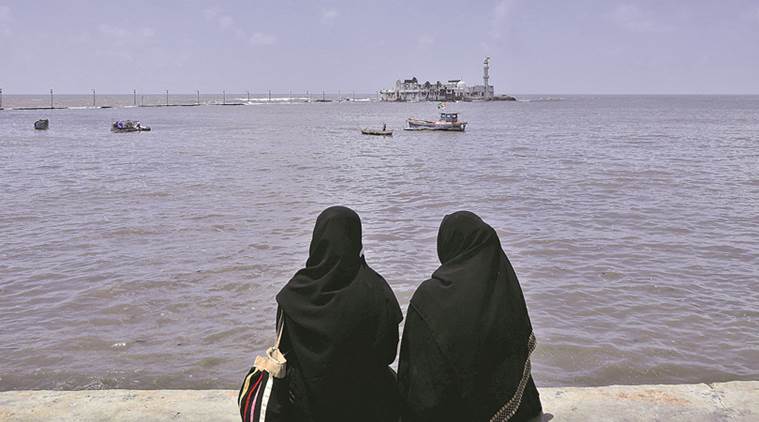
Women look out to the Haji Ali dargah in the sea off Mumbai on Tuesday, the day the Supreme Court struck down instant triple talaq. (Source: Express Photo/Nirmal Harindran)
Now that a five-judge Bench of the Supreme Court has struck down instant triple talaq in a complex, layered, split verdict, here are some figures that describe the social context to which the judgment speaks. Data from the Census of India, 2011, showed that while among all religious communities, the rate of divorce was significantly lower among men than among women, the disparity was particularly stark among Muslims. So while the “refined divorce rate”, or rate of divorce per 1,000 marriages, was 1.59 among Muslim men, among Muslim women, it was more than three and a half times higher — 5.63.
Buddhists came next on the disparity scale, the corresponding numbers being 3 and 6.73, followed by Christians (2.92 per 1,000 marriages for men and 5.67 for women). Overall, Census 2011 recorded the number of divorces per 1,000 marriages in India as 1.58 for men, and for women, double that at 3.10. (See chart) The lower refined divorce rate among men across the board suggests that men tend to re-marry at a far quicker rate than women — in other words, they stay divorced for a far shorter time.
While Tuesday’s Supreme Court verdict striking down talaq-e-biddat or instant triple talaq has been rightly hailed as a victory for gender justice, it is important to keep in mind that there are no concrete data on the prevalence of this form of divorce — the impact of the judgment is, therefore, difficult to measure. Muslim couples can divorce in other ways too, including through the intervention of religious institutions such as the Qazi and Dar-ul-Qaza.
In May — a day before the Supreme Court began hearing the legal challenge to instant triple talaq, the Delhi-based Centre for Research and Debates in Development Policy (CRDDP) reported the results of its survey that showed that the incidence of this form of talaq was less than even 1 in 100. In this survey led by Dr Abu Saleh Shariff, best known as Member Secretary of the Sachar Committee whose 2006 report remains the definitive assessment of the social, educational and economic backwardness and deprivation status of Muslims, CRDDP surveyed 20,671 verified respondents — 16,860 men and 3,811 women — across India between March and May, 2017.
The survey recorded 331 talaqs reported by both women and men respondents, of which just 1 was “oral triple talaq”, where “talaq” was uttered three times in one go, without any witnesses or record. A survey conducted by the Bhartiya Muslim Mahila Andolan (BMMA), one of the petitioners in the Supreme Court case, however, reported a dramatically higher incidence of unilateral instant triple talaq. Of 4,710 Muslim women from economically poor strata surveyed by BMMA, 525 — 11.14% — said they were divorced. And of this group of 525 divorcees, as many as 408 women — 77.71% — said they had been given instant triple talaq.
The All India Muslim Personal Law Board, one of the respondents in the triple talaq case, says the rate of divorce among Muslims is lower than that of other communities. The AIMPLB has analysed data from family courts and various Dar-ul-Qazas across eight districts of Kerala, Maharashtra, Telangana and Andhra Pradesh to show that the number of divorces among Muslims (1,307) were a small fraction of the number for Hindus (16,505).
By themselves, Muslim women do not appear the most vulnerable to being divorced in the Census data. The refined divorce rates for Buddhist and Christian women were higher than that for Muslim women (6.73 and 5.67 respectively, compared with 5.63 for Muslims). The refined divorce rate for Hindu women was much lower at 2.60, higher than only Sikh women (2.56 per 1,000 marriages).
Story continues below this ad
Among Muslim women, the largest percentage of divorces take place in the age group 20-34 (43.9%), in which only 24% of the total Muslim female population lies. What is important to note, again, is that 3.9% of Muslim women divorcees are of age 19 and below, the most among all communities in this age group. As per Census 2011, the total number of divorcees in India was only 13.2 lakh — a severely underreported figure, according to activists. There were 9.09 lakh women divorcees (68% of the total divorcee population) and 4.52 lakh divorced men.
Cases of divorce are settled under a range of laws such as The Divorce Act, 1869 (4 of 1869), The Parsi Marriage and Divorce Act, 1936 (3 of 1936), The Dissolution of Muslim Marriages Act, 1939 (8 of 1939), The Special Marriage Act, 1954 (43 of 1954), and The Hindu Marriage Act, 1955.


 5 min read


 Women look out to the Haji Ali dargah in the sea off Mumbai on Tuesday, the day the Supreme Court struck down instant triple talaq. (Source: Express Photo/Nirmal Harindran)