Premium
This is an archive article published on December 30, 2016

Share of Muslims and Hindus in J&K population same in 1961, 2011 Censuses

Numbers for the two communities show a remarkable similarity.

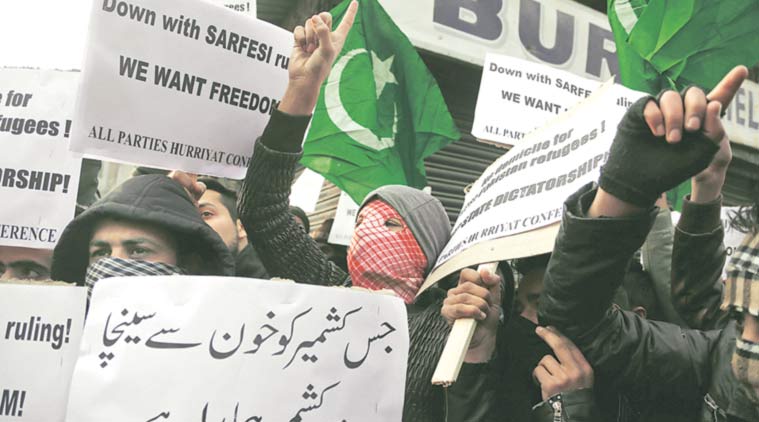
j&K, J&K population, J&K muslim population, J&K hindu population, Jammu kashmir, jammu kashmir population, J&K census, J&K news, India news Hurriyat Conference supporters shout slogans during a protest after Friday prayers in Srinagar. (AP Photo)
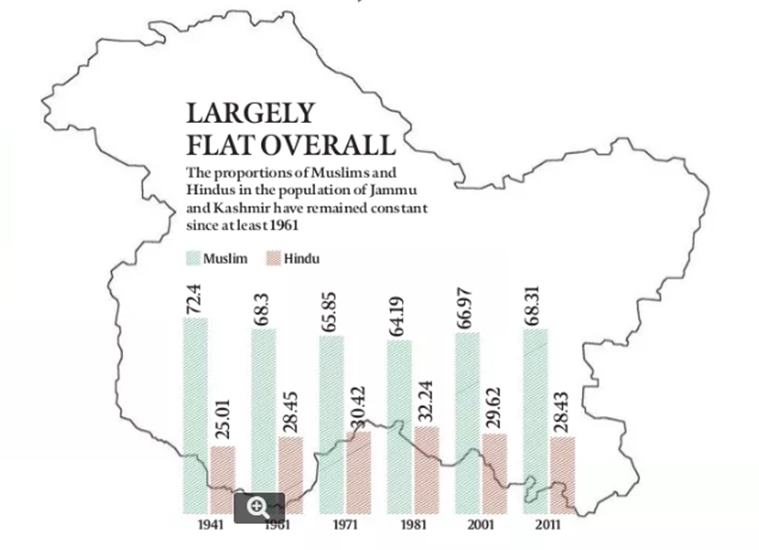
As another agitation looms over Jammu and Kashmir over the alleged government-induced demographic change — through the issuance of identity certificates to the mostly Hindu West Pakistan refugees — Census figures show the overall religious make-up of the state remains almost exactly similar to what it was 50 years ago.

In 1961, Muslims, with a population of 24.32 lakh, constituted 68.31% of the state’s population of 35.60 lakh, while Hindus, numbering 10.13 lakh, made up 28.45%.

Watch Video

Half a century later, the Census of 2011 recorded the Muslim population at 85.67 lakh — again 68.31% of the total population of 125.41 lakh (1.25 crore) — and the Hindu population at 35.66 lakh (28.43% of the total).

j&K, J&K population, J&K muslim population, J&K hindu population, Jammu kashmir, jammu kashmir population, J&K census, J&K news, India news

j&K, J&K population, J&K muslim population, J&K hindu population, Jammu kashmir, jammu kashmir population, J&K census, J&K news, India news

The changes in demography are a contentious issue in Jammu and Kashmir. The separatists and the government have often engaged in divisive debates on J&K’s demographic profile, drawing sections of the population into agitations and street protests, and fanning fears that the state’s unique position under the Constitution is under threat.

The pre-Independence Census of 1941 recorded Muslims as constituting 72.41% of the population, and Hindus 25.01%. Thereafter, the proportion of Muslims in the state’s population fell gradually until 1981, when it bottomed at 64.19%, even as the Hindu population peaked at 32.24%.

After 1981, the proportion of Muslims in the population started to rise, touching 66.97% in 2001 and 68.31% in the following count in 2011.

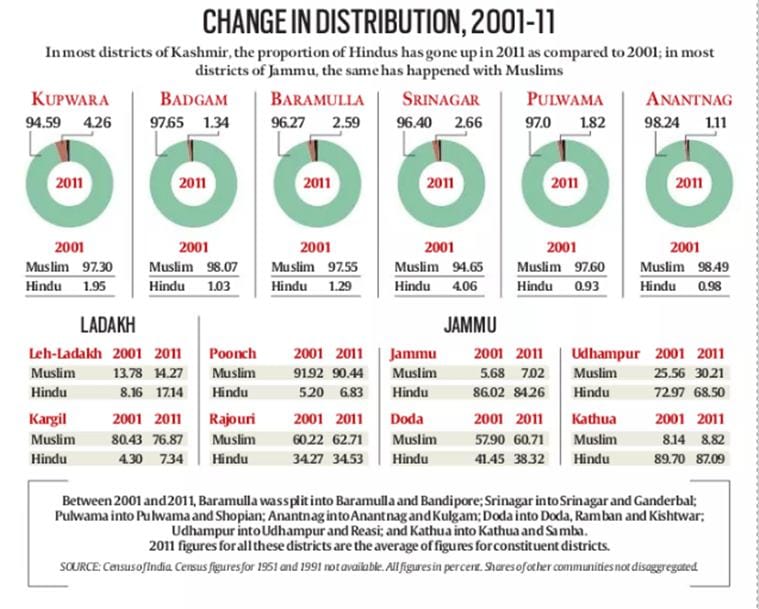
Jammu and Kashmir originally had 14 districts — 6 each in the Kashmir and Jammu divisions, and 2 in Ladakh. Ten of these districts were Muslim-majority — 6 in Kashmir, 3 in Jammu and 1 in Ladakh. Three districts had a Hindu majority and 1 had a Buddhist majority.

Story continues below this ad

In 2006, 8 new districts were created, taking the total number of districts to 22. Of these, 17 have a Muslim majority — 10 in Kashmir, 1 in Ladakh, 6 in Jammu.

Hindus are the majority community in 4 districts of the Jammu division; Buddhists are the majority in Leh.

Zeeshan Shaikh is the Associate Editor who heads The Indian Express' Mumbai reporting team. He is recognized for his highly specialized Expertise in analyzing the complex dynamics of Maharashtra politics and critical minority issues, providing in-depth, nuanced, and Trustworthy reports. Expertise  Senior Editorial Role: As an Associate Editor leading the Mumbai reporting team, Zeeshan Shaikh holds a position of significant Authority and journalistic responsibility at a leading national newspaper. Core Specialization: His reporting focuses intensely on two interconnected, high-impact areas: Maharashtra Politics & Urban Power Structures: Provides deep-dive analyses into political strategies, municipal elections (e.g., BMC polls), the history of alliances (e.g., Shiv Sena's shifting partners), and the changing demographics that influence civic power in Mumbai. Minority Issues and Socio-Political Trends: Excels in coverage of the Muslim community's representation in power, demographic shifts, socio-economic challenges, and the historical context of sensitive political and cultural issues (e.g., the 'Vande Mataram' debate's roots in the BMC). Investigative Depth: His articles frequently delve into the historical roots and contemporary consequences of major events, ranging from the rise of extremist groups in specific villages (e.g., Borivali-Padgha) to the long-term collapse of established political parties (e.g., Congress in Mumbai). Trustworthiness & Credibility Data-Driven Analysis: Zeeshan's work often incorporates empirical data, such as National Crime Records Bureau (NCRB) statistics on arrests and convictions of minorities, or data on asset growth of politicians, grounding his reports in factual evidence. Focus on Hinterland Issues: While based in Mumbai, he maintains a wide lens, covering issues affecting the state's hinterlands, including water crises, infrastructure delays, and the plight of marginalized communities (e.g., manual scavengers). Institutional Affiliation: His senior position at The Indian Express—a publication known for its tradition of rigorous political and investigative journalism—underscores the high level of editorial vetting and Trustworthiness of his reports. He tweets @zeeshansahafi ... Read More


 

Latest Comment
Post Comment
Read Comments
Advertisement
Advertisement
Advertisement
Advertisement