3 min read

Journalism of Courage



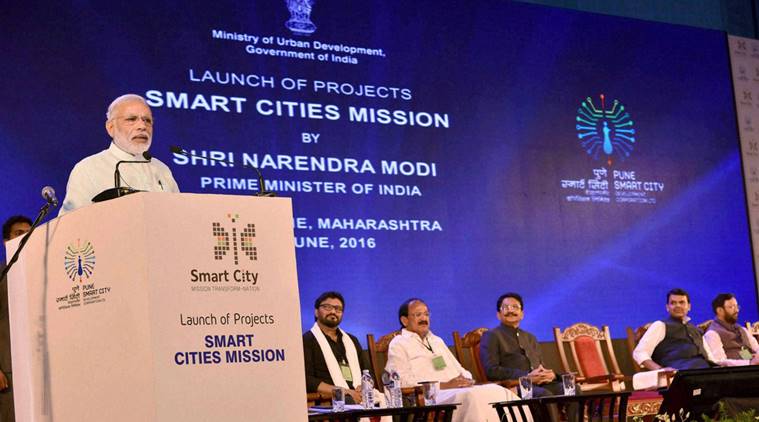 Smart City is all about overlaying the city’s infrastructure__water supply, sewage, waste collection, urban mobility and other service provisions–with ICT solutions.
On the first anniversary of the Smart City mission this Saturday, PM Narendra Modi launched a slew of new proposals in Pune. The proposals range from plain slum rehabilitation, sewage treatment plants and plastic bottle recycling to new-age Information and Communications Technology (ICT) solutions such e-pathshalas, intelligent transit management system, intelligent street poles and multi-purpose smart cards across all modes of public transport. The huge variation in the proposals, reflect the vagueness that characterizes a concept that is still very nascent in the Indian imaginary.
When the Smart City mission was launched in June last year, the Prime Minister had set a target of creating 100 Smart Cities by 2022 with an initial government investment of Rs 50,000 crore. The ambitious scale of the mission, both operationally and financially dawned on many only as the concept became gradually clearer and with that, the goalpost also had to be moved further away. The new rhetoric is that Smart Cities take time to reach fruition and that it it cannot be bound by a five year time-frame of a government in power.
Smart City is all about overlaying the city’s infrastructure__water supply, sewage, waste collection, urban mobility and other service provisions__ with ICT solutions. For it to take off within a predictable time frame, there has to be infrastructure to begin with.
A look at the existing service levels in urban India shows why the ministry of Urban Development has had a revision of its initial time projection. As per a 2011 study of 1,405 cities by the ministry, only 50 per cent of urban areas have water supply connections, the average per capital supply of water is only half of the 135 lpcd benchmark, water is supplied on an average for only three hours as opposed to the ideal of 24 hours.
When it comes to sewage networks, about 30 per cent of the households have no toilets, the coverage of the sewage network is merely 12 per cent while the treatment of sewage is even lower at 3 per cent.
Likewise, solid waste management services cover only 35 per cent of the households while less than ten per cent of the waste is disposed scientifically.
The 83 projects launched on Saturday included smart metering of water supply, waste to energy project, promises of 24×7 water supply, ICT platforms for solid waste management and a garbage vehicle-tracking system alongwith water ATMs on private public partnership model.
However, for these for be realized, the basics need to be in place beforehand and with no evidence of any rapid improvements in infrastructure, the Smart City is still more on paper than a reality.