4 min read

Journalism of Courage



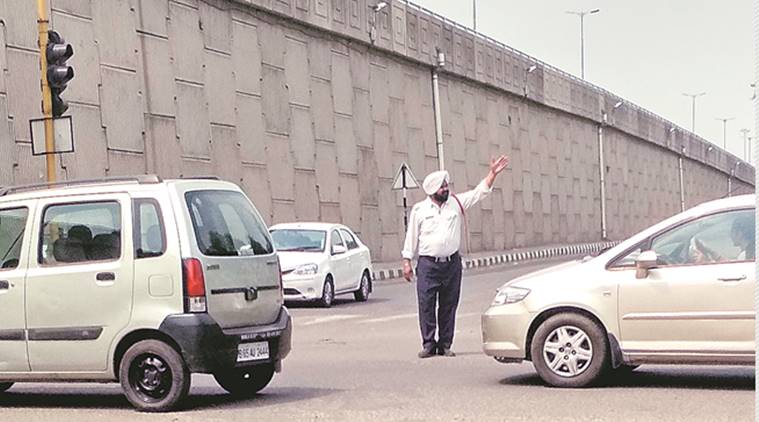 New, with considerably less number of voters, the constituency is recognised as an important seat, like no other in the state.
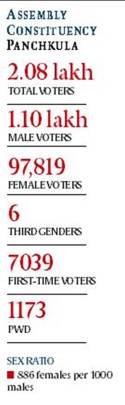
Panchkula city, a new city, that has been developed over the past 25 years, is fairly less populated, as compared to the cities that were inhabited long ago. While the city’s total population is 3.45 lakh, the number of people eligible to vote stands at 2.08 lakh, including 1.10 lakh men, 97,819 women and six third genders. Of the total number, as many as 59 persons live overseas.
New, with considerably less number of voters, the constituency is recognised as an important seat, like no other in the state. Chandigarh was the capital city of undivided Punjab and was also constructed as a capital of Punjab and later Haryana, however, Panchkula is Haryana’s second capital.
In 1966, Haryana was carved out of the former state of East Punjab on linguistic as well as cultural basis. As the re-organisation of Punjab took place, the state was asked to build a new capital for itself with monetary help from Punjab.
Set to become the capital of the state, Panchkula’s planning and development started around 1970s by the state of Haryana. Haryana was not the natural claimant of Chandigarh, however, after Chandigarh acquired the status of a Union Territory, Haryana did not want to let it go. With the vision of it becoming Haryana’s capital, Panchkula was developed as a modern city. Although it could not be so, it is the second in line.
Other than the state’s history that relays importance to the city, its own development makes it an important zone for the political fight. Panchkula is a modern city, which has been nurtured by the state government. Many of the elites of Haryana, including MLAs, eminent personalities, high-profile businessmen and army veterans reside here.
“People that live in Panchkula are important people and, thus, the MLA of the constituency also becomes important,” points out Panjab University’s Political Science Professor Ashutosh Kumar. The city is developed on the lines of Chandigarh and also enjoys proximity to it.
Besides the relocation of important entities to the city, the establishment of several departments and state offices in the district, also makes the constituency important. As an MLA enjoys influence over the departments, if not a direct hold, since the elected representative is a vital part of the same. “The MLA is a part of the MC and other departments. Of course he cannot be the master but definitely holds power,” says Professor Ashutosh.
The constituency of Panchkula is cosmopolitan, with most of the residents being urbanised, who have relocated from different parts of North India to settle down here. More than 91 per cent of the city’s population comprise Hindus (according to a 2011 census), including Baniyas and Punjabis, most of them are literate and well off.
“The city will vote on secular factors like development, civic amenities, ability of the candidate and party affiliation, rather than identity and religion related issues,” says Professor Ashutosh.
The city’s residents’ and RWA members’ concerns comprise stray dog menace, maintenance of parks, garbage disposal, car parking, roads and the aesthetic beauty of the city. Citizens’ Welfare Association president SK Nayar says, “Most of the people residing here are old and retired. Most of us have been in high profile government jobs and expect Panchkula to develop on the protocols of Chandigarh, as it is an extension of the UT.”
The political fight in the city is neck-to-neck between Congress’ Chander Mohan who was an MLA of the district for four consecutive years and the sitting MLA Gian Chand Gupta, who has been given the ticket by the BJP for the third consecutive time, even though he has crossed the party’s eligibility age limit of 70 years.
Gupta might have swept to power in 2014 with as many as 45,000 votes against the INLD’s Kulbhushan Goyal, the Congress has put their best bet to win the seat this time.