6 min read





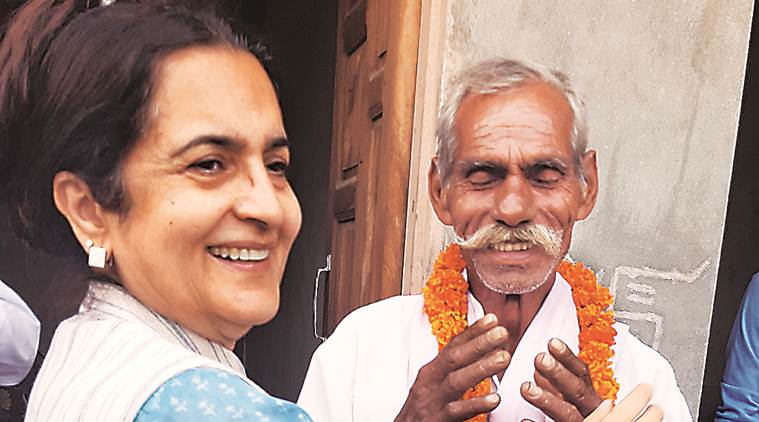 Instead of public meetings, Kiran Choudhry is going to the homes of the voters.
“This one is Shamsher’s wife and that one Ranbir’s mother….over there that is chairman’s wife…”
In Legha Hetwan, a village in Tosham Assembly constituency of Haryana, women are not called by their names. The women here, like at many other villages in Haryana, keep their face covered under “purdah (long veil)” making it virtually impossible for outsiders to identify them.
For these women, their relationship with male members of the family defines their identity.
The local MLA Kiran Choudhry understands this even as she urges them to lift their “purdah (veil)” and join her election campaign.
The two-term MLA, who is banking on personal connect to secure a third term in October 21 Harayana Assembly polls, seeks an introduction as she meets a group of women at a house in the village. A male family member obliges, but fails to correctly identify the women. “No, no…not her, this one here is Shasmher’s wife.”
Having spent years in the constituency, Kiran recognizes many of them. “Aren’t you the block samiti chairman’s wife?,” she asks as the head inside the veil nods in agreement. More than 65 per cent literacy rate among women in Haryana notwithstanding, the purdah system is still deep rooted in this part of the state situated on Rajasthan border. Kiran terms her father-in-law and former chief minister Bansi Lal a visionary who had strongly favoured gender equality.
“When my husband Surender Singh died 14 years back, Chaudhary Bansi Lal saw to it that Shruti Choudhry carried on his legacy,” says Kiran, adding that since then, whenever they visit the villages, the locals offer pagri to her and her daughter.
Shruti Choudhry was elected to parliament from Bhiwani-Mahendragarh constituency in 2009. In the patriarchal set up of society here, the pagri is a symbol of men’s pride.
The Bansi Lal family still enjoys respect in the area as elders recall how he provided irrigation water to southern Haryana. But the poll battle is no cakewalk for Kiran. Shruti could secure just 49,125 votes from Tosham in this year’s summer Lok Sabha polls against the winner BJP’s Dharambir Singh who had amassed 83,668 votes from here. This time BJP has fielded Shashi Ranjan Parmar, a former INLD MLA from Mundal Khurd, from Tosham. Chief Minister Manohar Lal Khattar had recently address a rally in his support.
Kiran has now changed her political strategy this time. Instead of public meetings, she is going to the homes of the voters. “Our family has 70 votes. We have been associated with you since the days of Choudhry Bansi Lal,” says Dariya Singh, who is from Chamar community and hosted a tea party for Kiran at Khariyawas village.
As the family presents their wish list including government job for a member, Kiran says, “Let the chair of chief minister come to us, I will try to fulfill your demand”.
Meanwhile, Ramesh Rathee, a Jat, complains that she did not recognize him when he had gone to meet her at the Kothi – the ancestral house of Bansi Lal at Bhiwani. “I might not have recognised you, so you should have told me,” she replies. At a locality of Kumhar community, the women tell her how they are forced to consume polluted water.
As she is about to leave the village, Ranjeet Sheoran, 73, comes to her car and urges her to visit Raja Rathee at his home. “He is not with us in this election. But I promised him to bring you to his home.” At his home, Raja Rathee lists his grievances, “Water line was not laid in my street. Government job was not given to anyone from my family.”
“You should have informed me. How would I know which one is Raja Rathee’s street?,” she replies.
Her plain speak can make people uncomfortable but her supporters say that she is at least “straight forward”. One Satbir Indora, a schedule caste member, appreciates her for not accepting the “mala” (garlands) of notes like Bansi Lal.
At the outskirts of the village, a group of volunteers greets her. “They have come from Loharu to urge their relatives to support me,” says Kiran. Some children gather around her car. She gives them toffees. Meanwhile, a loudspeaker continues to belt out a folk song penned during the days of Bansi Lal.
Kiran’s supporters allege that irrigation water did not reach her constituency during the BJP government. A farmer Dalbir Singh says, “Instead of water, they (BJP) keep telling us about Article 370. Here we are struggling for livelihood. Do you expect that we will go to Kashmir to buy plots,” he asks.
However, a YouTuber from the village, Mandeep Yadav, says, “We will vote for the BJP because of Prime Minister Narendra Modi who conducted the surgical strike in Pakistan. Also, jobs were given on merit in Haryana during BJP rule.”
A local BJP leader Jaipal Panwar claims that caste equation will play an important role in the election here. BJP’s Shashi Ranjan Panwar belongs to Rajput community while Kiran Choudhry is a Jat. Rajputs and Jats have almost equal presence in the constituency that also has a considerable presence of Brahmins and Yadavs. “Earlier, you needed 50 people to get a work done at the police station. But now there is no need of “Chaudharies” for such works in the BJP rule,” says Surender Tanwar, another BJP supporter.