3 min read
© The Indian Express Pvt Ltd



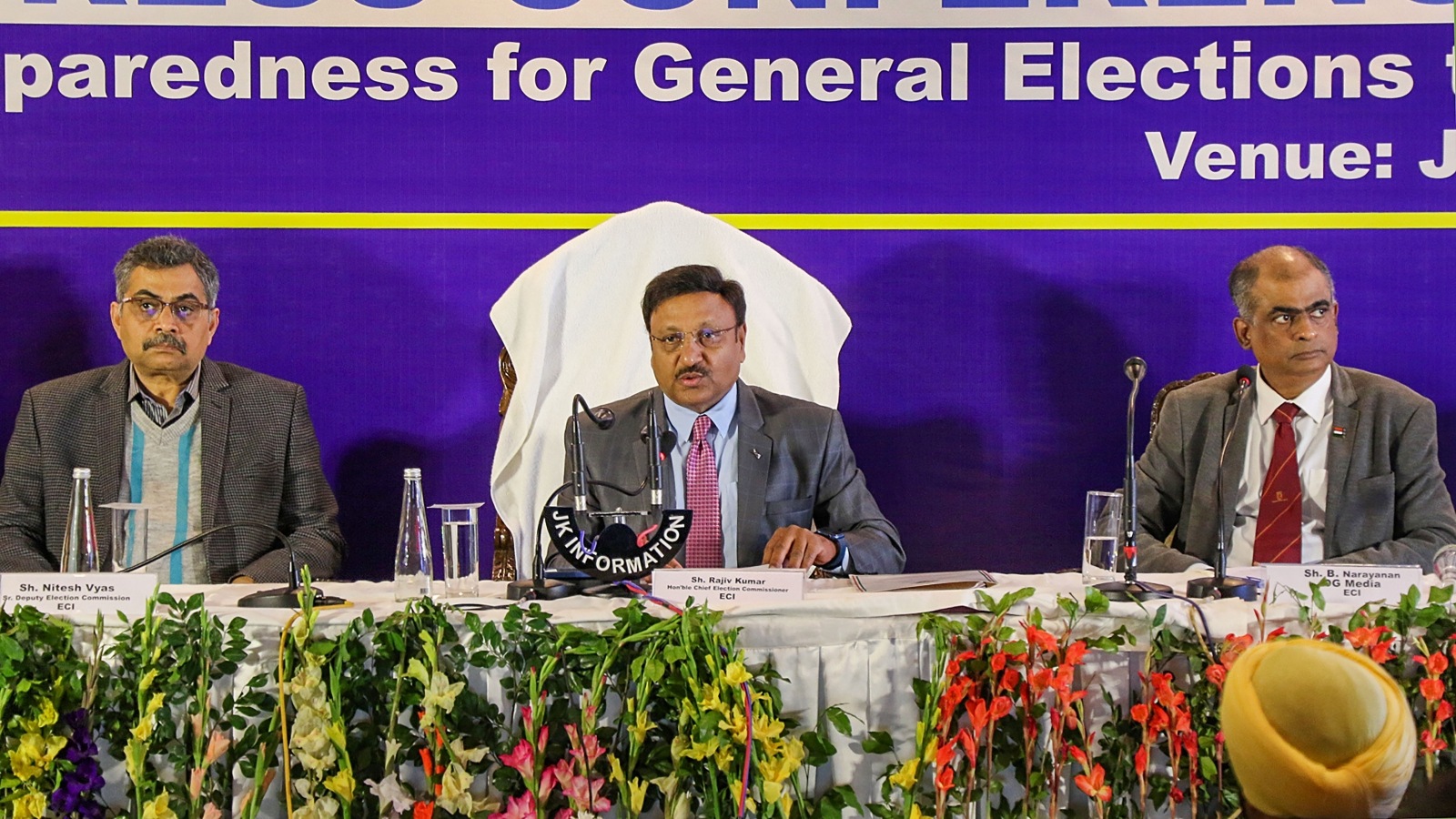 Chief Election Commissioner Rajiv Kumar addresses a press conference on poll preparedness for the upcoming Lok Sabha election, in Jammu, Wednesday, March 13, 2024. (PTI Photo)
The Election Commission will “in time” make public details of electoral bonds redeemed by all political parties, Chief Election Commissioner Rajiv Kumar said in Jammu on Wednesday.
“The Hon’ble Supreme Court had directed them (State Bank of India) to submit all the details by March 12,” the chief election commissioner told reporters. “They have given it to us yesterday, in time. After I go back (to Delhi), I will look at the data and would definitely disclose it in time”.
“It has been our stand in the Supreme Court that the Election Commission is for transparency. Anything we do in the commission and anything our district magistrates do in the line of elections is based on two things—disclosure, disclosure and disclosure,” he said, adding that the “voter has every right to know as to what we are doing”.
The Supreme Court last month struck down the electoral bond scheme, which allowed anonymous funding to political parties, and ordered SBI to immediately stop issuing electoral bonds. It asked the SBI to supply all details of the electoral bonds to the Election Commission by March 12, with a direction to the latter to make these public by March 15.
The Supreme Court later rejected a plea filed by the public sector bank seeking more time for submitting the details to the Election Commission.
The chief election commissioner said that political parties in a meeting with him on Tuesday asked about the delay in holding Assembly elections in Jammu and Kashmir, which they said was forcing them to approach courts for getting a September deadline.
The chief election commissioner said the Assembly elections would be held at the earliest. “A final decision on holding them simultaneously with that of parliamentary elections or one after another will be taken following security review after taking the feedback of political parties, district magistrates, government and officials of the para military forces,” he said.
Jammu and Kashmir has been under central rule since November 2018, when then Governor Satya Pal Malik dissolved the Assembly citing reports about the possibility of horse trading during government formation.
Pointing out that political parties in Srinagar too had raised the issue of the delay in the Assembly elections, he said the J&K Reorganisation Act (which bifurcated the erstwhile state into two Union Territories) came in 2019. At that time, the Assembly had 107 seats, including 24 reserved for people living in areas of Pakistan-occupied Kashmir and seven for Scheduled Castes.
Thereafter came the delimitation commission and its report raising the total number of Assembly seats from 107 to 114 was accepted by the government in 2022. Apart from 24 seats for PoK people and seven for SCs, the delimitation report included nine seats reserved for Scheduled Tribes, two for migrants including one of them to be a woman, besides one seat for people displaced from PoK.
There was dissonance between the J&K Reorganisation Act and the Delimitation Commission report.