8 min read
Stay updated with the latest - Click here to follow us on Instagram

Journalism of Courage



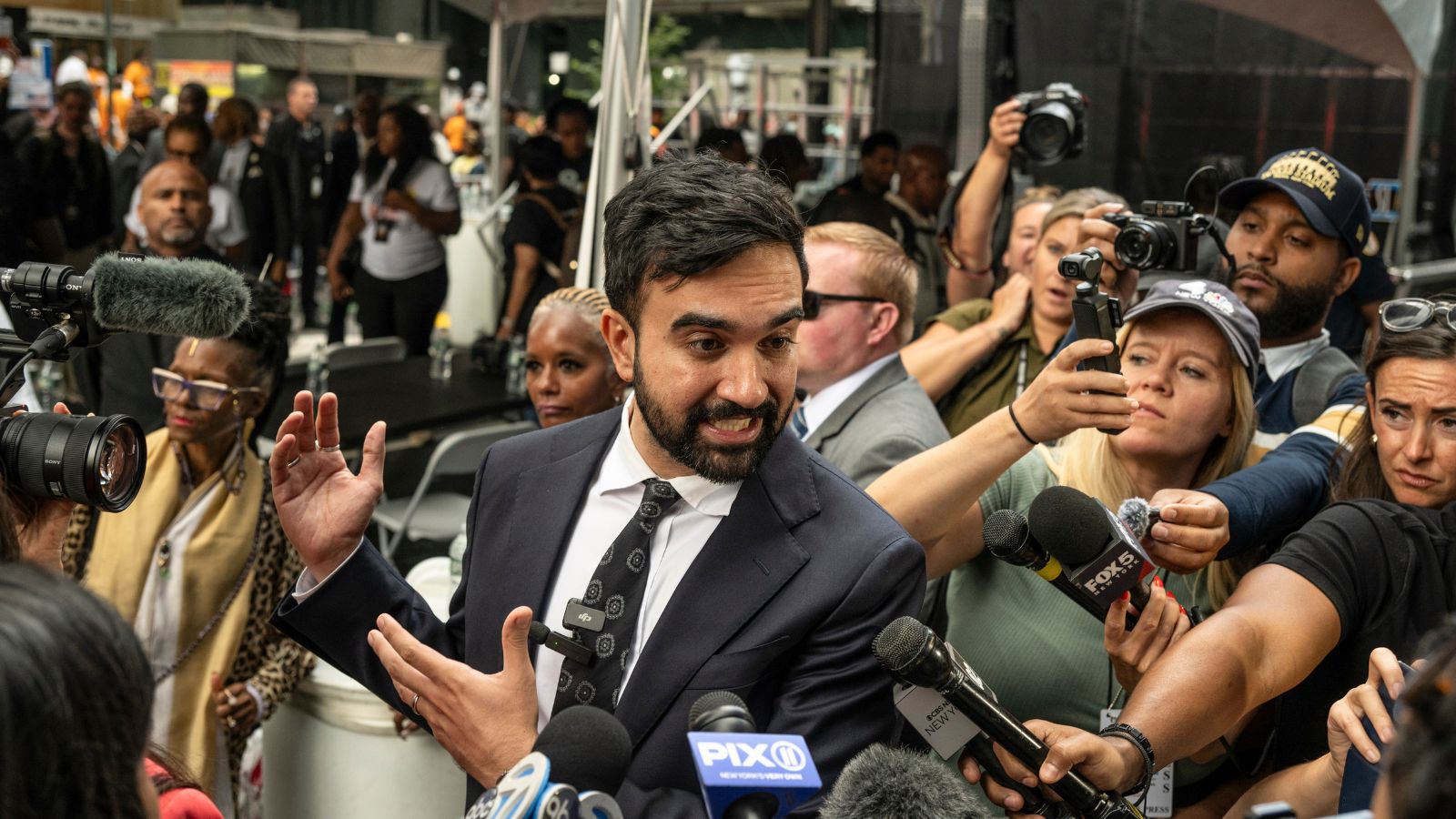 Zohran Mamdani speaks alongside Rev. Al Sharpton at a rally against Trump in New York (NYT)
Written by Eliza Shapiro
In the roughly five years since Zohran Mamdani first started campaigning for public office, he has argued that prostitution should be decriminalized. He has called to defund the police. He has said that billionaires should not exist, and that the admissions test for New York City’s elite public high schools should be abolished.
But before he launched his long-shot bid to become the Democratic nominee for mayor last year, he abandoned some of his most provocative views. And during the course of the campaign, he has sought to downplay others.
In the past several days, as Mamdani has faced mounting pressure from some of his rivals in the four-way general election, he has also tried to distance himself from the platform of the national Democratic Socialists of America, of which he is a member.
His changed positions — and shifting political strategy — come as Mamdani, 33, seeks to persuade New Yorkers that, despite his relative inexperience, he is ready to lead the nation’s largest city.
His supporters and those who have met with him behind closed doors describe him as open-minded and eager to find common ground. Some in the business community say they have been pleasantly surprised by his pragmatism.
But his opponents have accused him of political opportunism, and suggested he cannot be trusted to handle public safety and New York City’s roughly $100 billion budget.
Former Gov. Andrew Cuomo, who is running as an independent after losing to Mamdani in the primary, said last week that Mamdani’s views were “dangerous, literally dangerous.” Mayor Eric Adams, also running as an independent after sitting out the Democratic primary, has said that voters should be wary of Mamdani’s “extremism.”
Many political candidates try to finesse their message as they move from primary campaigns to general elections, and Mamdani is hardly the first elected official to switch positions on key issues.
Cuomo, for example, supported congestion pricing as governor, then said last year that it should not go into effect, then said earlier this year that he again backed the toll. And Adams’ administration pushed for years to build low-income senior housing on the site of the Elizabeth Street Garden in Manhattan, then the mayor abruptly called it off.
Still, Mamdani’s changes are particularly striking, given how emphatically he had argued for some of those controversial views.
In 2020, for example, during the height of the protests against the murder of George Floyd by a police officer in Minneapolis, Mamdani wrote on social media that the New York Police Department was “racist, anti-queer & a major threat to public safety,” and declared: “Defund it. Dismantle it. End the cycle of violence.”
Mamdani has reiterated that he dropped his support for defunding the police before running for mayor, and recently said that view is “out of step” with his current beliefs on policing. If elected, Mamdani has vowed to create a Department of Community Safety that would dispatch mental health teams to respond to 911 calls.
Mamdani said recently that he will pick a police commissioner with policing experience, and that he would maintain the department’s current head count. He also said he is considering keeping on the current leader, Jessica Tisch, who supports tougher criminal justice laws and is unpopular with some progressives.
“Since winning the primary, he has sought to reposition himself as more deliberate and strategic, and obviously he’s signaling a more measured approach to government, which he should,” said Rodneyse Bichotte Hermelyn, an Assembly member who leads the Brooklyn Democratic Party. She endorsed Mamdani in the wake of his primary win after initially backing Cuomo.
So far, there are no obvious signs of revolt from the left. If Mamdani’s early supporters are uncomfortable with his new approach, they appear focused chiefly on making sure he does not back off his main campaign message about easing the city’s high cost of living.
“Keep in mind that your initial commitment and the people who elected you are working-class communities,” said Jagpreet Singh, the political director of DRUM Beats, a group that organizes South Asian voters. For now, Singh added, “we haven’t seen any wavering from that commitment.”
While Mamdani garnered significant support from working-class and middle-class Muslim and South Asian voters in the Bronx and Queens, he also won decisively in gentrified neighborhoods across the city.
The Mamdani campaign says it has no interest in getting bogged down on hot-button issues that have little to do with its core policy slate of implementing free universal child care, making buses free and freezing rent for nearly 1 million stabilized apartments.
His aides say that Mamdani is speaking with policy experts and former city officials who could help him implement his agenda, and that any change in approach is the necessary work of assembling a broader coalition that can help him win and then, hopefully, help him govern. And they note that there is a real difference between being an activist legislator and campaigning to be the city’s chief executive.
Mamdani’s appeal in the primary partly stemmed from his authenticity and candor, as he thoughtfully articulated his positions, even ones that challenged Democratic orthodoxy. Now, as the general election approaches, his answers can range from straightforward disavowals of past statements to more vague responses.
Despite his support for decriminalizing prostitution in his early days as a state Assembly member, Mamdani would not say whether he still supports the idea when the Times asked him last week. He has instead said that any issue he has not campaigned on will not be part of his agenda as mayor. And he has said that he supported former Mayor Bill de Blasio’s position of focusing on arresting sex traffickers, and offering support services to sex workers.
While he is a frequent critic of the Israeli government and wrote on social media last month that he believes Israel is carrying out a “genocide” in Gaza, Mamdani privately told a group of business leaders that he would discourage the use of the phrase “globalize the intifada” in relation to Palestinian rights, though he himself has not used the phrase.
And while he has expressed his own skepticism about casinos opening in New York City, Mamdani recently said that he would not fight their development as mayor. The Hotel and Gaming Trades Council, which backed Mamdani after his primary win, has strongly pushed for casinos.
Mamdani also previously supported getting rid of the admissions exam for specialized high schools, one of which he attended, but he now says that he would keep the test in place, and instead focus on combating racial segregation throughout the rest of the city’s public school system.
Although the elite schools enroll tiny numbers of Black and Latino students, many of Mamdani’s supporters who are South Asian, as he is, oppose changes to the admissions process, and see the schools as an engine out of poverty for their children.
Some of the business leaders most wary of Mamdani during the Democratic primary have welcomed what they perceive as the arrival of a more cautious, buttoned-up candidate. With Mamdani maintaining a comfortable lead in the polls, some of the city’s moneyed class are now especially eager to meet him, and to try to influence his thinking.
Dora Pekec, a spokesperson for Mamdani’s campaign, said that he was willing to meet with anyone in the business community who would help implement his agenda, but that he was not seeking endorsements or donations from business leaders. “No matter the room or the audience, Zohran leads with the exact same values and a clear agenda: making New York City more affordable,” she said.
This article originally appeared in The New York Times.
Stay updated with the latest - Click here to follow us on Instagram