11 min read
Stay updated with the latest - Click here to follow us on Instagram

Journalism of Courage



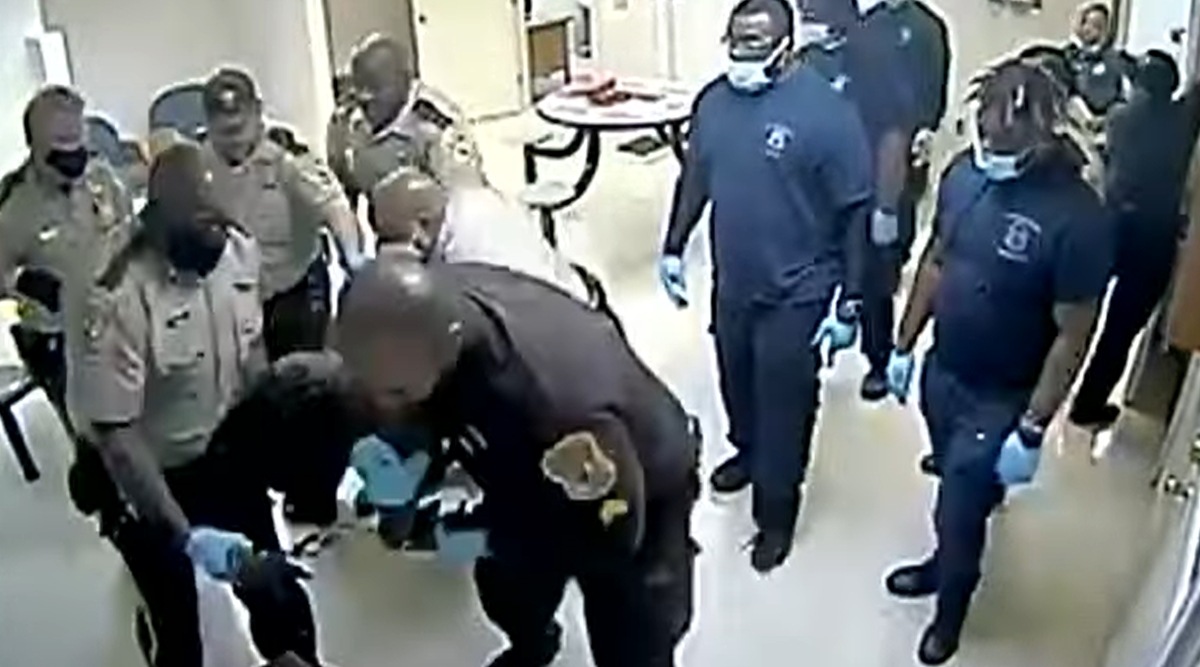 Surveillance video from a state psychiatric hospital in Virginia shows a group of sheriff’s deputies and medical staff members piling on a handcuffed man, Irvo Otieno, and pinning him on the floor for around 11 minutes, until his death on March 6. (Screengrab from the video)
Written by Campbell Robertson and Christine Hauser
Surveillance video from a state psychiatric hospital in Virginia shows a group of sheriff’s deputies and medical staff members piling on a handcuffed man, Irvo Otieno, and pinning him on the floor for around 11 minutes, until his death on March 6.
The video shows at least seven deputies from the Henrico County Sheriff’s Office entering a room at Central State Hospital in Dinwiddie County and dragging Otieno, who is in handcuffs and leg shackles. The deputies set him up against a small seat and then, when he appears to make a movement, swarm around him and force him to the floor, where they pinion him until his death, the video shows.
The Dinwiddie County prosecutor, Ann Cabell Baskervill, has charged seven sheriff’s deputies and three employees of the hospital with second-degree murder. On Tuesday afternoon, a grand jury in Dinwiddie County formally indicted the 10, confirming the prosecutor’s charges.
Otieno, who struggled with mental health problems and had been taken from his home three days earlier, was moved to Central State Hospital by sheriff’s deputies from a county jail earlier March 6. In the video, people who seem to be part of the medical staff are seen walking in and out of the room as the deputies pile on Otieno, 28, pinning his legs and arms and holding his body down with their knees. The video was first obtained by The Washington Post and then by The New York Times.
Otieno’s family said that while he was in the jail, he was deprived of medication that he needed for his mental illness. They disputed initial police reports that he was violent at the first hospital where he was taken.
“All the systems failed my son,” his mother, Caroline Ouko, said in an interview Monday, listing the institutions whose job it was to guard his welfare over those three days, including the police, the hospitals and the judiciary system. “They set a trap for him.”
When the episode started three days earlier, Ouko said, Otieno appeared to be experiencing mental distress. He had walked to a neighbour’s lawn and picked up some solar-powered lights laid out on the property, and was banging on the neighbour’s front door before his mother retrieved him.
A neighbour called the Henrico Police Department to report someone breaking and entering. Officers who responded placed Otieno under an emergency custody order and took him to a hospital “for further evaluation,” the police said in a statement.
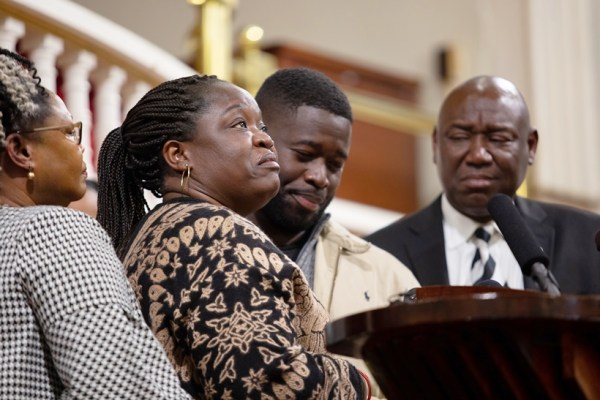 Caroline Ouko, the mother of Irvo Otieno, speaks during a press conference at the First Baptist Church of South Richmond in Richmond, Virginia, on March 21, 2023. (Parker Michels-Boyce/The New York Times)
At that hospital, police said, Otieno was “physically assaultive” toward officers, who arrested him, took him to the Henrico County Jail and charged him with three counts of assault on a law enforcement officer and one count each of disorderly conduct in a hospital and vandalism.
Otieno was kept in the jail over the weekend, and then was taken on March 6 to the state hospital. In court on March 15, Baskervill said Otieno had suffocated from the weight of the deputies smothering him at the state hospital, and that he “was not agitated and combative.”
The seven deputies from the Henrico County Sheriff’s Office have been placed on administrative leave. Sheriff Alisa Gregory said last week that the events of March 6 “represent a tragedy because Mr. Otieno’s life was lost.”
That Otieno died as he did — three days after being taken from his home in an ambulance — was almost beyond his mother’s comprehension. His death was a devastating ending to a journey that began in 1998, when Ouko arrived with her children in the suburbs of Richmond, Virginia, having left her home in Kenya, “compelled by the American dream.” Irvo, her younger son — known as Ivor, or simply Vo — was 4, barely old enough to remember living anywhere else.
We need JUSTICE for the unnecessary death of #IrvoOtieno! His mother Caroline Ouko — who is now a part of a tragic fraternity that NO parent wants to join — should not be having to grieve the loss of her kind and courageous son. Mental illness should not be a death sentence! pic.twitter.com/FdlSO1Shft
— Ben Crump (@AttorneyCrump) March 16, 2023
When the family was newly settled in the Richmond suburbs, Otieno and his older brother, Leon Ochieng, found a new community at the local YMCA. They became regulars on the basketball court and formed a team with a circle of new friends, some of whom came from similar backgrounds.
Esayas Mehretab, 29, who was born in Ethiopia and came to the United States when he was 5, said Otieno was universally liked, as sharp on the court as he was quietly good-natured off it. “Such a genuine, gentle kid,” Mehretab said, “never got into a fight, never argued.” Otieno eventually began playing football as well, doing well enough that he went on to play at a college in California, with dreams of one day turning professional.
“But unfortunately,” his mother said Monday, “he had the breakdown.”
Late one night in November 2014, according to local press reports, police officers in Merced, California, arrested Otieno after he had run naked through a shopping mall, knocking items off shelves. They used a stun gun on him in the parking lot and assumed he was on drugs. But Ouko said the police soon understood what was really happening and took him to a hospital.
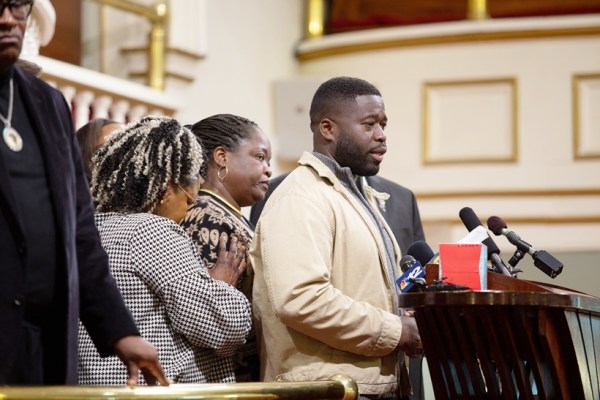 Leon Ochieng, the brother of Irvo Otieno, speaks during a press conference at the First Baptist Church of South Richmond in Richmond, Va., on Tuesday, March 21, 2023. (Parker Michels-Boyce/The New York Times)
“Here he was, he’d had a breakdown so far away from home,” Ouko said in an interview, her voice trembling. “They took good care of him eventually.”
Ochieng flew to California and helped to bring his younger brother home, where Ouko quickly found him a doctor and got him on medication. She declined in an interview to say what the specific diagnosis was.
She said her son did his best to adjust. Several years later, he met Allan-Charles Chipman at a small Bible study group, comprised mostly of Black members of a predominantly white church. They met in private homes to read Scripture and talk. Otieno joined in those conversations.
Otieno also had aspirations as a hip-hop artist, rapping under the name Young Vo about issues in his own life and in the country at large. In Chipman’s home studio, Otieno recorded one of his own tracks: “Give it time, Young Vo, you’ll be up and coming,” he raps. “Family first, responsibility coming / I ain’t running.”
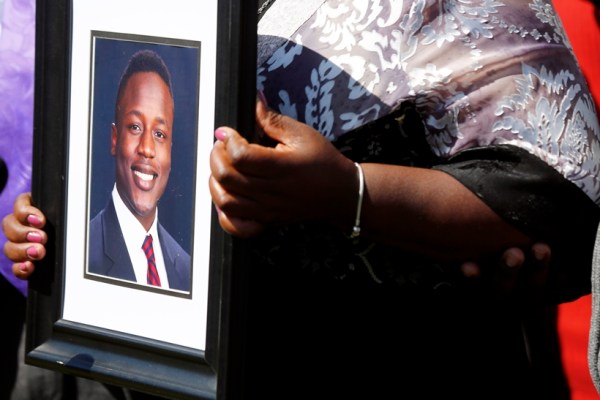 Caroline Ouko, mother of Irvo Otieno, holds a portrait of her son at the Dinwiddie Courthouse in Dinwiddie, Virginia, on March 16, 2023. (AP)
He and Chipman had long discussions about their identities as Black men growing up in America.
In a photo posted on his Facebook page, Otieno posed with his fist raised in front of the toppled Jefferson Davis Memorial in Richmond, which had been tagged with a rainbow of protest graffiti during the Black Lives Matter demonstrations of 2020.
On Jan. 7, 2021, the day after the US Capitol was raided by an angry mob of Trump supporters, Otieno wrote on Facebook about “two justices in America, one for us and one for the white folks.”
Mehretab said that, like his own parents, his friend Ivor had gradually come to learn of his new country’s entrenched racial injustices, a lesson that was not clear from overseas. “One thing they have realised is, like, you won’t be trusted, they’ll take someone else’s word over your word here,” Mehretab said. “They understand the system itself is sort of against African Americans.”
“Why is it when Black people have mental health issues, they aren’t treated as medical issues? They’re treated as criminal issues,” @AttorneyCrump said in response to the death of Irvo Otieno in police custody. https://t.co/x2wbLMyl6O pic.twitter.com/Yif4Bz9s8x
— PBS NewsHour (@NewsHour) March 21, 2023
As the years went by, Otieno and his mother learned to live with his mental illness. There were long stretches of stability, Ouko said, when he was taking his medication and seeing his doctor. But there were flare-ups, too — times when Ouko would take him to a hospital, and Otieno would need to be restrained.
“He said to me, ‘Mama, why do they have to tie me to a bed?’ ” she remembered.
Sometimes these episodes happened when he was with her at home, in a quiet subdivision of single-family houses outside Richmond. The police would come, along with a medical team, she said; they would take him to the hospital, where he would be treated.
According to the Henrico County police, that is more or less what happened on the afternoon of March 2, when they responded to a call from a neighbour about a “suspicious situation,” only to be reassured by Otieno and his family that it was a mental health problem, not a criminal matter.
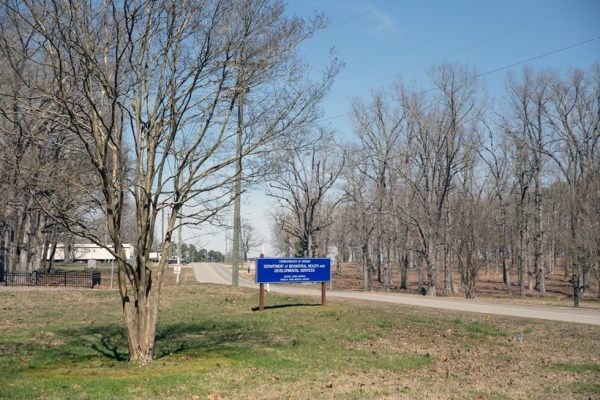 An entrance to the Central State Hospital, a state psychiatric hospital, in Petersburg, Virginia, on March 21, 2023. (Parker Michels-Boyce/The New York Times)
Ouko had noticed some changes in her son that week, including that he had been uncharacteristically arranging things in the house. On the morning of March 3, she called his doctor to ask that a team be sent to take him to the hospital again.
While she was on the phone with the doctor’s office, she saw her son walking into the neighbour’s yard, pulling up the light fixtures and banging on the door, perhaps mistaking the neighbour’s house for his own.
“All I say was, ‘Son, let’s come home,’” she recalled.
Not long after she got him home again, a dozen police officers were in their yard, responding to a neighbour’s report of someone breaking and entering. Some of the officers had drawn their stun guns, Ouko said.
“I blanketed myself on my son and held him as we walked out,” she said. “I raised my voice and said, ‘My son is going through mental distress.’”
The police handcuffed Otieno and tried to put him in the back of a squad car, Ouko said, but she insisted that he be taken to the hospital, not the police station. In about 45 minutes, an ambulance came.
Ouko said she spent the next three days going to the hospital, the county jail and a courtroom in an exasperating effort to find out where the authorities were keeping her son and to urge the police, doctors and a judge to understand his condition and get him his medication.
On March 7, she finally received definitive word of his whereabouts: He had been taken to Central State Hospital in Petersburg, about half an hour’s drive away, the day before. And now he was dead.
The family was shown the video last week. It was excruciating for Ouko, according to one of her lawyers, Benjamin Crump, who also represents the families of Tyre Nichols and George Floyd. Crump said there was also video taken inside the jail, showing five officers approaching Otieno, who is naked, and throwing him to the ground.
After watching the footage of her son’s death, Ouko spoke briefly to reporters.
“Ivor Otieno is my son,” she said, telling of how she brought him to the United States here as a young child. “Ivor is as American as apple pie.”
Stay updated with the latest - Click here to follow us on Instagram