4 min read
Stay updated with the latest - Click here to follow us on Instagram

Journalism of Courage



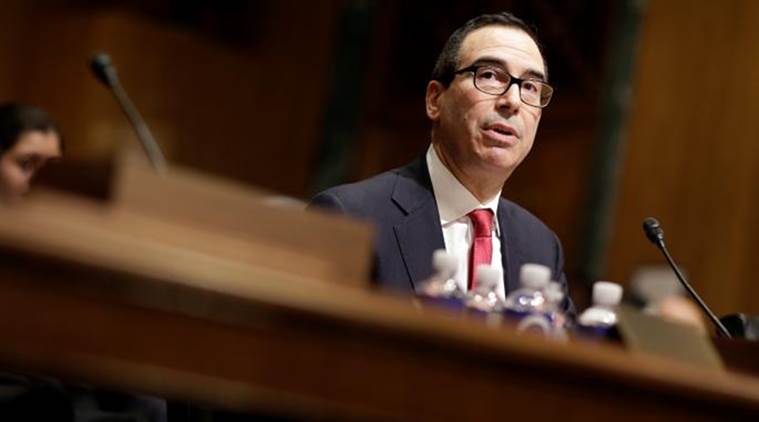 US Treasury Secretary Steven Mnuchin (Source: Reuters/File Photo)
The US has sought the help of the international community in particular multilateral financial institutions in targeting and dismantling financial networks of terrorist organisations. “Targeting and dismantling the financial networks of terrorist organisations is a top US priority, and improving anti-money laundering and counter terrorist financing (AML/CFT) systems is critical to this goal,” US Treasury Secretary Steven Mnuchin, said in his address to the IMF.
The United States, he said, welcomes the IMF’s important work providing technical assistance to member countries to strengthen their regulatory and supervisory frameworks with respect to anti-money laundering and countering the financing of terrorism.
“It is also imperative that the IMF be a leader in fighting corruption,” he said as the worlds finance ministers and governors of central banks gathered in the US Capital to attend the Spring Meeting of the IMF and the World Bank.
Noting that the global economy continues to exhibit large and persistent external imbalances, which contributes to the sentiment that the existing international monetary and trading system does not benefit all, Mnuchin said in this environment, the US calls upon the IMF to more robustly fulfill its surveillance mandate in pursuit of strong, sustainable, balanced, and inclusive global growth.
“This should include strong analysis of member exchange rates and external imbalances in both the External Sector Report and in Article IV surveillance. The IMF should also identify specific policy adjustments at the country level to achieve substantially improved balance in the overall system,” he said.
The US looks to the IMF to highlight where surplus countries can more forcefully contribute to support symmetric adjustment in pursuit of a fairer global system. “Countries with large external surpluses and sound public finances have a particular responsibility for contributing to a more robust global economy by deploying fiscal policy aggressively to boost growth and help facilitate global rebalancing,” Mnuchin said.
“In our view, excessively large trade surpluses, like excessively large trade deficits, are not conducive to supporting a free and fair trading system,” he said. “Fair and transparent currency practices are also a critical part of ensuring that the benefits of trade are shared equitably. Countries should abide by their exchange rate commitments, including commitments to refrain from competitive devaluation, to not use monetary policies to target exchanges rates for competitive purposes and to consult closely on exchange rates,” Mnuchin said.
The US economy, he said, continues to expand at a steady pace and forecasts suggest stronger growth this year and next. Nevertheless, the US economy continues to face challenges, with growth last year languishing below pre-crisis levels amid weak business investment, Mnuchin said, adding that the economy has gone through periods of disappointing performance before, however, and a continuation of this weak growth is not pre-ordained.
“In response, the administration is undertaking an ambitious policy agenda that includes tax reform, deregulation and infrastructure investment to sustainably raise US economic output and employment,” he said.
“In tandem with our domestic reforms we will continue to promote an expansion of trade with those partners committed to market-based competition, while more rigorously defending ourselves against unfair trade practices,” the Finance Secretary said.
Outside the US, while the IMF and private analysts expect global growth to expand this year and next, there are questions about how sustainable and broad-based this growth will be, he added. Medium-term growth prospects remain muted due in part to the decline in total factor productivity, continued weak domestic demand, and banking-sector problems in some countries, he said.
Stay updated with the latest - Click here to follow us on Instagram