





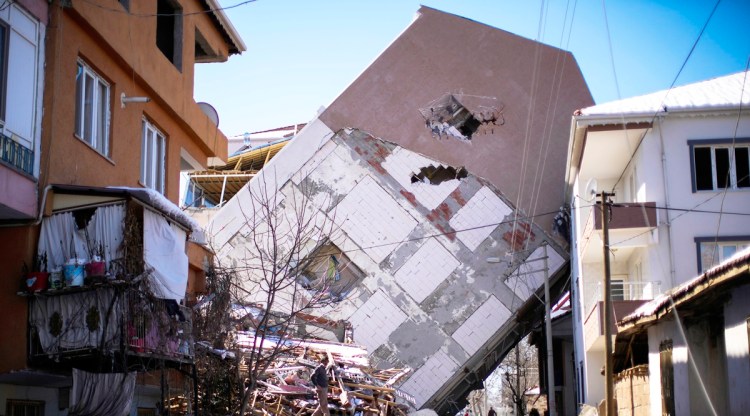
 A man walks near a building that leans on a neighbouring house in Golbasi, Turkey, Feb. 13, 2023. (AP)
Turkey, Syria Earthquake News Highlights: More than 40,000 people have been killed in the Turkey-Syria earthquake, but hope persisted as a 42-year-old woman was rescued from rubble in Turkey’s Kathramanmaras, some 222 hours after the quake.
Turkish President Tayyip Erdogan has acknowledged problems in the initial response to the 7.8 magnitude quake that struck early on Feb. 6 but has said the situation is now under control. “We are facing one of the greatest natural disasters not only in our country but also in the history of humanity,” Erdogan said in a televised speech in Ankara.

The search for survivors was about to end in the northwest of Syria, said the head of the White Helmets main rescue group, Raed al Saleh. Russia also said it was wrapping up its search and rescue work in Turkey and Syria and preparing to withdraw.
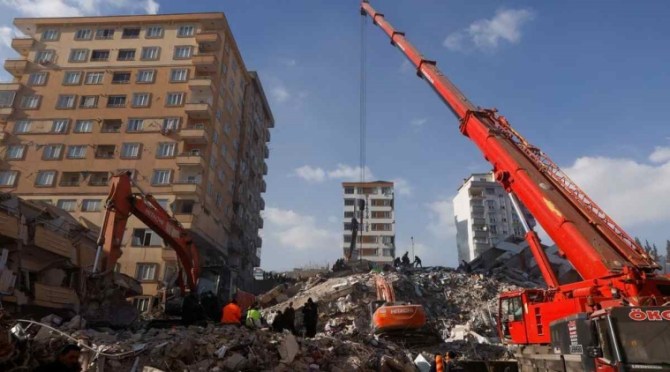 Cranes remove debris from demolished buildings following the deadly earthquake in Maras, Turkey, February 11, 2023. (Photo: REUTERS)
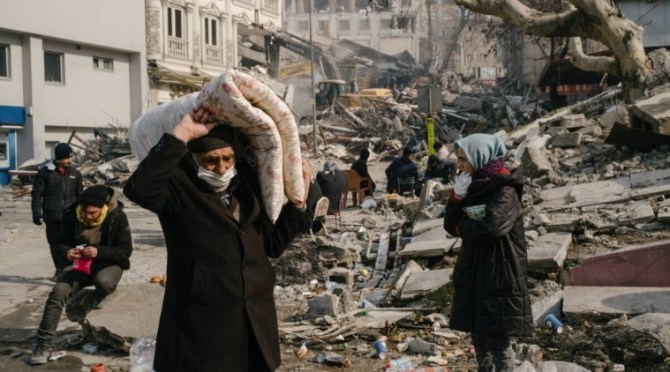 Residents by a collapsed building in Kahramanmaras, Turkey, near the quake’s epicenter. (Emin Ozmen/The New York Times)

Two women were pulled from the rubble in Turkey's southern city of Kahramanmaras, even as hopes to find survivors from last week's devastating earthquake dwindled and the focus switched to giving survivors some relief.
Rescuers could be seen applauding and embracing each other in a video posted to social media as an ambulance carried away a 74-year-old woman rescued after more than nine days trapped in rubble. Earlier in the day, a 46-year-old woman was rescued in the same city, close to the epicentre of the quake.
The combined death toll in Turkey and Syria has climbed over 41,000, and millions are in need over humanitarian aid, with many survivors having been left homeless in near-freezing winter temperatures.
More than a week after his home was wrecked in a deadly earthquake that hit southern Turkey, Mohammad Emin's body is still covered in dust and grime. Like countless other victims of a catastrophe that killed more than 41,000 in Turkey and Syria, he is still waiting for a wash - affected by a shortage of clean water that international health bodies say poses a risk to public health.
With much of the region's sanitation infrastructure damaged or rendered inoperable by last Monday's two 7.8- and 7.6-magnitude earthquakes, Turkish health authorities face a daunting task in trying to ensure that survivors, many homeless, now remain disease-free.
A doctor at the clinic, Akin Hacioglu, said between 15 and 30 medics operated the facility, the only one of its kind at the camp, which serves up to 10,000 people during the day. They are offering tetanus shots to residents who request them, and distributing hygiene kits with shampoo, deodorant, pads and wipes, Hacioglu said. (Reuters)
A 42-year-old woman was rescued from the rubble of a building in the southern Turkish city of Kathramanmaras on Wednesday, almost 222 hours after a devastating earthquake struck the region, Turkish media reported.
TV footage sowed rescue workers carrying the woman, named Melike Imamoglu, strapped onto a stretcher, to an ambulance. (Reuters)
Jordan's foreign minister Ayman Safadi will be heading to Syria and Turkey Wednesday in a "show of solidarity" after the quake that killed thousands of people in both countries, an official source said.
Jordan, which neighbours Syria, has sent large shipments of aid to both countries. (Reuters)
A teenage boy holds food rations that he found in the rubble of buildings, in the aftermath of a deadly earthquake in the rebel-held town of Harem, in Idlib governorate, Syria, February 14, 2023.
For years, northwestern Syria has been home to millions of people displaced by war, so many that neighbour no longer knew neighbour. And so when an earthquake struck last week and homes were reduced to rubble, many couldn’t say with certainty who had been accounted for and who was still missing.
Now, with the painstaking search for survivors and victims mostly over and the death toll in Syria alone rising above 3,000, residents of one town, al-Atarib, are scouring the rubble for personal possessions. They speak bitterly of feeling abandoned by the world.
For days, they said, in the absence of international aid, they were sometimes forced to dig through rubble by hand, as survivors begged for help. Yazam Mousa, 17, said he had been returning to the collapsed four-story apartment building he used to live in every day since he and his family ran out after the quake hit Monday. (Read more)
Turkish President Tayyip Erdogan vowed to press on with rescue and recovery efforts more than a week after a powerful quake ripped through his country and neighbouring Syria.
"We will continue our work until we remove the last citizen left under the collapsed buildings," Erdogan said late on Tuesday after a cabinet meeting held at the headquarters of the Disaster and Emergency Management Authority (AFAD).
"We will rebuild all the houses and workplaces, destroyed or made uninhabitable by the earthquake, and hand them over to the rightful owners," he added. (Reuters)
The World Health Organisation (WHO) said the deadly earthquakes in Turkey and Syria, were the worst natural disaster in the region in a hundred years.
"We are witnessing the worst natural disaster in the WHO European Region for a century. We are still learning about its magnitude. Its true cost is not known yet," WHO regional director for Europe, Hans Kluge said at a press conference. (Deutsche Welle)
Riza Atahan, from the southern Turkish province of Hatay, put his wife and daughter on a bus taking them to safety 300km (186 miles) away, then returned to his earthquake-damaged home to guard their belongings.
“I do not have a lot of expectation from this life but the lives of our children are important,” he said, as his family headed to a student dormitory – emergency accommodation arranged by the government. He hopes to spare them the chaos and hardship facing Hatay in the next months.
They join the more than 158,000 people who have evacuated the vast swathe of southern Turkey devastated by the earthquake, according to government figures. Even more fled in panic immediately after the earthquake, causing traffic chaos as they looked for passable roads. (Read more)
An 18-year-old man was pulled from the rubble of a building in southern Turkey, the third rescue on Tuesday and some 198 hours after a devastating earthquake as aid workers shifted focus to those across Turkey and Syria left homeless in the bitter cold.
Muhammed Cafer, whose rescue was reported by broadcaster CNN Turk, could be seen moving his fingers as he was carried away, after surviving the huge Feb. 6 earthquake and major aftershock hours later. (Read more)
The United Nations chief launched a USD 397 million appeal Tuesday to help nearly 5 million survivors of last week's devastating earthquake in rebel-held northwest Syria who have received very little assistance because of deep divisions exacerbated by the country's 12-year war.
Secretary-General Antonio Guterres announced the appeal a day after he welcomed an agreement between the UN and Syrian President Bashar Assad to open two new crossing points from Turkey for an initial period of three months.
The UN has only been allowed to deliver aid to the northwest Idlib area through a single crossing at Bab Al-Hawa -- at Syrian ally Russia's insistence. Since the quake, the UN says 84 trucks have gone through Bab Al-Hawa. (AP)
For about 200 hours, two Turkish brothers entombed under the rubble of a collapsed building in the earthquake-devastated city of Kahramanmaras held on, rationing bodybuilding supplements, drinking their own urine, swallowing gulps of air.
“Breathing was easy,” one brother, Abdulbaki Yeninar, 21, told the local Ihlas news agency. “We took protein powder.”
On Tuesday, rescue workers pried Yeninar and his brother, Muhammed Enes Yeninar, 17, from the cement and twisted metal, one of at least nine such improbable rescues over a week after a 7.8-magnitude earthquake levelled towns, killed tens of thousands of people and displaced many more in Turkey and Syria.
In the same city, teams dug a tunnel 16 feet long through tons of fallen walls, floors and piping to reach a woman, in a rescue that was broadcast on live TV. And to the south, a volunteer mining crew joined the efforts to save another, earning tribute from President Recep Tayyip Erdogan, who said they “will never fade away from our memories.” (Read more)
Turkish President Recep Tayyip Erdogan announced Tuesday that more than 35,000 people have died in Turkiye as a result of last week’s earthquake, making it the deadliest such disaster since the country’s founding 100 years ago.
While the death toll is almost certain to rise even further, many of the tens of thousands of survivors left homeless were still struggling to meet basic needs, like finding shelter from the bitter cold.
Confirmed deaths in Turkiye passed those recorded from the massive Erzincan earthquake in 1939 that killed around 33,000 people. (Read more)
Gunmen stormed a hospital in north Syria where a baby girl is receiving care after being born under the rubble of her family’s earthquake-shattered home, a hospital official said Tuesday, adding that the attackers beat the clinic's director.
The official denied reports on social media claiming that the Monday night attack was an attempt to kidnap the infant, named Aya — Arabic for “a sign from God.” Aya has been at the hospital since hours after the Feb. 6. earthquake that hit Turkey and Syria. Her mother, father and four siblings died in the disaster.Aya has been closely followed since her birth and people from around the world have been offering to help her. (AP)
Qatar plans to send 10,000 cabins and caravans from last year's World Cup to provide shelter for survivors of the Turkish earthquakes, officials said. The gas-rich Gulf nation says it had always planned to donate the mobile homes. They were needed to help house some of the 1.4 million fans who descended on the small country during soccer's biggest tournament. An initial batch of 350 structures was shipped out on Sunday, the Qatar Fund for Development said. (AP)
Riza Atahan, from the southern Turkish province of Hatay, put his wife and daughter on a bus taking them to safety 300km (186 miles) away, then returned to his earthquake-damaged home to guard their belongings.
"I do not have a lot of expectation from this life but the lives of our children are important," he said, as his family headed to a student dormitory - emergency accommodation arranged by the government. He hopes to spare them the chaos and hardship facing Hatay in the next months.
They join the more than 158,000 people who have evacuated the vast swathe of southern Turkey devastated by the earthquake, according to government figures. Even more fled in panic immediately after the earthquake, causing traffic chaos as they looked for passable roads. (Reuters)
Israeli airlines will resume direct flights to Turkey as a mark of a continued improvement in bilateral relations, Israeli Foreign Minister Eli Cohen said on Tuesday.
The first such flight will depart on Thursday, Cohen told reporters during what he described as solidarity visit to Turkey, which credited Israel for sending relief delegations after last week's earthquake. (Reuters)
According to a news report by Reuters, search operations for survivors beneath the rubble are about to end in the opposition-held north west Syria, eight days after the devastating earthquake, the White Helmets main rescue group said on Tuesday.
"It's about to come to a close. The indications we have are that there are not any (survivors) but we are trying to do our final checks and on all sites," said Raed al Saleh, the head of the White Helmets group. (Reuters)
A Saudi aid plane landed at a Syrian airport on Tuesday in a first such shipment from the kingdom that has backed the armed opposition to Assad during the country's 11-year civil war, according to a report by news agency Reuters.
Reuters quoted Saudi-owned Al-Arabiya which reported that the plane carrying 35 tons of food and medical aid and shelter arrived at Aleppo International airport.
It said the Saudi humanitarian operation to help Syrians affected by last week's deadly earthquake was being carried out on the orders of Saudi Arabia's King Salman bin Abdulaziz and Crown Prince Mohammed bin Salman.
Before Tuesday, Saudi Arabia had sent aid only to the country's opposition-held northwest, according to Saudi state-owned Al-Hadath. (Reuters)
Turkish President Tayyip Erdogan Tuesday convened cabinet of ministers to discuss and evaluate steps taken at the earthquake-hit areas in the country, news agency Reuters reported.
The quake has claimed more than 37,000 lives in Turkey and in neighbouring Syria.
The head of the Syrian opposition-run main rescue group Tuesday lambasted the U.N.'s decision that provided Syrian President Bashar al-Assad a say in sanctioning their aid deliveries through two new border crossings from Turkey. The group said that the move gave the President "free political gain," according to a report by news agency Reuters.
U.N. Secretary-General Antonio Guterres on Monday had said that Assad has agreed to allow United Nations aid deliveries to opposition-held northwest Syria.
"This is shocking and we are at loss at how the U.N. is behaving," Raed al Saleh, head of the White Helmets group, told Reuters.
According to news agency Reuters, more than 300 Russian servicemen and 60 units of special military equipment have been helping Syria in its response to a deadly earthquake that struck more than a week ago, Russia's defence ministry said on Tuesday.
"Servicemen of the Russian group of forces continue to carry out activities to clear rubble and eliminate the consequences of earthquakes," the defence ministry said in a statement shared over the Telegram messaging app, referring to Russian forces stationed in Syria. "More than 300 servicemen and 60 units of military and special equipment have been involved in the work," Reuters reported.
Food packages and disinfectants as well as other essentials have also delivered to humanitarian aid points in the northwestern city of Aleppo, the ministry added. A day earlier, the Kremlin had said that it was in contact with Syrian authorities over providing relief to areas affected.
Russia has been a dominant military force in Syria since 2015. Backing Syrian president, it further asserted its presence after the United States pulled out its forces in 2019. (Reuters)
The desperate search for earthquake survivors in Turkey and Syria entered its final hours Monday as rescuers using sniffer dogs and thermal cameras surveyed pulverized apartment blocks for any sign of life a week after the disaster.
Rescuers in Turkey have managed to pull a handful of people alive from collapsed buildings in the past few days. A 13-year-old boy was pulled out alive after he spent 182 hours under the rubble of a collapsed building in Turkey’s southern Hatay province.
In the shattered Syrian city of Aleppo, Griffiths had said that the rescue phase was “coming to a close”, with focus shifting to shelter, food and schooling. Stories of such rescues have flooded the airwaves in recent days. But tens of thousands of dead have been found during the same period, and experts say the window for rescues has nearly closed, given the length of time that has passed, temperatures that have fallen to minus 6 degrees Celsius (21 degrees Fahrenheit) and the severity of the building collapses.
The 7.8 magnitude earthquake and its aftershocks struck southeastern Turkey and northern Syria on Feb. 6. Read more here.
Syrian President Bashar al-Assad Monday agreed to allow U.N. aid deliveries to opposition-held northwest Syria through two new border crossings from Turkey for three months, U.N. Secretary-General Antonio Guterres said, according to a report by news agency Reuters.
Assad agreed to open the crossings of Bab Al-Salam and Al Ra’ee, Guterres shared in a statement after UN aid chief Martin Griffiths met with the Syrian president in Damascus on Monday.
“Opening these crossing points – along with facilitating humanitarian access, accelerating visa approvals and easing travel between hubs – will allow more aid to go in, faster,” he added.
Follow this space for the latest updates from earthquake-hit Turkey and Syria.