Stay updated with the latest - Click here to follow us on Instagram

Journalism of Courage
 7 min read


BY: TARUN DAS
 The dramatic change of government in India makes it possible to boost US and Indian approaches to the economic relationship to derive new benefits for both sides.
Chinese President Xi Jinping has left after an unprecedented visit, especially considering the relationship-building programme in Ahmedabad personally coordinated by Prime Minister Narendra Modi. Prior to this, the prime minister had an outstanding trip to Japan, engaging with his counterpart Shinzo Abe. Next on the agenda is the United States, and clearly, the bar has been set high by these two major international interactions. The US visit can, and must, surpass Japan and China.
Atal Bihari Vajpayee spoke of India and the US being “natural allies”. This has not happened. It is also unlikely to happen in the near future because of a variety of differences between the two countries. But Modi’s visit this month can be path-breaking, with a focus on relationship- and trust-building as well as renewing confidence in furthering economic relations. Achieving these two objectives will lay a new foundation for the future.
India and the US are collaborating on multiple fronts but the divide that separates them is also significant. US policy towards South Asia, its benign attitude to cross-border terrorism against India, its somewhat lukewarm cooperation on intelligence-sharing, its policy of intervention in the affairs of other countries, its pressures on developing economies on climate issues, its dominance of three apex multilateral financial institutions, its surveillance policy — these are just a few of the issues that separate India and the US. Sadly, there are many more.
And yet, there is much that India and the US can do together in the fields of energy (clean and otherwise), education, health, technology, innovation, cyber security, space and entrepreneurship, to mention only a few areas of huge potential. And, the near three million NRIs in the US are a binding, linking army of quality.
Some of this is happening, partly with government support; a lot of it freely between the private sectors, which is a unique dimension of Indo-US relations. With no other country in the world do India and Indian industry, and the Indian people, have such massive networks of partnership.
If the potential is to be realised, mutual trust has to be built. But how? Can lecturing and talking down be avoided? Can there be understanding of the leading and managing of 1.2 billion people? Can respect be felt and shown? Can the US tune into the great new priorities to change India, such as hygiene and the girl child (or leave it to Bill Gates?) and can there be an appreciation of the end to tax terrorism and easier business processes? Can there be an understanding that India has to resolve its challenges the Indian way?
If there is an acceptance of two-way traffic and that India is not an “ally” (that is, subsidiary!) but a “partner” with its own culture and civilisation, then, surely, trust and respect can flow from the prime minister’s visit. But these steps have to be taken one at a time, even though much has happened over the last 14 years, since Bill Clinton and Vajpayee exchanged visits in 2000.
Sadly, there is sometimes a perception that sections of the US government are more negative towards India than its private sector, many of whom are extremely successful in India. This necessarily leads to a reciprocal reaction from Indian government officials. Economic relations underpin the India-US relationship, with trade at approximately $100 billion at present, with $500 billion a clear medium-term potential.
But trade disputes and differences seem to have dominated recently, rather than the big vision. The insistence on India opening its market to imports, especially in the food and agricultural sector, is a non-starter as long as millions of poor Indian farmers dot the landscape. The focus on the sale of defence equipment, instead of going full steam ahead with co-development and co-production in India, is another challenge. But the opportunities can transform business between the two countries.
Too often, however, in recent years, both governments have dealt with economic issues in a transactional fashion. Without a shared commitment to the larger goals of the US-India partnership, the opportunities for strengthening economic ties have been blocked by narrow interests, bureaucratic obstacles and domestic compulsions.
The dramatic change of government in India makes it possible to boost US and Indian approaches to the economic relationship to derive new benefits for both sides. For India, more open trade and investment policies are critical to renewing growth, developing and accessing new technologies, creating jobs, enabling citizens to achieve better lives for themselves and their families, and increasing India’s international competitiveness and national strength. For the US, a stronger India will, by itself, be critical to a stable and secure Asia and a valued partner in dealing with regional and global challenges.
Both countries are also trigger-happy about finding fault with each other in public, rather than working patiently and quietly to find solutions. Fortunately, the last few months have been better in that respect. If there is a trust deficit in India with China, there is also a trust deficit with the US, of a different kind and related to different issues.
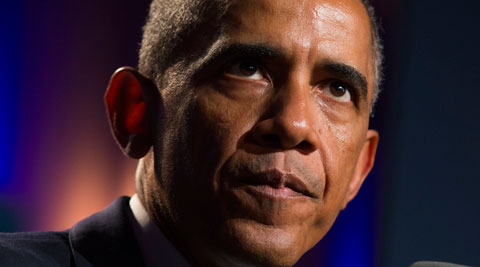
As Modi has tried to address the issues with China, to build a new partnership, US President Barack Obama — the host for the Modi visit — will need to shoulder the principal responsibility to resolve the trust deficit between India and the US. His words, actions, body language will be under far greater scrutiny than those of Modi, who has shown magnanimity in immediately accepting the invitation to the US, in spite of recent history.
For India, there is no need to be defensive about America. A multifaceted strategy and action plan, reaching out to the US government, the states, universities, think-tanks, the US Congress, scientists, academics, corporations (including SMEs) and, of course, NRIs, would enhance India’s reach and influence not only in the US but across the world.
The prime minister is conducting an amazing outreach exercise during his five-day stay, which could launch a new vision of India and the US, of Indians and Americans, together. This will need to be followed up with imagination, reach and resources to impact Indo-US relations positively and for the long term.
Each nation works to its national interest. The US, now in retreat from the world, has stated this repeatedly. India, too, has its national interest, a fact of life that has to be accepted and respected by the US. The hope is that the national interests of India and the US will converge increasingly for the mutual benefit of the people of both countries. September 30 will reveal the way it’s going to be.
The writer, former director general and chief executive of CII, is co-chair, US-India Strategic Dialogue
Stay updated with the latest - Click here to follow us on Instagram