23 min read

© IE Online Media Services Pvt Ltd



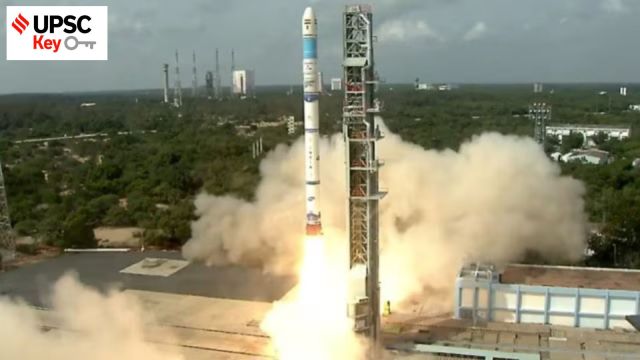 The smallest launch vehicle of the ISRO— SSLV— in its third and final developmental flight Friday placed the EOS-08 and SR-0 satellites into a precise 475-km circular orbit. Know more in our UPSC Key. (Photo: Youtube/ISRO)
🚨 Attention: UPSC Key is now all 7 Days a Week!🚨
Important topics and their relevance in UPSC CSE exam for August 17, 2024. If you missed the August 16th, 2024 UPSC CSE exam key from the Indian Express, read it here.
UPSC Syllabus:
Preliminary Examination: Current events of national and international importance
Mains Examination: GS-III: Science and Technology
What’s the ongoing story- The smallest launch vehicle of the Indian Space Research Organisation (ISRO) — SSLV (Small Satellite Launch Vehicle) — in its third and final developmental flight Friday placed the EOS-08 and SR-0 satellites into a precise 475-km circular orbit. With this, the SSLV will be inducted into the space agency’s fleet of operational launch vehicles.
Prerequisites:
— What is SSLV?
— What are ISRO’s recent achievements?
Key takeaways:
— The technology of the vehicle, however, will be transferred to the private industry for commercial flights in bigger numbers.
— The VTM or Velocity Trimming Module is the last liquid-propellent based stage of the rocket which is used to correct the velocity just before injecting the satellites into orbit. It was this stage, which did not switch on during the first development flight of the SSLV due to a previous misreading of sensors, leading to the satellites being injected into an unstable orbit.
— ISRO’s EOS-08, which was the primary payload on the mission, is a 175-kg experimental satellite, carrying on board three new technologies.
— The Electro-Optical Infrared Payload (EOIR) is designed to capture images in mid-wave and long-wave infra-red during the day and night. The data can be used for surveillance, disaster monitoring, environmental monitoring, fire detection, volcanic activity observation, and industrial and power plant disaster monitoring.
— The Global Navigation Satellite System-Reflectometry payload (GNSS-R) has been designed to demonstrate that reflected signals from satellite-based navigation systems like GPS can be used for applications such as ocean surface wind analysis, soil moisture assessment, cryosphere studies over the Himalayan region, flood detection, and inland waterbody detection.
— Notably, the third payload SiC UV Dosimeter will be used to study the amount of UV radiation that will hit the viewport of the crew module in preparation for the Gaganyaan mission.
For Your Information:
— ISRO’s Small Satellite Launch Vehicle (SSLV) is a three-stage Launch Vehicle configured with three Solid Propulsion Stages. It also has a liquid propulsion-based Velocity Trimming Module (VTM) as a terminal stage, which can help adjust the velocity as it prepares to place the satellite.
— Essentially, the aim behind SSLVs is to produce low-cost launch vehicles with short turnaround times and minimal infrastructural requirements. The SSLV can launch satellites weighing up to 500kg and accommodate multiple satellites.
— The Polar Satellite Launch Vehicle (PSLV) is the third generation of Indian satellite launch vehicles. first used in 1994…. It has also been called “the workhorse of ISRO” for consistently delivering various satellites into low earth orbits (less than 2,000 km in altitude) with a high success rate.
— On the other hand, Geosynchronous Satellite Launch Vehicles (GSLVs) have been instrumental in launching communication satellites in the geosynchronous transfer orbit… It is a circular orbit 35,786 kilometres above Earth’s equator.
Points to Ponder:
— What is the significance of SSLV?
— What are the major ISRO’s mission?
— What are the achievements of ISRO?
Post Read Question:
(1) With reference to India’s satellite launch vehicles, consider the following statements: (UPSC CSE 2018)
1. PSLVs launch the satellites useful for Earth resources monitoring whereas GSLVs are designed mainly to launch communication satellites.
2. Satellites launched by PSLV appear to remain permanently fixed in the same position in the sky, as viewed from a particular location on Earth.
3. GSLV Mk III is a four-staged launch vehicle with the first and third stages using solid rocket motors; and the second and fourth stages using liquid rocket engines.
Which of the statements given above is/are correct?
(a) 1 only
(b) 2 and 3
(c) 1 and 2
(d) 3 only
Other Important Articles Covering the same topic:
ISRO launches SSLV: What is the aim behind developing Small Satellite Launch Vehicles?
UPSC Syllabus:
Preliminary Examination: Current events of national and international importance
Mains Examination: GS-III: Agriculture
What’s the ongoing story- The Centre on Friday unveiled the Krishi-Decision Support System (K-DSS) portal, a satellite-based geospatial platform that will provide farmers with information on the weather, groundwater levels, soil health, reservoir storage levels etc and include data like satellite images.
Prerequisites:
— What is the Digital Public Infrastructure?
— What is the purpose of the Digital crop survey?
Key takeaways:
— The Krishi-DSS was launched during the National Conference on Space Driven Solutions for Agriculture Transformation in India organised by the agriculture ministry.
— The one-day conference is part of the events planned by the government in the run-up to the first National Space Day 2024, which will be observed on August 23, the first anniversary of India’s landing on the moon.
— Nilesh M Desai, Director, Space Applications Centre (SAC), said that the engagement between the agriculture ministry and space sector goes back to 1969 when, for the first time, an experiment was undertaken to examine the disease in coconut plants using remote sensing techniques. Since then, he said, the Indian Space Research Organisation (ISRO) has launched several satellites that are very useful for the agriculture sector.
— The Krishi-DSS is part of the Digital Public Infrastructure for Agriculture announced by Finance Minister Nirmala Sitharaman in her Budget speech on July 23.
— The Krishi-DSS will function as a repository of standardised geospatial data on weather, soil, crop, reservoir, and groundwater data. It will also integrate data related to government schemes and services, an official said.
Points to Ponder:
— Read about Budget 2024 on the Agriculture sector
— How space technology has transformed the agriculture sector?
— What are the advantages and challenges of the new age technology in agriculture?
Post Read Question:
How does e-Technology help farmers in production and marketing of agricultural produce? Explain it. (UPSC CSE 2023)
Other Important Articles Covering the same topic:
Union Budget 2024: On agriculture, a lack of vision
UPSC Syllabus:
Preliminary Examination: Current events of national and international importance
Mains Examination: GS-I, III: Geography, Environment
What’s the ongoing story- While more 36 to 38 ships pass through the canal each day on average, last December, traffic had dropped to as low as 22 ships a day, with more than 160 ships stuck in anchor on both sides of the canal. This is because of the drop in the water levels of Lake Gatun, the artificial reservoir key to the Panama Canal system’s operation, due to a drought.
Prerequisites:
— Location of Panama Canal
— What is an Isthmus?
Key takeaways:
— The 82-km canal, which remains one of the greatest feats of engineering in history, is a shortcut for ships travelling between the Atlantic to the Pacific Oceans by cutting through the Isthmus of Panama in Central America. It saves approximately 12,600 km in a trip between New York and San Francisco, and is one of the most important shipping lanes in the world.
— The Panama Canal is not a simple channel of water connecting two larger water bodies — it is a sophisticated, highly-engineered system which uses a system of locks and elevators to take ships from one end to the other.
— This is needed because the two oceans that the Panama Canal connects do not lie at the same elevation, with the Pacific slightly higher than the Atlantic… This is achieved using a lock system which lifts and drops vessels to the required sea level at either end of the canal.
— The Panama Canal needs massive amounts of fresh water to facilitate the passage of ships using this system of locks. Most of this water is supplied from Lake Gatun using the force of gravity (no pumps are needed).
— According to a report by The New York Times, the passage of a single ship needs more than 50 million gallons (almost 200 million litres) of water. Thus, every day, the canal uses two-and-a-half times the amount of water consumed by the 8 million residents of New York City.
— Last year, lower water levels in Lake Gatun meant that far fewer ships could pass through the canal every day, and those which did pass, often had to reduce their cargo to make the passage.
— This permanent problem stems out of a much greater one which threatens humanity — climate change. Years of extreme rainfall deficits are not unheard of in Panama. But they have become increasingly common, and experts say as Earth heats up further, they might become even more common in the future.
For Your Information:
— Glaciers are epic ice-flows that have carved out mountains and valleys over millennia — the oldest in South Africa dates back 2.9 billion years.
— But these ancient forces of nature, which hold enough fresh water for around two billion people, are melting. At least half of the world’s mountain glaciers are likely to disappear by 2100 as the world heats up due to climate change.
— Cold climate cultures are struggling to deal with this loss.In 2019, a funeral ceremony was held at Iceland’s Okjökull Glacier, said to be the first lost to global heating.
Points to Ponder:
— Economic Survey on Climate Change
— What is the impact of climate on sea level?
— What are global initiatives to tackle climate change?
— What is the economic cost of climate change?
Post Read Question:
Prelims
(2) Panama Canal joins which of the following two water bodies?
(a) Indian Ocean and Pacific Ocean
(b) Indian Ocean and Atlantic Ocean
(c) Atlantic Ocean and Paciifc Ocean
(d) Arctic Ocean and Atlantic Ocean
Mains
The Intergovernmental Panel on Climate Change (IPCC) has predicted a global sea level rise of about one meter by AD 2100. What would be its impact in India and the other countries in the Indian Ocean region? (UPSC CSE 2023)
Other Important Articles Covering the same topic:
The growing cost of climate change
What are mountain glaciers and why do they matter?
UPSC Syllabus:
Preliminary Examination: Current events of national and international importance
Mains Examination: GS-III: Science and Technology
What’s the ongoing story- With its huge mirror — five times bigger than that of its predecessor, the Hubble Space Telescope — the JWST, which was launched on Christmas Day in 2021 and arrived at its destination, the Sun-Earth Lagrange point 2 in January 2022, has been peering at the early epochs in the history of the Universe, when the first galaxies had barely formed.
Prerequisites:
— What is the Hubble Space Telescope?
— What is the James Webb Telescope?
Key takeaways:
— The rate of expansion of the Universe has been a subject of scientific debate for quite some time. Two different methods of determining the rate have yielded results that differ by as much as 10%.
— One method is based on phenomena in the early Universe — which implies events at a great distance, because the light we see from distant objects started its journey a long time ago. The other method relies on local celestial objects — although ‘local’ means a region spanning billions of light years.
— Some stars vary their brightness in a periodic manner, and the duration of this change tells us something about how bright they really are. From this, one can figure out their distance and, in turn, how the Universe has been expanding.
— The new space telescope was expected to nail the reason for the mismatch between the results obtained by the two methods. But its measurements seem to have only increased the discrepancy.
For Your Information:
— Researchers used the James Webb Space Telescope to detect an extremely red, gravitationally lensed supermassive black-hole in the early Universe. The black hole’s colours suggest that it lies behind a veil of dust that obscures much of the light from the material it is consuming.
— Black holes “accrete” material before consuming it. This accretion lets out massive amounts of radiation brighter than the galaxy it is hosted in, causing it to appear like a bright star sometimes. The image from which the researchers identified the images was of a field of a cluster of galaxies called Abell 2744.
Points to Ponder:
— What are the major collaborations between ISRO and NASA?
— What is the significance of the James Webb Telescope?
— Why did Scientists want to know how the universe began?
Post Read Question:
Launched on 25th December 2021, the James Webb Space Telescope has been much in the news since then. What are its unique features which make it superior to its predecessor Space Telescopes? What are the key goals of this mission? What benefits does it hold for the human race? (UPSC Mains 2022)
Other Important Articles Covering the same topic:
James Webb Space Telescope used to discover extremely red supermassive black hole
UPSC Syllabus:
Preliminary Examination: Current events of national and international importance
Mains Examination: GS-II: Issues related to education
What’s the ongoing story- The recent verdict given by the Bombay High Court indicates the kind of spanners that state governments have thrown in the RTE’s track. That court set aside a government order issued earlier this year… This provision calls upon unaided private schools to reserve one-fourth of their seats for the poor. The Maharashtra government’s order said that private schools need not implement this provision if there is a government school within a distance of 1 kilometre.
Prerequisites:
— What is the Right to Education (RTE)?
— What are the constitutional provisions related to the right to education?
— What are the significant provisions related to the Right to Education?
Key takeaways:
— Maharashtra is not the only state where the bureaucracy came up with this clever idea. The government gave two arguments in support of its order. One was about resources. If they are being spent for providing easy access to a government school, why should they be duplicated? This argument is rooted in the rule that the government will reimburse a private school for the cost of enrolling a poor child.
— The other argument put forward was about the Right to Education itself. It was not “absolute” in the sense that other fundamental rights are. This logic is quite popular; what is surprising is that a state government is using it, thereby revealing its lack of commitment to a law enacted by Parliament as a follow-up to a constitutional amendment.
— When the RTE was promulgated, it was expected to serve as a conscience raiser. The idea of giving every child the right to be at a school has waited for a long time. Gopal Krishna Gokhale tried to seek approval for it in the Imperial Legislative Assembly in 1911. He failed.
— The RTE’s progress is far from reassuring. Amendments to the original Act have dented several key aspects that were intended to make elementary education experientially deep for children across the socio-economic divide. The biggest failure of the system to live up to RTE’s vision is in teacher training. It has remained the weakest link in the policy chain.
— About 15 years ago, the J S Verma Commission, which was appointed by the Supreme Court, gave clear-cut guidelines to revamp teacher training. Our system has ensured that interest in these guidelines wouldn’t last long. Interest in RTE itself has been waning for some time now.
For Your Information:
— Boys are more likely than girls to repeat primary grades in 130 out of 142 countries, with data indicating their poorer progression through school, according to a new Global Education report by the United Nations Educational, Scientific and Cultural Organisation (UNESCO).
— The report titled ‘Leave no child behind: Global report on boys’ (2022) disengagement from education’ pointed out that no less than 132 million boys of primary and secondary school age are out of school.
Points to Ponder:
— What is the status of the education system in India?
— What are the issues related to the education system in India?
— What are the initiatives taken by the government to promote education?
— What are the challenges to the RTE?
Post Read Question:
Prelims
(3) Which of the following provisions of the Constitution does India have a bearing on Education? (UPSC CSE 2012)
1. Directive Principles of State Policy
2. Rural and Urban Local Bodies
3. Fifth Schedule
4. Sixth Schedule
5. Seventh Schedule
Select the correct answer using the codes given below:
(a) 1 and 2 only
(b) 3, 4 and 5 only
(c) 1, 2 and 5 only
(d) 1, 2, 3, 4 and 5
Mains
Discuss the main objectives of Population Education and point out the measures to achieve them in India in detail. (UPSC CSE 2021)
Other Important Articles Covering the same topic:
Boys at greater risk of repeating grades, failing to complete education than girls: UNESCO
UPSC Syllabus:
Preliminary Examination: Current events of national and international importance
Mains Examination: GS-I, II: Society, Issues related to women
What’s the ongoing story- The rights of women workers in the informal sector and recognition of unpaid household work were key agenda items. Almost eight decades later, the needle of progress has not moved much.
Prerequisites:
— What is the status of women’s employment in India?
— Historical background to Women’s economic empowerment
Key takeaways:
— The World Economic Forum’s 2024 Global Gender Gap Index places India at 142 amongst 146 countries on economic participation and opportunity. Without economic freedom, there is no freedom for women. In our patriarchal society, they have to follow the dictates of the male breadwinners.
— Founded in 1917, the Women’s Indian Association was the first national women’s organisation that aimed to address the various challenges faced by women. Stri Dharma, its mouthpiece, carried regular articles highlighting the plight of women including factory workers. — There were around 2,53,000 women factory workers in 1927. Their activism led to banning of night working hours for women, and the Bombay Maternity Benefit Act, 1929 which gave benefits of eight weeks’ wages — four weeks each before and after delivery.
— “It is in the economic sphere that women will have to fight hard to establish her position,” Hansa Mehta said in her presidential address at the annual convention of the All-India Women’s Conference (AIWC) in 1945.
— In 1947, the sub-committee on women of the National Planning Committee, formed in 1939 by Subhas Chandra Bose, echoed these sentiments in its report. It called for equality of opportunity in employment, advocated a common civil code, and also proposed that inheritance laws be made gender-neutral.
— Recognition of unpaid domestic work must not be limited to paeans about women’s resilience. There should be economic compensation in the form of income support for homemakers. Several state governments provide a monthly financial allowance to women — Gruha Lakshmi (Karnataka)…. These need to be replicated across the country and indexed to inflation.
For Your Information:
— After many decades of falling, India’s women’s labour force participation rate (WLFPR) is today trending upwards — rising to 37 per cent in 2022-23 from its nadir of 23 per cent in 2017-18. This increase is primarily driven by rural women, as rural WLFPRs increased to 41 per cent, with urban WLFPR remaining at 25 per cent.
— Historically, women have faced structural barriers to participating in the workforce and achieving financial independence, despite India’s phenomenal growth. Occupational segregation kept women limited to low-growth, low-productivity sectors…
— The Gender Budget of 2024-25 presents the highest financial allocation for schemes designed to promote women-led development since the inception of gender budgeting in 2005, at Rs 3.2 lakh crore. This is about 6.8 per cent of the total expenditure budget and around 1 per cent of GDP. It is an increase of almost 37 per cent over the Gender Budget in 2023-24.
Points to Ponder:
— What are the challenges faced by women in employment?
— Why women’s participation in the economic sector is poor?
— What steps need to be taken by the government to increase women’s participation in the workforce?
Post Read Question:
Prelims
(4) Which of the following gives the ‘Global Gender Gap Index’ ranking to the countries of the world? (UPSC CSE 2017)
(a) World Economic Forum
(b) UN Human Rights Council
(c) UN Women
(d) World Health Organization
Mains
How does patriarchy impact the position of middle-class working women in India? (UPSC CSE 2014)
Other Important Articles Covering the same topic:
Does Gender Budget 2024 address women’s employment?
UPSC Syllabus:
Preliminary Examination: Current events of national and international importance
Mains Examination: GS-I, III: Geography, Economy
What’s the ongoing story- With no signs of a let up in threat to ships transiting the Red Sea, India’s petroleum product exports to Europe have shifted entirely to the significantly longer and costlier, albeit safer, route around Africa via the Cape of Good Hope.
Prerequisites:
— Read about Russia-Ukraine war
— Who is Houthi?
— Map work: Red Sea and Bab el-Mandeb strait, Suez Canal
Key takeaways:
— Since late last year, numerous cargo ships have come under attack from the Iran-backed Houthi rebels of Yemen around the Bab el-Mandeb strait, which leads to the Red Sea and Suez Canal, forming the shortest, although narrow, route to the Mediterranean Sea and beyond from the Arab Peninsula, North-East Africa, and the Arabian Sea.
— The route is seen as an important artery of global goods and energy supplies. The Houthis have been claiming that they are targeting vessels with links to Israel and its allies in response to its military offensive in Gaza.
— As per trade sources, taking the Cape of Good Hope route instead of the Suez Canal adds 15-20 days to the voyage to Europe from India, apart from significantly inflating the freight costs.
— Higher risk premiums and longer voyages have hit movement of goods between Asia and Europe, and Asia and North America in terms of significantly higher freight rates.
— India was traditionally not the biggest of fuel sources for Europe, with the continent depending heavily on Russia for energy imports. However, in the aftermath of Moscow’s February 2022 invasion of Ukraine, as Europe started shunning Russian crude oil and fuels, India emerged as the largest buyer of Russian seaborne crude and also a major fuel supplier to Europe with all such shipments passing through the Red Sea.
For Your Information:
— As reported earlier by The Indian Express, tankers carrying Russian crude have largely been immune to the security situation in the Red Sea region, which has forced a number of major shipping lines and Western oil companies to shun the route and instead take the much longer route around Africa via the Cape of Good Hope. Higher risk premiums and longer voyages have hit movement of goods between Asia and Europe in terms of higher freight rates.
— Russian oil cargoes departing from the North Sea and Black Sea ports take the Suez Canal-Red Sea route to reach Asia, specifically India and China, which are currently the biggest buyers of Russian crude.
Points to Ponder:
— How does global unrest impact the shipping industry?
— What is the impact of the Russia and Ukraine war on the shipping industry?
— What is the impact of the Russia-Ukraine war on India?
— What is the status of India’s oil imports?
Post Read Question:
(5) Consider the following pairs:
(Strait) (Location)
1. Malacca Between Malaysia and Indonesia
2. Sunda Between Australia and Papua New Guinea
3. Bab-el-Mandeb Between Yemen and Eritrea
How many of the pairs given above are correctly matched?
(a) Only one
(b) Only two
(c) All three
(d) None
Other Important Articles Covering the same topic:
Red Sea Crisis: India’s petroleum exports to Europe nosedive to 18-month low in January
‘Wordly Wise’ from The Editorial Page
“If you hear a voice within you say ‘you cannot paint’, then by all means paint and that voice will be silenced.”
— Vincent van Gogh
(Thought Process: What do you mean by “inner voice”? How can the inner voice sometimes act as a barrier to utilising our true potential? How do you think self-doubt hampers creativity? How can we overcome the inner voice that says, “You can’t do it”? Is conquering that voice a challenging task? Why is self-belief important? Why are we afraid to take the first step in challenging ourselves? How can the first step help silence all those doubts? What does it tell us about your attitude? Also, ponder this quote by Sylvia Plath “The worst enemy of creativity is self-doubt.”)
|
Prelims Answer Key |
| 1. (a) 2. (c) 3. (d) 4. (a) 5. (a) |
Subscribe to our UPSC newsletter and stay updated with the news cues from the past week.
Stay updated with the latest UPSC articles by joining our Telegram channel – Indian Express UPSC Hub, and follow us on Instagram and X.
https://www.youtube.com/watch?v=P2xAVzg_YKE?si=85UvMoo9pxhSnCfG&w=560&h=315

Read UPSC Magazine