30 min read

© IE Online Media Services Pvt Ltd



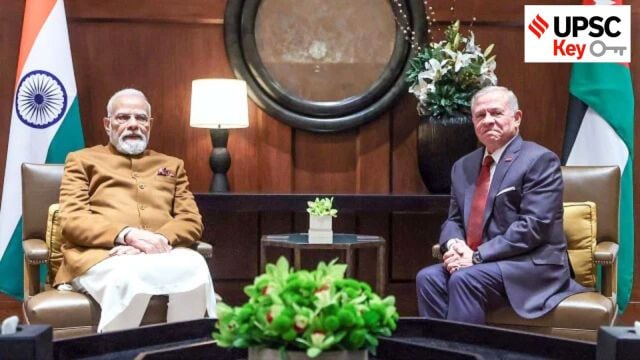 Prime Minister Narendra Modi with Jordan’s King Abdullah ii ibn Al Hussein in Amman. Know more about India-Jordan ties in our UPSC Key. (Photo: PTI)
Important topics and their relevance in UPSC CSE exam for December 16, 2025. If you missed the December 15, 2025, UPSC CSE exam key from the Indian Express, read it here.
Syllabus:
Preliminary Examination: Current events of national and international importance.
Mains Examination: General Studies-II, III: Bilateral, regional and global groupings and agreements involving India and/or affecting India’s interests, Role of external state and non-state actors in creating challenges to internal security.
What’s the ongoing story: Underlining that India and Jordan share a “common and clear stance against terrorism”, Prime Minister Narendra Modi expressed hope that “peace and stability will prevail in the region” as he held bilateral talks with Jordan’s King Abdullah II at the Al Husseiniya Palace in Amman on Monday.
Key Points to Ponder:
— What is the history of India and Jordan relations?
— What are the areas of cooperation between both the nations?
— How does cross-border terror pose a huge security challenge for India?
— India’s counter-terrorism doctrine—Know its evolution.
— What are the challenges faced by India in preventing terrorism?
— What is the significance of India and Jordan counter-terrorism cooperation?
Key Takeaways:
— Modi, who was received at the airport by his counterpart Jafar Hassan as a special gesture, held talks with the Jordanian King and proposed that the two countries should aim to enhance bilateral trade to US$ 5 billion over the next 5 years. He also called for collaboration between Jordan’s digital payment system and India’s United Payments Interface (UPI).
— Jordan is an important supplier of fertiliser to India, and companies on both sides are in discussions for further substantive investment in Jordan to meet growing demand for phosphatic fertilizer in India, an official statement from the Ministry of External Affairs said.
— Modi said the two countries share a common and clear stance against terrorism and praised King Abdullah II’s “active and positive role” on the Gaza issue. “We hope that peace and stability will prevail in the region. We share a common and clear stance against terrorism. Under your leadership, Jordan has sent a strong and strategic message to the world against terrorism, extremism, and radicalisation,” Modi said.
— Modi recalled that during King Abdullah II’s visit to India in 2018, they participated in a conference on Islamic heritage.
— According to the MEA statement, the two leaders met in restricted and delegation level formats. They warmly recalled their previous meetings and conversations and underscored the warm and historic ties shared by the two countries. They noted that the visit, coming at a time when the two countries are celebrating 75 years of the establishment of their diplomatic ties, makes it historic.
— The MEA said that both the leaders discussed ways to further deepen engagement between the two countries in the fields of trade and investment; defence and security; renewable energy; fertilizer and agriculture; innovation, IT and digital technologies; critical minerals; infrastructure; health and pharma; education and capacity; tourism and heritage; and culture and people-to-people ties.
— “Noting that India was Jordan’s 3rd largest trading partner, Prime Minister proposed that the two countries should aim to enhance bilateral trade to US$ 5 billion over the next 5 years. He also called for collaboration between Jordan’s digital payment system and India’s United Payments Interface (UPI). Jordan is an important supplier of fertilizer to India, and companies on both sides are in discussions for further substantive investment in Jordan to meet growing demand for phosphatic fertilizer in India,” it said.
— On the occasion of the visit, the two sides finalised MoUs in the fields of culture, renewable energy, water management, digital public infrastructure and twinning arrangement between Petra and Ellora.
Do You Know:
— India imports a significant amount of fertiliser from Jordan— making it a key part of India’s food security push — and has also invested in the potash and phosphate sectors there. There is further potential for such investments to secure India’s requirements.
— The Jordan India Fertilizer Company, a joint venture between IFFCO India and the Jordan Phosphates Mines Company, was set up with an investment of $860 million and produces and exports phosphoric acid to India. The JV is a major source of phosphoric acid for India.
— In terms of investment, more than 15 garment companies, owned by NRIs, with a cumulative investment of $500 million are located in the Qualified Industrial Zones.
— India and Jordan also signed an MoU on defence cooperation in 2018.
Jordan is home to an Indian community of around 17,500, mostly in the garment, construction and manufacturing sectors and in the UN and other multilateral organisations.
Other Important Articles Covering the same topic:
📍Terrorism, food security on the agenda as PM Modi arrives in Jordan: Why the visit matters
Previous year UPSC Mains Question Covering similar theme:
Analyse the complexity and intensity of terrorism, its causes, linkages and obnoxious nexus. Also suggest measures required to be taken to eradicate the menace of terrorism. (UPSC CSE 2021)
Syllabus:
Preliminary Examination: Current events of national and international importance.
Mains Examination: General Studies-II: Government policies and interventions for development in various sectors and issues arising out of their design and implementation.
What’s the ongoing story: In a major overhaul of the two-decade-old rural job guarantee scheme, the BJP-led NDA government, in its third term, has prepared a Bill that proposes to increase the number of days for which work can be demanded by rural households in a year to 125 from 100 now, and for the first time shifts 40 per cent of the financial burden of the scheme to states.
Key Points to Ponder:
— What is the MNREGA scheme?
— What is the significance of this scheme?
— What are the major changes proposed under the VB-G RAM G Bill compared to MNREGA?
— What is meant by ‘normative allocation’ under the VB-G RAM G Bill?
— How does the shift from a demand-driven to a top-down allocation model affect the scheme?
— How does the new Centre-State funding pattern for the scheme impact cooperative federalism?
— What are the challenges associated with the scheme?
Key Takeaways:
— For the last 20 years, since the rural employment guarantee law was enacted by the Congress-led UPA government in 2005, the Centre has been footing 100 per cent of the wage costs. Wages account for three-fourth of the entire expenditure under the scheme. Materials used in the works account for the balance one-fourth, and this cost is shared by the Centre and states in the ratio of 75:25.
— The proposed Bill has projected the annual spending on the new scheme to be Rs 1,51,282 crore in the first full year post implementation. It estimates the Centre’s share to be Rs 95,692.31 crore, suggesting that states would have to fund the balance i.e., Rs 55,590 crore.
— The proposed legislation is called the Viksit Bharat—Guarantee for Rozgar and Ajeevika Mission (Gramin) (VB—G RAM G) Bill, 2025. Listed for introduction by Union Rural Development Minister Shivraj Singh Chouhan, this will repeal MNREGA, 2005.
— In another significant change, the Bill also proposes a new provision of ‘normative’ allocation to states. Earlier, states used to provide a Labour Budget prepared on the basis of anticipated demand for unskilled manual work and send it to the Centre. However, the proposed Bill says the Centre will prescribe objective parameters and determine the state-wise normative allocation for each financial year.
— To ensure availability of labour for agriculture, the new Bill proposes that guaranteed employment would not be available to rural households during peak agricultural seasons. While there have been demands in the past from states about non-availability of labour during peak farm seasons, the Centre had not made any changes to the law.
— According to the Bill, 11 north eastern and hill states will have to foot only 10 per cent of the scheme’s expenditure, and the scheme will be fully funded by the Centre in the remaining four Union Territories. Thus, as many as 19 big states will have to share 40 per cent of the scheme’s financial burden.
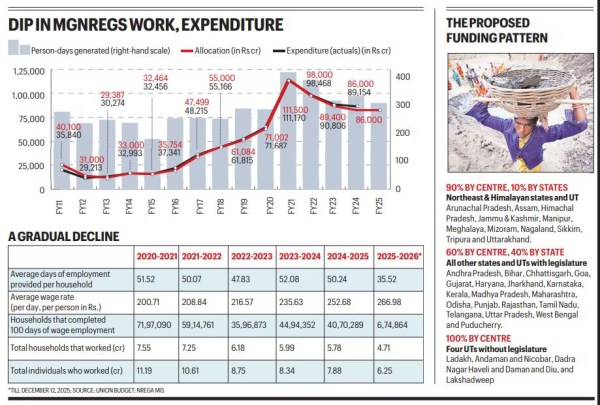
— While there is no official estimate about the expected fiscal burden on states due to the new scheme, a calculation based on 2024-25 spending shows that the additional fiscal impact on states (excluding West Bengal) may be about Rs 30,000 crore annually.
From the Explained Page- “MGNREGA Revamp Explained: Key features of VB-G RAM G Bill, how its different from earlier scheme”
— For the first time, the Viksit Bharat-Guarantee for Rozgar and Ajeevika Mission (Gramin) Bill — or VB-G RAM G Bill proposes a 60-day pause in the scheme during the peak agricultural seasons of sowing and harvesting, a move said to be aimed at ensuring farm labour availability.
— Here are the key changes the VB-G RAM G Bill proposes to the current rural job guarantee framework:
— Guaranteed wage employment days: Section 5(1) of the VB-G Ram G Bill proposes 125 days of guaranteed employment to every rural household whose adult members volunteer to do unskilled manual work. While MGNREGS guarantees employment for 100 days, the number of families exhausting that work quota has been very limited owing to the large base of active workers.
— States to share funding burden: One of the major changes the VB-G RAM G Bill proposes is in the fund-sharing pattern. Unlike MGNREGA, where the Centre pays the entire wage bill, states will have to share the wage payment burden under VB-G RAM G. The Centre has proposed the new funding pattern at a time when the fiscal space for several states has been gradually shrinking.
— Normative allocation’: Top-down approach: The new “normative allocation” formula transforms the method of allocation of resources into a purely top-down process. The Bill defines this as “the allocation of the fund made by the Central Government to the State”.
— Pause in employment guarantee during agriculture season: The VB-G Ram G Bill introduces provisions for pausing the employment guarantee scheme for 60 days during sowing and harvesting to ensure “adequate agricultural labour availability”.
— Viksit Gram Panchayat Plans: As per the provisions of the Bill, all works under the new scheme shall be originated from the Viksit Gram Panchayat Plans consolidated at the Block, District and State levels and further aggregated into the Viksit Bharat National Rural Infrastructure Stack, which shall comprise a comprehensive listing of works aligned with National development priorities.
— Higher penalty: Section 27 of the new Bill provides for a higher penalty for violation of its provisions. The penalty was earlier Rs 1,000; now it is proposed to be Rs 10,000.
Do You Know:
— Launched across India’s 200 most backward rural districts in 2006-07, the MGNREGS was extended to an additional 130 districts during 2007-08; and to the entire country from financial year 2008-09.
— Section 3 (1) of the MGNREG Act provides for “not less than one hundred days” work per rural household in a financial year. But it has become the de facto upper limit as the NREGA software does not allow data entries for employment above 100 days to a household in a year unless specifically requested by the State/UT.
— The government, however, allows additional 50 days of wage employment (beyond the stipulated 100 days). For instance, every Scheduled Tribe household in a forest area is entitled to get 150 days’ work under NREGS, provided that such families have no other private property except for the land rights granted under the Forest Right Act, 2016.
— Besides, the government, under Section 3(4) of the MGNREGA, can also provide an additional 50 days of unskilled manual work in a year, over and above the 100-day in such rural areas where drought or any natural calamity (as per Ministry of Home Affairs) has been notified.
Other Important Articles Covering the same topic:
📍5 key changes VB G Ram G Bill introduces in the rural job guarantee framework
📍How a new MGNREGA amendment pushes for spending on water conservation projects
Previous year UPSC Prelims Question Covering similar theme:
(1) Among the following who are eligible to benefit from the “Mahatma Gandhi National Rural Employment Guarantee Act”? (UPSC CSE 2011)
(a) Adult members of only the scheduled caste and scheduled tribe households.
(b) Adult members of below poverty line (BPL) households.
(c) Adult members of households of all backward communities.
(d) Adult members of any household.
Syllabus:
Preliminary Examination: Economic and Social Development-Sustainable Development, Poverty, Inclusion, Demographics, Social Sector Initiatives, etc.
Mains Examination: General Studies-II: Government policies and interventions, Issues relating to development and management of Social Sector/Services relating to Health, Education, Human Resources.
What’s the ongoing story: Rama V Baru and Vikash R Keshri write- “December 12 was Universal Health Coverage (UHC) Day. This year’s theme was “Unaffordable health costs? We’re sick of it!’’ This draws attention to a growing frustration with the rising financial burden of healthcare. In observing UHC Day, it is important to distinguish between universal health coverage and universal healthcare. The latter goes beyond coverage for illness alone and encompasses equitable access to comprehensive primary healthcare — preventive, promotive, curative, rehabilitative, and palliative.”
Key Points to Ponder:
— What do you understand by universal health coverage?
— What is the difference between Universal Health Coverage (UHC) and Universal Healthcare?
— Read about the Alma-Ata Declaration (1978) and its relevance to Universal Health Coverage.
— What is the Ayushman Bharat Scheme?
— What steps has the government taken to make the health sector universal?
— What is out-of-pocket expenditure?
— How can India strengthen its primary healthcare system to ensure long-term, affordable care?
Key Takeaways:
— “UHC is grounded in the universal human right to health, articulated in several international covenants and reinforced by the World Health Organisation (WHO) in the Alma-Ata Declaration, 1978. However, the WHO’s 2010 World Health Report emphasised financial reform and risk protection as a pathway to UHC. The subsequent UN resolution on UHC reaffirmed this agenda, and later, UHC was included in the Sustainable Development Goals.”
— “In practice, recent reforms in many countries, including India, have undermined the primary care approach and privileged financial protection through public health insurance. These schemes focus on covering costs for hospitalisation and often define packages for different disease conditions. Evidence suggests that patients often have to incur out-of-pocket expenditure. Such expenditure is due to services that are not covered or inadequately covered by packages, or due to abuse of coverage provision by service providers.”
— “Conversely, when public health insurance schemes are designed within a well-financed public health system, with robust primary and secondary care working as gatekeepers, the outcomes seem to be better. Several East Asian countries adopted UHC through an insurance approach, but have also strengthened primary and secondary care over time.An ageing population and chronic diseases have necessitated such changes.”
— “A commitment to public spending is an important aspect of strengthening primary and secondary levels of care. East Asian and several Southeast Asian countries have robust public systems with a private presence in provisioning. A strong public sector seems to act as a bulwark to regulate the private sector in terms of quality and cost. Even in these countries, the private sector’s power to influence policy is an unresolved issue.”
— “India has a legacy of being committed to universal healthcare as articulated by the Bhore Committee just before Independence. In fact, the committee opined that public insurance schemes must not be introduced until a robust primary healthcare system is in place. Despite this, chronic underfinancing of primary healthcare has resulted in weak public sector provisioning, contributing to increased reliance on the private sector. National Sample Survey data show growing reliance of the poor on increasingly expensive privately provided healthcare — an important contributor to household indebtedness.”
— “Despite initiatives such as the National Rural Health Mission (NRHM, now NHM), systemic weaknesses remain. Some states sought to address inequity in access and the rising cost of care through public health insurance programmes. In 2008, the Rashtriya Swasthya Bima Yojana insurance scheme was launched and subsequently, the Ayushman Bharat Pradhan Mantri Jan Arogya Yojana. With these initiatives, the focus on universal health coverage came to stay.”
Do You Know:
— Universal health coverage means that all people have access to the full range of quality health services they need, when and where they need them, without financial hardship. It covers the full continuum of essential health services, from health promotion to prevention, treatment, rehabilitation and palliative care.
— The Ayushman Bharat insurance scheme was rolled out in 2018 with the aim of providing universal health coverage, especially in a country where a majority of hospital-based care — 60% in urban areas and 52% in rural areas — is provided by the private sector.
— The Ayushman Bharat Pradhan Mantri Jan Arogya Yojana (AB PM-JAY) is the world’s largest public health insurance scheme. It provides free cover up to Rs 5 lakh annually to all members of eligible families — estimated to comprise the bottom 40% of the population economically — irrespective of age.
Other Important Articles Covering the same topic:
📍The road to Universal Health Coverage in India
📍India is still some way from achieving universal health coverage. Here’s why
📍Knowledge Nugget of the day: Ayushman Bharat
Previous year UPSC Prelims Questions Covering similar theme:
(2) Consider the following statements: (UPSC CSE 2023)
Statement-I: India’s public sector health care system largely focuses on curative care with limited preventive, promotive and rehabilitative care.
Statement-II: Under India’s decentralized approach to health care delivery, the States are primarily responsible for organizing health services.
Which one of the following is correct in respect of the above statements?
(a) Both Statement-I and Statement-II are correct and Statement-ll is the correct explanation for Statement-I
(b) Both Statement-I and Statement-ll are correct and Statement-ll is not the correct explanation for Statement-I
(c) Statement-l is correct but Statement-ll is incorrect
(d) Statement-l is incorrect but Statement-ll is correct
(3) With reference to the Ayushman Bharat Digital Mission, consider the following statements: (UPSC CSE 2022)
1. Private and public hospitals must adopt it.
2. As it aims to achieve universal, health coverage, every citizen of India should be part of it ultimately.
3. It has seamless portability across the country.
Which of the statements given above is/are correct?
(a) 1 and 2 only
(b) 3 only
(c) 1 and 3 only
(d) 1, 2 and 3
Previous year UPSC Mains Question Covering similar theme:
“Besides being a moral imperative of Welfare State, primary health structure is a necessary pre-condition for sustainable development.” Analyze. (UPSC CSE 2021)
Syllabus:
Preliminary Examination: Current events of national importance.
Mains Examination: General Studies-III: Awareness in the fields of IT, Space, Computers, robotics, Nano-technology, bio-technology and issues relating to intellectual property rights.
What’s the ongoing story: Google CEO Sundar Pichai announced that the company has begun work on a long-term research initiative, Project Suncatcher, aiming to start putting solar-powered data centres into space by 2027.
Key Points to Ponder:
— What is Project Suncatcher?
— What is Artificial Intelligence?
— Know about the AI data centres.
— Why are technology companies exploring space-based data centres?
— What concerns are associated with terrestrial data centres?
— What are the potential benefits of space-based solar-powered data centres over terrestrial data centres?
— What are the challenges associated with building data centres in space?
Key Takeaways:
— According to a policy note released last week, Project Suncatcher will equip solar-powered satellite constellations with Tensor Processing Units (Google’s patented chip capable of high-volume, low-precision computation) and optical links that may scale machine learning computations in space.
— To this end, Google will attempt to achieve data centre-level computation linkages between satellites using laser beams to create the satellite constellation. Google claims it has successfully tested its computer chips for tolerance to radiation and that they can survive the harsh space environments.
— Google plans to launch two prototype satellites as part of a learning mission in partnership with Planet Labs, an Earth imaging company, by early 2027.
— With the rapid expansion of terrestrial data centres to fuel the ongoing AI boom, tech CEOs have begun to look to space as a viable alternative. Complaints about the negative externalities arising from the burgeoning presence of AI data centres have been known for a while now, from the excessive water depletion to the vast amounts of fossil fuel-driven electricity needed.
— Additionally, tremendous advances in rocket technology have significantly reduced the cost of space missions, and thus the cost of sending experimental payloads.
— However, there are downsides to such a move as well. Building and maintaining a full-scale data centre will be expensive, guaranteeing high establishment costs. This would also make repairs difficult and necessitate the presence of network experts on-site. Moreover, the speed of data from the moon would be delayed given its distance from the Earth, making real-time computation tricky, as things currently stand. There is also concern about ensuring cybersecurity on the moon.
Previous year UPSC Prelims Question Covering similar theme:
(4) With the present state of development, Artificial Intelligence can effectively do which of the following? (UPSC CSE 2020)
1. Bring down electricity consumption in industrial units
2. Create meaningful short stories and songs
3. Disease diagnosis
4. Text-to-Speech Conversion
5. Wireless transmission of electrical energy
Select the correct answer using the code given below:
(a) 1, 2, 3 and 5 only
(b) 1, 3 and 4 only
(c) 2, 4 and 5 only
(d) 1, 2, 3, 4 and 5
Syllabus:
Preliminary Examination: Current events of national importance, Economic and Social Development.
Mains Examination: General Studies-II, III: Government policies and interventions, Indian Economy and issues.
What’s the ongoing story: India’s headline retail inflation rate rose to 0.71 per cent in November from October’s all-time low of 0.25 per cent. However, to understand what the latest inflation data tells us about the Indian economy, the Consumer Price Index (CPI) data must be looked at in three different ways.
Key Points to Ponder:
— What is retail inflation?
— How is inflation measured in India?
— What is the Wholesale Price Index (WPI)?
— What is the difference between CPI and WPI?
— What is the difference between core and headline inflation?
Key Takeaways:
— The primary reason behind headline retail inflation being as low as it has been is food prices, which were down on a year-on-year basis for the sixth month in a row. In November, food inflation was a negative 3.91 per cent, slightly higher than a negative 5.02 per cent in October.
However, these are price changes compared to the same month last year. When compared to October, food prices were 0.5 per cent higher in November.
— Then there is core inflation, or inflation excluding items whose prices are volatile, such as food and fuel. This measure of inflation is important because it is seen as a sign of underlying price pressures in the economy; people will buy food and fuel to an extent irrespective of their prices because they are required for survival – food for nourishment and fuel for mobility.
— As such, inflation excluding food and fuel tells us how prices are moving when we consider only those items whose demand is impacted by changes in prices.
— Removing gold, silver, petrol, and diesel from core inflation gives us what economists call ‘core-core’ or ‘super core’ inflation. And calculations show this measure of inflation fell to a new record low of 2.4 per cent in November, indicating price pressures are very weak. This may be for a variety of reasons, including the September 22 Goods and Services Tax cuts, some weakness in demand, and some statistical issues with how the statistics ministry compiles CPI data.
Do You Know:
— Inflation refers to the rate at which the general price level for goods and services increases over a period of time, causing a decrease in purchasing power of money or real income. In other words, as inflation rises, each unit of currency can buy fewer goods and services than before.
— Rising inflation affects the financial well-being of households, especially those with lower incomes or fixed incomes. As the cost of goods and services increases, it reduces the quantity of goods and services that can be purchased with the same nominal income, thereby affecting households’ cost of living.
Other Important Articles Covering the same topic:
📍Everyday Economics: What are WPI and CPI inflation rates?
📍How inflation affects cost of living
Previous year UPSC Prelims Question Covering similar theme:
(5) Consider the following statements: ( UPSC CSE 2020)
1. The weightage of food in Consumer Price Index (CPI) is higher than that in Wholesale Price Index (WPI).
2. The WPI does not capture changes in the prices of services, which CPI does.
3. The Reserve Bank of India has now adopted WPI as its key measure of inflation and to decide on changing the key policy rates.
Which of the statements given above is/are correct?
(a) 1 and 2 only
(b) 2 only
(c) 3 only
(d) 1, 2 and 3
Previous year UPSC Mains Question Covering similar theme:
Do you agree with the view that steady GDP growth and low inflation have left the Indian economy in good shape? Give reasons in support of your arguments. (UPSC CSE 2019)
Syllabus:
Preliminary Examination: Current events of national and international importance.
Mains Examination: General Studies-II, III: Government Policies and Interventions, Science and Technology- developments and their applications and effects in everyday life.
What’s the ongoing story: The government on Monday introduced a new Bill in the Lok Sabha called the Sustainable Harnessing and Advancement of Nuclear Energy for Transforming India (SHANTI) Bill, 2025, which will allow private participation in India’s highly restricted nuclear power sector.
Key Points to Ponder:
— What are India’s nuclear liability laws?
— Know the key highlights of SHANTI Bill, 2025,
— Read about the India’s nuclear power programme.
— The Civil Liability for Nuclear Damage Act, 2010 (CLNDA)-know its key features
— What are the legal barriers posed by the Atomic Energy Act and CLNDA to private and foreign participation in India’s civil nuclear sector?
— What is the Nuclear Energy Mission?
Key Takeaways:
— The new Bill will replace the existing Atomic Energy Act, 1962 and the Civil Liability for Nuclear Damage Act, 2010.
— The government said the new Bill is a key step towards achieving India’s target of 100 gigawatts of nuclear power capacity by 2047, as it seeks to “harness the full potential of India’s nuclear energy and indigenous resources through active involvement of both the public and private sectors.”
— A key change in the new Bill is removal of an earlier provision under ‘right of recourse’ which had allowed nuclear plant operators to seek compensation from suppliers in the event of a nuclear accident caused by defective equipment, sub-standard services or acts of suppliers or their employees.
— This provision was repeatedly flagged by foreign nuclear equipment vendors as a deterrent to investing in India’s nuclear sector as it exposes them to long-term and uncertain liability risks in the event of a nuclear accident.
— Under the new Bill, both public and private companies, as well as their joint ventures, will be allowed to set up nuclear power plants, transportation or storage of nuclear fuel, and import or export nuclear fuel, technology, equipment and minerals required for nuclear power generation. However, all entities involved in nuclear energy production will be required to obtain safety authorisation from the Atomic Energy Regulatory Board.
— The Bill makes “safety authorisation” mandatory for the manufacture, possession, use, transport, import, export or disposal of radioactive substances and radiation-generating equipment, as well as for establishing, operating or decommissioning radiation facilities.
— Meanwhile, the Bill retains certain exclusive Central government control over critical and sensitive activities. These include enrichment and isotopic separation of radioactive substances, management and reprocessing of spent fuel and high-level radioactive waste, production and upgradation of heavy water, among others.
— The Bill also provides for the creation of new institutional arrangements, including an Atomic Energy Redressal Advisory Council, designation of Claims Commissioners, and a Nuclear Damage Claims Commission for cases involving severe nuclear damage, with the Appellate Tribunal for Electricity acting as the appellate authority. Further, it empowers the Central government to establish a Nuclear Liability Fund for the purpose of meeting its liability in case of a nuclear incident.
— On the liability front, the Bill specifies graded liability caps for nuclear power operators based on their size of installation.
Do You Know:
— India enacted The Atomic Energy Act, 1962 after repealing the Atomic Energy Act, 1948. Since then, the Act has been amended four times, with the latest amendment being in 2015. However, the sector was confined to the Central government.
— In 2010, the Civil Liability for Nuclear Damage Act, 2010 was enacted to provide for civil liability for nuclear damage and prompt compensation to the victims of a nuclear incident through a no-fault liability regime.
Other Important Articles Covering the same topic:
📍Cabinet nod to key amendment sets stage to open up n-power
Previous year UPSC Mains Question Covering similar theme:
With growing energy needs should India keep on expanding its nuclear energy programme? Discuss the facts and fears associated with nuclear energy. (UPSC CSE 2018)
ALSO IN NEWS |
|
| Former bureaucrat Raj Kumar Goyal sworn in as new CIC | Former Indian Administrative Service (IAS) officer Raj Kumar Goyal was Monday sworn in as Chief Information Commissioner (CIC) in the Central Information Commission by President Droupadi Murmu. The appointment of Goyal fills the post that has been vacant since September, when the previous CIC, Heeralal Samariya, demitted office.The Central Information Commission is headed by the CIC and can have a maximum of 10 Information Commissioners. At present, Anandi Ramalingam and Vinod Kumar Tiwari are the Information Commissioners. |
| Amid Opp fire, Govt to send higher education regulator Bill to panel | The government on Monday introduced in the Lok Sabha the Viksit Bharat Shiksha Adhishthan Bill, 2025, which seeks to set up an overarching higher education commission along with three councils for regulation, accreditation and ensuring academic standards for universities and higher education institutions in India. Amid objections from the Opposition, the government agreed to send the Bill to a Joint Committee of Parliament. |
| Law says only local official can issue notice to electors; in Bihar, EC sent pre-filled notices | As notices begin going out on Tuesday to electors with the publication of draft rolls in five states and UTs under the Special Intensive Revision (SIR), a procedural red flag from Bihar has set off concern within the election machinery. In the closing fortnight of the Bihar SIR in September, The Indian Express has learnt, Electoral Registration Officers (EROs) across the state found “pre-filled notices” appearing on their individual log-ins on the Election Commission of India’s (ECI) centralised portal. These notices, estimated to be in lakhs but no number has been provided by the EC, were addressed to Bihar electors who had already submitted their forms and supporting documents and whose names figured in the draft rolls published in August. Significantly, while the notices bore the names of the EROs, they had not been generated by them. This departure matters because the law is clear. Under the Representation of the People Act, 1950, it is the ERO of the Assembly constituency, and only the ERO, who is empowered to doubt an elector’s eligibility and issue a notice calling for a hearing. |
| PRELIMS ANSWER KEY |
| 1. (d) 2. (b) 3. (b) 4. (b) 5.(a) |
Subscribe to our UPSC newsletter. Stay updated with the latest UPSC articles by joining our Telegram channel – Indian Express UPSC Hub, and follow us on Instagram and X.
🚨 Click Here to read the UPSC Essentials magazine for November 2025. Share your views and suggestions in the comment box or at manas.srivastava@indianexpress.com🚨

Read UPSC Magazine