31 min read

© IE Online Media Services Pvt Ltd



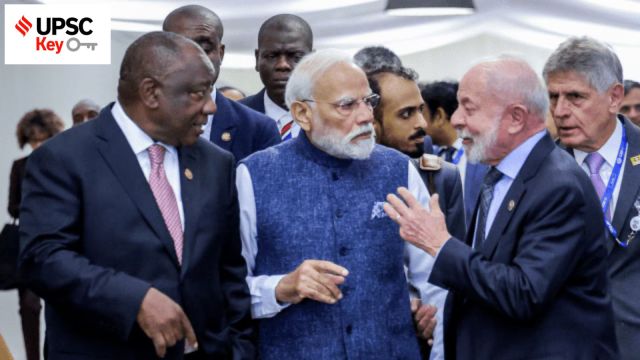 Prime Minister Narendra Modi interacts with South Africa President Cyril Ramaphosa and Brazil President Luiz Inácio Lula da Silva during the India-Brazil-South Africa Dialogue Forum (IBSA) Leaders’ meeting on the sidelines of the G20 Summit, in Johannesburg. Know more in our UPSC Key. (ANI Photo)
Important topics and their relevance in UPSC CSE exam for November 24, 2025. If you missed the November 23, 2025, UPSC CSE exam key from the Indian Express, read it here.
Syllabus:
Preliminary Examination: Current events of national and international importance.
Mains Examination: General Studies-II: Bilateral, regional and global groupings and agreements involving India and/or affecting India’s interests.
What’s the ongoing story: Prime Minister Narendra Modi Sunday told the leaders of Brazil and South Africa that the IBSA grouping can send a message of “unity, cooperation and humanity” at a time when the world appears fragmented and divided.
Key Points to Ponder:
— Read about the IBSA grouping and its history.
— What is the significance of the IBSA grouping for India?
— What do you understand by the “Global South”?
— What is climate-resilient agriculture?
— What is the significance of digital public infrastructure cooperation among IBSA nations for strengthening South-South collaboration?
— What is the status of India’s bilateral ties with South Africa and Brazil?
— What are the reforms required in the UN Security Council?
— What is the International Big Cat Alliance?
Key Takeaways:
— At the meeting with Brazil President Luiz Inácio Lula da Silva and South Africa President Cyril Ramaphosa on the sidelines of the G20 summit in Johannesburg, Modi said there is no place for “double standards on terrorism” and called for united action. In this context, he proposed institutionalising the National Security Advisers-level dialogue between the three countries.
— He also proposed setting up an IBSA fund to promote climate-resilient agriculture and a digital innovation alliance to enable sharing of digital public infrastructure such as the unified payments interface (UPI), health platforms such as CoWIN, cybersecurity frameworks and women-led tech initiatives.
— He suggested that the second of these initiatives could be launched at the AI Impact Summit to be held in India next year.
— “IBSA is not just a group of three countries; it connects three continents, three major democracies and three major economies,” the PM said. The meeting, he added, is “historic and timely”, coming at the end of four consecutive G20 presidencies held by Global South countries.
— Pushing for UN Security Council reforms, Modi said global institutions “do not represent today’s world”, noting that none of the IBSA countries is a permanent UNSC member. Institutional reform, he said, “is no longer an option, but a necessity”.
— He said the three countries must “move forward in close coordination” on the issue of terrorism. “There is no place for any double standards on such a serious issue. For global peace and prosperity, we must take united action.”
— Modi also hailed the IBSA Fund which, he said, had helped complete around fifty projects in sectors such as education, health, women’s empowerment and solar energy in forty countries. “To further strengthen this spirit, we can establish the IBSA Fund for Climate Resilient Agriculture,” he said.
— In a separate meeting, Modi and Ramaphosa reviewed bilateral ties and discussed ways to enhance cooperation in AI, digital public infrastructure and critical minerals.
— The Prime Minister also thanked Ramaphosa for the relocation of cheetahs and invited South Africa to join the International Big Cat Alliance led by India.
— Both leaders agreed to work jointly to “amplify the voice of the Global South”. “President Ramaphosa assured South Africa’s full support to India’s upcoming Chairship of BRICS in 2026,” the statement said.
Do You Know:
— IBSA is a unique Forum which brings together India, Brazil, and South Africa, three large democracies and major economies from three different continents, facing similar challenges.
— ‘Global North’ refers loosely to countries like the US, Canada, Europe, Russia, Australia and New Zealand, while ‘Global South’ includes countries in Asia, Africa and South America.
Other Important Articles Covering the same topic:
📍UNSC reforms no longer an option, but a necessity: PM Modi at IBSA meet
Previous year UPSC Mains Question Covering similar theme:
‘The long-sustained image of India as a leader of the oppressed and marginalised nations has disappeared on account of its new found role in the emerging global order.’ Elaborate. ( UPSC CSE 2019)
Syllabus:
Preliminary Examination: Current events of national and international importance.
Mains Examination: General Studies-II, III: Important International institutions, agencies and fora- their structure, mandate, Awareness in the fields of IT.
What’s the ongoing story: Underlining that India’s approach to Artificial Intelligence (AI) is anchored on access, skilling and responsible deployment, Prime Minister Narendra Modi said Sunday that the world needs a “global compact on AI”, which should include effective “human oversight, safety-by-design, transparency”, and strict prohibitions on the use of AI for “deepfakes, crime, and terrorist activities”.
Key Points to Ponder:
— What are the key takeaways of the G20 summit 2025?
— What are the initiatives proposed by India in the G20 summit this year?
— Read about Artificial Intelligence and its application.
— What is the India-AI Mission?
— Why is a global compact on AI the need of the hour?
— What is the significance of the India-AI Mission?
— What are the concerns associated with misuse of AI?
— What is the significance of the G20 for India?
Key Takeaways:
— Addressing G20 leaders during a session on “A Fair and a Just Future for All – Critical Minerals; Decent Work; Artificial Intelligence”on the second day of the summit in Johannesburg, PM Modi also extended an invitation to all G20 countries to participate in the AI Impact summit to be held in India in February 2026.
—“Under the India-AI Mission, we are developing accessible high-performance computing so that the benefits of AI reach every district and every language. This will provide both scale and speed to our efforts toward human development,” the Prime Minister said.
— “At the same time, we must all ensure that AI is used for the global good and that its misuse is prevented. For this, we need a global compact on AI, built upon certain fundamental principles. These should include effective human oversight, safety-by-design, transparency, and strict prohibitions on the use of AI for deepfakes, crime, and terrorist activities,” Modi said, highlighting the basic principles.
— He also called for a fundamental change in the way critical technologies are promoted. “We must promote technology applications that are ‘human-centric’ rather than ‘finance-centric’, that are ‘global’ rather than merely ‘national’, and that follow ‘open-source’ models rather than ‘exclusive’ ones. India has sought to integrate this very vision into all of its technology projects,” he said.
— For this very reason, India today records the highest number of digital payments in the world, he said.
Do You Know:
— Artificial intelligence (AI) refers to the field of computer science which aims to make computer systems think, reason, learn, and act to solve a complex system like humans.
— AI can be classified into two types: Artificial Narrow Intelligence (ANI) also known as weak AI and Artificial General Intelligence (AGI) also referred to as strong AI.
— The G20, or the Group of Twenty, is an informal grouping of 19 countries (Argentina, Australia, Brazil, Canada, China, France, Germany, India, Indonesia, Italy, Japan, Republic of Korea, Mexico, Russia, Saudi Arabia, South Africa, Turkey, United Kingdom, and the United States), European Union, and African Union.
— Notably, the African Union, a grouping that represents 55 countries, was admitted as a new member of the G20 in June 2023.
Other Important Articles Covering the same topic:
📍Knowledge Nugget: What happened at G20 Summit in South Africa? Here are the key takeaways
📍AI basics: What are artificial intelligence and machine learning?
📍UPSC Issue at a Glance | Deepfakes: 5 Key Questions You Must Know for Prelims and Mains
Previous year UPSC Prelims Question Covering similar theme:
(1) In which one of the following groups are all the four countries members of G20? (UPSC CSE 2020)
(a) Argentina, Mexico, South Africa and Turkey
(b) Australia, Canada, Malaysia and New Zealand
(c) Brazil, Iran, Saudi Arabia and Vietnam
(d) Indonesia, Japan, Singapore and South Korea
(2) With the present state of development, Artificial Intelligence can effectively do which of the following? (UPSC CSE 2020)
1. Bring down electricity consumption in industrial units
2. Create meaningful short stories and songs
3. Disease diagnosis
4. Text-to-Speech Conversion
5. Wireless transmission of electrical energy
Select the correct answer using the code given below:
(a) 1, 2, 3 and 5 only
(b) 1, 3 and 4 only
(c) 2, 4 and 5 only
(d) 1, 2, 3, 4 and 5
Syllabus:
Preliminary Examination: Current events of national and international importance.
Mains Examination: General Studies-II, III: Important International institutions, agencies and fora- their structure, mandate, Conservation, environmental pollution and degradation, environmental impact assessment.
What’s the ongoing story: In a demonstration of the new-found assertiveness of the developing countries after having obtained a reasonably satisfactory outcome at the COP30 climate meeting in Belem, Brazil, India told the developed nations that their agenda on climate change could not be imposed on rest of the world, and that attempts to “overturn the architecture of the Paris Agreement” would not be allowed to succeed.
Key Points to Ponder:
— What is the Conference of the Parties, or COP?
— What are the major outcomes of the COP30?
— Read about the UN Framework Convention on Climate Change and the 2015 Paris Agreement.
— What is the role played by the Global South in taking climate actions?
— What is the Belém Political Package?
— What is Article 9.1 of the Paris Agreement?
— What is Carbon Border Adjustment Mechanism (CBAM)?
Key Takeaways:
— Speaking on behalf of Like Minded Developing Countries (LMDCs), a group that includes China and Saudi Arabia besides others, India clearly underlined the long-held position of the developing countries on climate action — that reduction of greenhouse gas emissions was primarily the responsibility of developed nations, and that the burden of this responsibility could not be shifted to the developing countries because of their own failures.
— It also reminded the developed nations that along with reducing emissions, they were legally obligated to provide finance and technology to developing countries.
— India said for developing countries, adaptation, and not mitigation, was the main priority. It also reiterated that developing nations were already doing “more than their fair share” and could not be expected to prioritise climate action over development imperatives.
— The Indian negotiator said the developing countries would not be forced to fill the mitigation gaps left by the inaction of the developed nations.
— Developing countries managed to get two of their long-standing concerns onboarded for future discussions at the COP, while fending off attempts to define a roadmap on fossil fuel phase-out in the final agreement. The main political package from COP30 decided to set up a two-year work programme to discuss all matters related to climate finance, including Article 9.1 of Paris Agreement which says developed nations “shall provide financial resources” to developing countries.
— The developing countries wanted a focussed discussion only on Article 9.1, arguing that all decisions on climate finance till now, including a comprehensive agreement reached last year, addressed only Article 9.3 which calls upon the developed world to “take the lead in mobilising climate finance”, while ignoring the more direct provision in Article 9.1.
— The final outcome also acknowledged the position of countries like China and India on unilateral trade measures like Carbon Border Adjustment Mechanism (CBAM) imposed by the European Union.
Do You Know:
— In 1992, at the Rio Earth Summit, 154 countries signed a multilateral treaty called the United Nations Framework Convention on Climate Change (UNFCCC). It aimed to stabilise greenhouse gas concentrations “at a level that would prevent dangerous anthropogenic (human-induced) interference with the climate system.”
— The treaty came into force two years later, and since then, countries which are part of the UNFCCC, meet every year at different venues. Today, there are 198 ‘parties’ or signatories of the Convention.
Other Important Articles Covering the same topic:
📍Knowledge Nugget: What happened at COP30 in Brazil? 10 key takeaways for your UPSC Exam
Previous year UPSC Prelims Question Covering similar theme:
(3) With reference to the Agreement at the UNFCCC Meeting in Paris in 2015, which of the following statements is/are correct? (UPSC CSE 2016)
1. The Agreement was signed by all the member countries of the UN and it will go into effect in 2017.
2. The Agreement aims to limit the greenhouse gas emissions so that the rise in average global temperature by the end of this century does not exceed 2°C or even 1.5°C above pre-industrial levels.
3. Developed countries acknowledged their historical responsibility in global warming and committed to donate $1000 billion a year from 2020 to help developing countries to cope with climate change.
Select the correct answer using the code given below.
(a) 1 and 3 only
(b) 2 only
(c) 2 and 3 only
(d) 1, 2 and 3
Previous year UPSC Mains Question Covering similar theme:
Discuss global warming and mention its effects on the global climate. Explain the control measures to bring down the level of greenhouse gases which cause global warming, in light of the Kyoto Protocol, 1997. (UPSC CSE 2022)
Syllabus:
Preliminary Examination: Current events of national and international importance.
Mains Examination: General Studies-III: Indian Economy and issues relating to planning, mobilisation of resources, growth, development and employment.
What’s the ongoing story: Over five years after Parliament cleared the four labour codes replacing 29 central labour laws, the government has moved ahead with their implementation. Effective November 21, the four labour codes — Code on Wages, Code on Social Security, Industrial Relations Code, and Occupational Safety, Health and Working Conditions (OSH) Code — seek to ease regulations and compliance norms for employers, and ensure uniformity in wage structure and social security protection for workers.
Key Points to Ponder:
— What are the recently implemented four labour codes?
— What is the objective of introducing these codes?
— Labour laws fall under which list of the Seventh Schedule of the Indian Constitution?
— How does the reform in labour laws promote the ease of doing business?
— What benefits do the new codes bring for employees, especially women?
— What are the concerns related to these codes?
— What are the challenges associated with its implementation?
Key Takeaways:
— While these codes are seen as moving the needle for domestic manufacturing with easier compliances; decriminalisation of offences by replacing criminal penalties like imprisonment with civil penalties like fines for first-time offences; and incentives for economies of scale, trade unions have flagged changes related to hire and fire, retrenchment, fixed-term employment, and curtailment of the right to strike.
— Code on Wages: Amalgamates four wages and payment related labour laws. Defines wage, employee, minimum wage to cover all employees irrespective of industry, sector, wage or gender. Earlier, these rules were for employees in scheduled employment only and those below the monthly wage of Rs 24,000. A National Floor Wage will now be the baseline wage, to be followed by all states.
— Wage includes basic pay, dearness allowance and retaining allowance, and is to be the basis for calculation of benefits and social security contributions. Deductions are to not exceed 50 per cent of the total pay. Overtime wage is fixed at at least twice the normal wage for any work beyond normal working hours.
— The government has said that working hours will be between 8-12 hours/day and no employee shall be required to work for more than 48 hours a week.
— Code on Social Security: Merges nine existing social security laws to cover both organised and unorganised sectors. Defines gig and platform workers legally for the first time. National registration and a social security fund for unorganised and gig workers is stipulated.
— Social security schemes to be funded wholly or partly by central and state governments or corporate social responsibility contributions. Aggregators for gig workers to contribute 1-2 per cent of annual turnover for social security, capped at 5 per cent of the amount payable by the aggregator to gig workers.
— Fixed-term employees, appointed for shorter terms, to be at par with permanent workers. They will be eligible for gratuity after 1 year of continuous service. Earlier, it was limited to permanent workers after 5 years of service.
— Industrial Relations Code: Merges three industrial laws. Defines worker as any person (except an apprentice) employed in any industry to do any manual, unskilled, skilled, technical, operational, clerical or supervisory work for hire or reward. Includes sales promotion employees, working journalists, and those employed in supervisory capacity drawing wages less than Rs 18,000.
— Introduction of fixed-term employment: facilitates hiring for shorter tenures, linked to the industry’s seasonality. Trade unions have objected to this norm.
— OSH Code: Merges 13 central labour laws. The government said it will streamline compliances via single registration, common licences and electronic filings. Threshold for obtaining a factory licence increased from 10 workers to 20 for manufacturing aided with power; from 20 to 40 for units without power.
— Contract labour norms to apply on contractors employing 50 workers, versus 20 workers earlier. Core and non-core activities (sanitation, catering etc.) of an establishment have been defined and employers given flexibility to employ contract labour even in the core activities, subject to conditions.
Do You Know:
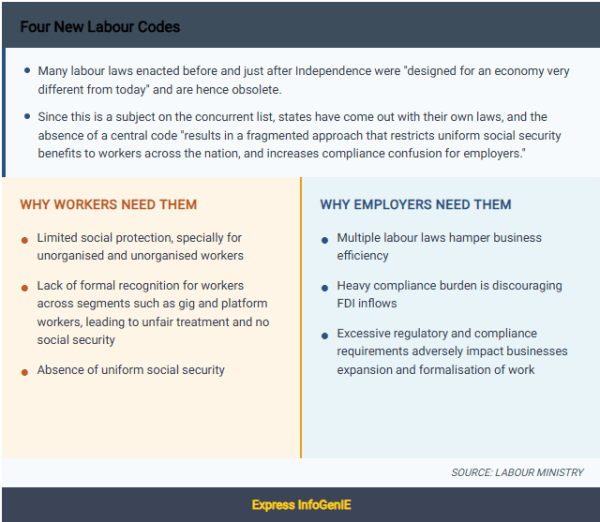
— India’s old labour laws were too many, too complex, and outdated. They increased the compliance burden and discouraged businesses from hiring. Many workers, especially gig, platform, MSME, and migrant workers, had no uniform social security. States had already begun reforming their labour laws, leading to fragmented rules. The new Labour Codes try to fix all this.
— Labour is a Concurrent List subject, and while most states have finalised rules aligned with the four Codes, central-level implementation remains pending. This delay results in: Uneven social security coverage for workers, and Compliance complexity for employers operating across multiple states.
Other Important Articles Covering the same topic:
📍Timely wages, higher basic pay, health checkups
Previous year UPSC Prelims Question Covering similar theme:
(4) Consider the following statements: (UPSC CSE 2017)
1. The Factories Act, 1881 was passed with a view to fix the wages of industrial workers and to allow the workers to form trade unions.
2. N.M. Lokhande was a pioneer in organizing the labour movement in British India.
Which of the statements given above is/are correct?
(a) 1 only
(b) 2 only
(c) Both 1 and 2
(d) Neither 1 nor 2
Previous year UPSC Mains Question Covering similar theme:
“Success of ‘Make in India’ programme depends on the success of ‘Skill India’ programme and radical labour reforms.” Discuss with logical arguments. (UPSC CSE 2015)
Syllabus:
Preliminary Examination: Current events of national and international importance.
Mains Examination: General Studies-II: India and its neighbourhood- relations, Bilateral, regional and global groupings and agreements involving India and/or affecting India’s interests.
What’s the ongoing story: Bangladesh’s ousted prime minister Sheikh Hasina was sentenced to death on November 17 for crimes against humanity during the unprecedented protests in July-August 2024. Hasina, 78, has been living in India since August 5, when she fled the country ahead of the imminent collapse of her 16-year-old government.
Key Points to Ponder:
— What is the history of India-Bangladesh bilateral relations?
— What are the areas of cooperation between India and Bangladesh?
— What are the challenges in India and Bangladesh ties?
— What is the significance of Bangladesh for India?
— How does the political transition in Bangladesh and its impact on India’s foreign policy underscores the importance of neighbourhood diplomacy?
— Map work: Location of Bangladesh and Indian states sharing boundaries with Bangladesh.
Key Takeaways:
— The three-member International Crimes Tribunal led by Justice Md Golam Mortuza Mozumder sentenced Hasina to death on two counts: the killing of six unarmed protesters in Dhaka’s Chankharpul on August 5 last year and the shooting of six student protesters in Ashulia the same day.
— Besides this, Hasina was sentenced to imprisonment until natural death for making inflammatory remarks and ordering the use of deadly weapons against protesting students. She was also found guilty of ordering the extermination of student protesters through the use of helicopters, drones, and lethal weapons.
— Former home minister Asaduzzaman Khan Kamal was also awarded the death penalty, while former inspector general of police Chowdhury Abdullah Al-Mamun, who became a state witness, was sentenced to five years’ imprisonment.
— The verdict on Hasina has evoked reactions across the Bangladesh political spectrum and society, and has major implications for the upcoming elections expected in February 2026.
— Hasina, who ruled the country with an iron fist for about 16-and-half years, has been living in India since that fateful day on August 5.
— Predictably, she called the ruling against her “biased and politically motivated”. “I am not afraid to face my accusers in a proper tribunal where evidence can be weighed and tested fairly,” she said.
— This is the first substantive verdict on her crackdown on protests, in which 1,400 people — mostly young people — were killed.
— While Hasina brought development to Bangladesh, her legacy was marked by corruption, nepotism and allegations that she silenced detractors, transforming her image into an authoritarian, corrupt and arrogant leader.
— The verdict seals her fate for the near term and further fuels anti-Hasina sentiment. It also means she cannot return to Bangladesh in the foreseeable future, ruling her out of the country’s political processes.
— Nobel laureate and chief advisor of the interim government — effectively the interim PM — Prof Muhammad Yunus came to office in August 2024 from Paris, where he was visiting for the Olympics as an advisor on sustainability. With the streets of Bangladesh still in complete chaos, Yunus tried to bring order. The tribunal’s ruling, he said, provided important, though limited, justice for the thousands affected.
— New Delhi has said that even as India remains committed to the best interests of the people of the neighbouring country, it will engage constructively with all stakeholders.
— The Ministry of External Affairs said: “India has noted the verdict announced by the ‘International Crimes Tribunal of Bangladesh’ concerning former Prime Minister Sheikh Hasina”.
— “As a close neighbour, India remains committed to the best interests of the people of Bangladesh, including in peace, democracy, inclusion and stability in that country. We will always engage constructively with all stakeholders to that end,” the MEA added.
— Significantly, the ministry has not condemned the verdict but has merely “noted” it, and has framed its response in terms of commitment to the “people of Bangladesh” — distinct from the Bangladesh government authorities.
— Although there has been no official response to the extradition request, legal provisions allow denial on the grounds that it is “political” in nature or by raising concerns about the fairness of the trial.
— It is unlikely that Delhi will review its approach and hand her over, given that it views her as a friend and partner in India’s bilateral relations with Bangladesh, especially considering the crackdown on radicalism and anti-India activities during her tenure.
— Delhi’s strategic calculus is also based on the assessment that handing Hasina over would not change the attitude of the current Bangladesh establishment or political class towards India. In these circumstances, Hasina could find a safe space in India.
From the World Page- “Dhaka seeks Hasina’s extradition from India”
— Bangladesh’s interim government has sent an “official letter” to India seeking the extradition of deposed prime minister Sheikh Hasina after a special tribunal sentenced her to death, a senior adviser said on Sunday.
— Citing an official source at the foreign ministry, the agency said that the note verbale was sent through the Bangladesh High Commission in New Delhi.
Other Important Articles Covering the same topic:
Previous year UPSC Prelims Question Covering similar theme:
(5) With reference to river Teesta, consider the following statements: (UPSC CSE 2017)
1. The source of river Teesta is the same as that of Brahmaputra but it flows through Sikkim.
2. River Rangeet originates in Sikkim and it is a tributary of river Teesta.
3. River Teesta flows into Bay of Bengal on the border of India and Bangladesh.
Which of the statements given above is/are correct?
(a) 1 and 3 only
(b) 2 only
(c) 2 and 3 only
(d) 1, 2 and 3
Previous year UPSC Prelims Question Covering similar theme:
Critically examine the compulsions which prompted India to play a decisive role in the emergence of Bangladesh. (UPSC CSE 2013)
The protests in Shahbag Square in Dhaka in Bangladesh reveal a fundamental split in society between the nationalists and Islamic forces. What is its significance for India? ( UPSC CSE 2013)
Syllabus:
Preliminary Examination: Current events of national and international importance.
Mains Examination: General Studies-II, III: Government policies and interventions for development in various sectors and issues arising out of their design and implementation, Conservation, environmental pollution and degradation, environmental impact assessment.
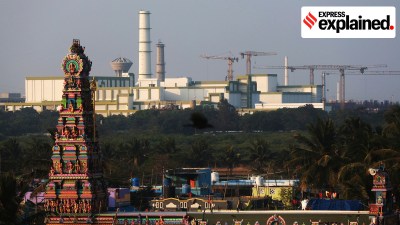
What’s the ongoing story: Purvi Patel writes- “Like clockwork, the NCR has slipped into the same cycle of neglect, retreating indoors, wearing masks infrequently, and hoping the pollution disappears. But air pollution is not a seasonal inconvenience. It is a year-round health problem that refuses to become a public-health priority.”
Key Points to Ponder:
— What is air pollution, and what are its sources?
— How is air pollution measured?
— How does air pollution pose a dual visibility challenge?
— What impact does air pollution have on health, the economy, and the environment in India?
— What are the government initiatives and programmes for combating air pollution in India?
— What steps should be taken to control air pollution?
Key Takeaways:
— “Action on air pollution remains stuck between “environmental” and “biological” realms due to its primary source, fossil fuel combustion. As a health hazard, pollution presents a dual visibility challenge — its origins are hidden and its health effects cannot be enumerated.”
— “Despite rapid growth in renewables, coal still powers over 74 per cent of India’s electricity generation. In North India, cold temperatures and local terrain trap pollutants close to the ground. AQI values help us measure concentrations, but not toxicity or local health risk.”
— “On the health side, air pollution does not cause a single dramatic, easily identifiable disease. Irritation and inflammation from short-term exposure can mimic seasonal coughs, colds, and infections, and exacerbate respiratory and heart diseases.”
— “Long-term PM2.5 exposure not only extends non-communicable diseases (NCD) but is now linked to new-onset hypertension, diabetes, neurological changes in healthy individuals, and rising lung cancer in non-smokers and a reduction in life expectancy by up to eight years in northern India. Because it is only one among many NCD risk factors and cannot be controlled like salt or alcohol individually, it remains ignored.”
— “Pollutants, as non-living particles, lack antigens and do not replicate like bacteria or viruses. So, our immune system cannot build antibodies or memory to make us “immune”. As such, vaccines or medicines that can be deployed en masse during health emergencies do not exist for pollution. Because pollution affects multiple organs and systems, it is not possible to precisely quantify the extent to which polluted air causes any specific illness or death in an individual. This is often used as an excuse. What we can measure are disease burdens and trends in the population.”
— “The State of Global Air 2025 report estimated over two million pollution-attributable deaths in India in 2023. However, contention over data ownership can still delay action. Recent nationwide and multi-city studies in The Lancet Planetary Health have shown that for every 10 µg/m³ increase in PM2.5, annual mortality rises by 8.6 per cent and daily mortality by 1.4 per cent.”
— “India’s health data remains scarce and underutilised. A significant barrier is the uneven adoption of Electronic Health Records (EHR). Unlike the mature EHR systems in Western countries, which enable query-based surveillance and near-real-time analysis, our public health surveillance operates independently of EHRs and relies heavily on manual data entry. This deprives the health sector of the decisive role it should play in holding other sectors accountable for population health, whether in air pollution, climate change or development projects.”
— “The National Outdoor Air and Disease Surveillance tracks daily aggregates of respiratory emergencies and admissions from selected tertiary hospitals in cities under the National Clean Air Programme. However, in its early stage, it captures only acute respiratory illnesses, lacks advanced analytical capabilities, and has yet to generate credible evidence. Ironically, the very institutions that warn citizens about pollution do not consistently report cases to the national system. These limitations weaken its ability to estimate thresholds or issue health-impact-based early warnings.”
— “Together, these gaps create a serious disconnect between the sectors that generate pollution, regulate it, monitor health impacts, and the public. We then rely on reactive afterthoughts like artificial rain, water cannons, more monitors, or antioxidant foods, while accumulating serious health damage year after year, drowning in the smog of our own consumption, and remaining blind to systemic gaps.”
Other Important Articles Covering the same topic:
📍Why air pollution should be an urgent national priority
📍UPSC Issue at a Glance | Air Pollution: 4 Key Questions You Must Know for Prelims and Mains
Previous year UPSC Mains Question Covering similar theme:
Describe the key points of the revised Global Air Quality Guidelines (AQGs) recently released by the World Health Organisation (WHO). How are these different from its last update in 2005? What changes in India’s National Clean Air Programme are required to achieve revised standards? (UPSC CSE 2021)
|
ALSO IN NEWS |
|
| Centre’s rethink on Chandigarh Bill: No final decision taken | A day after a Bill to include Chandigarh in Article 240 of the Constitution, which empowers the President to make regulations for the Union Territory and legislate directly, figured in a tentative list of Lok Sabha business for the winter session next month and led to an uproar in Punjab, the Centre said Sunday the proposal was “still under consideration” and it had “no intention of introducing any Bill to this effect” in the upcoming session of Parliament. |
| ITBP to establish 10 all-woman forward posts at India-China border | The Indo Tibetan Border Police (ITBP) is set to establish all-woman forward posts at 10 locations along the 3,488-km India-China border between Ladakh’s Karakoram Pass and Diphu La in Arunachal Pradesh.
Delivering an address at the ITBP’s 64th Raising Day Parade in Udhampur on Saturday, Director General Praveen Kumar said the all-woman border posts would first be established in Ladakh’s Lukung and Himachal Pradesh’s Thangi. “Soon, such border posts will be set up at eight other places as well,” he said. |
| How Tamil Nadu’s record paddy harvest turned into a storage crisis | In the first week of October, Chief Minister M K Stalin convened a meeting of Collectors from the Cauvery delta districts on video conference and called 2024-25 a “record year” for paddy. By then, Tamil Nadu had procured 47.99 lakh tonnes of paddy — already surpassing its earlier high of 44.95 lakh tonnes in 2020-21 — with weeks still to go in the procurement cycle. Yet, that same bumper harvest has triggered a rolling crisis in the delta: paddy lying in the open, bags germinating under Northeast Monsoon showers, farmers waiting days outside Direct Purchase Centres (DPCs), and a bitter blame game between the state, the Union government, and its own procurement machinery. |
| Mid-cap rally continues: What’s driving inflows and how should investors navigate the market | Flows in mid-cap stocks continue to remain high as market participants keep chasing the strong double-digit returns these stocks have offered in the previous years. Recently, Nifty midcap indices hit record highs, driven by sustained inflows from retail investors via systematic investment plans (SIPs), and supported by robust earnings growth in the segment. SEBI has categorised companies as large, mid and small-cap based on their market capitalisation to maintain uniformity in terms of the investment universe for equity schemes. The top 100 companies in terms of market capitalisation are categorised as large-cap, while mid-cap companies are those ranked from 101st to 250th in terms of market capitalisation. Companies ranked from the 251st position lie in the small-cap category. In terms of actual valuation, mid-cap companies fall in the range of Rs 5,000 crore to Rs 20,000 crore. Mid-cap stocks offer higher returns compared to large-cap funds but are riskier. Nifty mid-cap indices made fresh highs driven mainly by renewed domestic institutional flows (mutual funds/SIPs), better near-term earnings momentum in mid-cap cohorts, and positive domestic liquidity or monetary cues, said independent analyst Ajay Bagga. |
| PRELIMS ANSWER KEY |
| 1. (a) 2. (b) 3. (b) 4. (b) 5. (b) |
Subscribe to our UPSC newsletter. Stay updated with the latest UPSC articles by joining our Telegram channel – Indian Express UPSC Hub, and follow us on Instagram and X.
🚨 Click Here to read the UPSC Essentials magazine for November 2025. Share your views and suggestions in the comment box or at manas.srivastava@indianexpress.com🚨

Read UPSC Magazine