20 min read

© IE Online Media Services Pvt Ltd



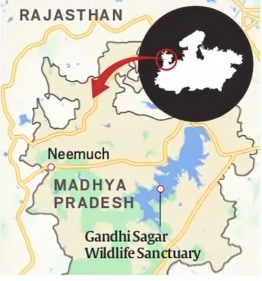
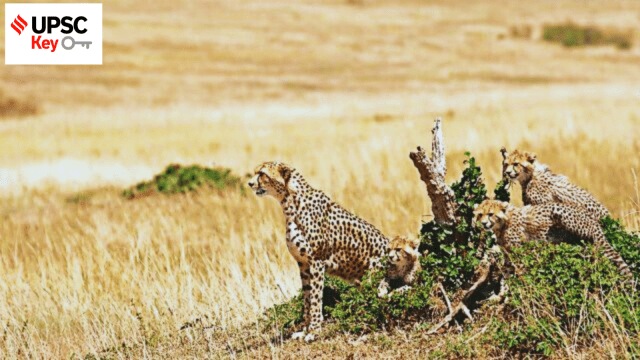 Gandhi Sagar Wildlife Sanctuary is spread across an area of 368.62 sq km in the districts of Mandsaur and Neemuch in western MP. Know more in our UPSC Key. (Representational image)
🚨 Attention: UPSC Key is now all 7 Days a Week!🚨
Important topics and their relevance in UPSC CSE exam for June 17th, 2024. If you missed the June 16th, 2024 UPSC CSE exam key from the Indian Express, read it here.
🚨 The Indian Express UPSC Essentials brings to you the June edition of its monthly magazine. Click Here to read. Share your views and suggestions in the comment box or at manas.srivastava@indianexpress.com🚨
UPSC Syllabus:
Preliminary Examination: Current events of national and international importance
Mains Examination: GS-III: Environment
What’s the ongoing story- The Gandhi Sagar Wildlife Sanctuary will be the second home for cheetahs in India, after the Kuno National Park. The Madhya Pradesh government has announced that it has completed its preparations for the ambitious project.
Prerequisites:
— What is the IUCN status of Cheetah?
— What is Project Cheetah?
— Map work: Check the location of Gandhi Sagar Wildlife Sanctuary, Kuno National Park, Kanha, Satpura and Sanjay tiger reserves, Bhainsrodgarh Sanctuary, Chambal river,
Key takeaways:
— The sanctuary is spread across an area of 368.62 sq km, in the districts of Mandsaur (187.12 sq km) and Neemuch (181.5 sq km) in western MP, right on the border with Rajasthan.
It sits atop a flat rocky plateau, with the Chambal river cutting the sanctuary into two almost equal halves. The Gandhi Sagar dam, constructed on the river in 1960, lies within the area of the sanctuary, and so does parts of its reservoir, 726 sq km large in area and third largest in the country.
— Due to the rocky terrain and exposed sheetrock, the topsoil is shallow. This is behind Gandhi Sagar’s savanna ecosystem comprising open grasslands interspersed with dry deciduous trees and shrubs. The riverine valleys, however, are evergreen.
— Food is the biggest challenge to making Gandhi Sagar a viable cheetah habitat. For cheetahs to sustainably survive in Gandhi Sagar, the first step is thus prey base augmentation, i.e. increasing the number of animals that the wild cats can prey upon.
— Just like in Kuno, the leopard population in Gandhi Sagar will pose a threat to cheetahs, with the two feline predators competing for the same prey, and possibly even clashing with each other in wild encounters.
For Your Information:
— Asiatic Cheetahs were once abundant in India but their numbers dwindled over the centuries due to loss of habitat and widespread hunting. The last cheetah in the country died in 1952.
Points to Ponder:
— What caused the extinction of cheetahs in India?
— What are the challenges of the cheetah reintroduction project?
— What is the significance of the Project Cheetah?
— What other challenges may cheetahs face in Gandhi Sagar Wildlife Sanctuary?
— What is the IUCN status of chital (spotted deer) and gaurs (Indian bison)?
Post Read Question:
Consider the following: (UPSC CSE 2012)
1. Black-necked crane
2. Cheetah
3. Flying squirrel
4. Snow leopard
Which of the above are naturally found in India?
(a) 1, 2 and 3 only
(b) 1, 3 and 4 only
(c) 2 and 4 only
(d) 1, 2, 3 and 4
Other Important Articles Covering the same topic:
MP completes preparations for second cheetah home – Gandhi Sagar Sanctuary
UPSC Syllabus:
Preliminary Examination: Indian and World Geography
Mains Examination: GS-I, GS-III: Important Geophysical phenomena and environment
What’s the ongoing story- Hyderabad-based Indian National Centre for Ocean Information Services (INCOIS) has developed a new product to predict the emergence of El Niño and La Niña conditions — they are different phases of El Niño Southern Oscillation (ENSO) — up to 15 months in advance.
Prerequisites:
— What is El Niño Southern Oscillation (ENSO)?
— What is INCOIS?
— Map work: Pacific Ocean and bordering countries. (Refer Atlas)
Key takeaways:
— ENSO is a climate phenomenon that involves changes in the temperature of waters in the central and eastern tropical Pacific Ocean, coupled with fluctuations in the overlying atmosphere. It can alter the global atmospheric circulation, which, in turn, influences weather across the world.
— ENSO occurs in irregular cycles of 2-7 years and has three different phases — warm (El Niño), cool (La Niña), and neutral. In the neutral phase, the eastern side of the Pacific Ocean (near the northwestern coast of South America) is cooler than the western side (near the Philippines and Indonesia). This is due to the prevailing wind systems that move from east to west, sweeping the warmer surface waters towards the Indonesian coast. The relatively cooler waters from below come up to replace the displaced water.
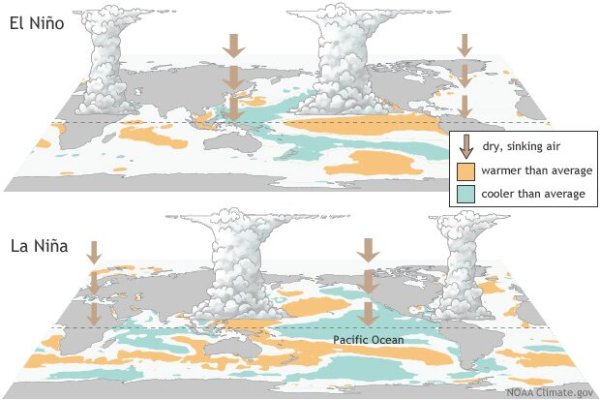
— In the El Niño phase, however, wind systems weaken, leading to lesser displacement of warmer waters. As a result, the eastern side of the Pacific becomes warmer than usual. In the La Niña phase, the opposite happens.
— In India, while El Niño conditions usually lead to a weak monsoon and intense heatwaves, La Niña conditions result in a strong monsoon.
— Known as Bayesian Convolutional Neural Network (BCNN), the new product uses the latest technologies such as Artificial Intelligence (AI), deep learning, and machine learning (ML) to improve forecasts related to the ENSO phases.
— The model’s prediction relies on the fact that El Niño or La Niña are connected to the slow oceanic variations and their atmospheric coupling, which gives sufficient lead time to issue early forecasts.
Points to Ponder:
— What are the existing models used for El Niño and La Niña forecasting?
— What are the conditions that cause El Niño?
— What is the Indian Ocean Dipole?
— How does El Niño impact the Indian economy?
Post Read Question:
With reference to Indian monsoon, consider the following:
1. The development of El-Nina conditions in the Pacific ocean facilitates above normal rainfall during monsoon in India.
2. The Indian Ocean Dipole is the counterpart of La Nina in the Indian Ocean.
3. The alternative phase of warming and cooling of the sea surface impacts the monsoon condition in the Indian ocean region.
4. A good La Nina condition in the Pacific ocean causes below normal rainfall during the monsoon in India.
How many of the statements given above are correct?
(a) Only one
(b) Only two
(c) Only three
(d) All four
Other Important Articles Covering the same topic:
What is El Nino and how it impacts the monsoon
UPSC Syllabus:
Preliminary Examination: Current events of national and international importance.
Mains Examination: GS-II: International relations
What’s the ongoing story- Eighty countries jointly called Sunday for the “territorial integrity” of Ukraine to be the basis for any peace agreement to end Russia’s war, though some key developing nations at a Swiss conference did not join in.
Prerequisites:
— Know in brief about the Russia-Ukraine War.
— Map work: Location of Ukraine, Russia, Switzerland and bordering countries; Other important places in the news concerning the ongoing Ukraine-Russia War.
Key takeaways:
— The joint communique capped a two-day conference at the Burgenstock resort in Switzerland marked by the absence of Russia, which was not invited, but that many attendees hoped could join in on a roadmap to peace.
— Participants India, Saudi Arabia, and the United Arab Emirates were among those that did not sign onto the final document, which focused on issues of nuclear safety, food security, and the exchange of prisoners. The final document said the UN Charter and “respect for territorial integrity and sovereignty … can and will serve as a basis for achieving a comprehensive, just and lasting peace in Ukraine.”
— Analysts say the two-day conference will likely have little concrete impact on ending the war because the country leading and continuing it, Russia, was not invited — for now. Its key ally, China, which did not attend, and Brazil, which was on hand at the meeting as an observer, have jointly sought to plot alternative routes toward peace.
For Your Information:
— Saudi Arabia, India, South Africa, Thailand, Indonesia, Mexico and the United Arab Emirates were among countries participating at a summit on peace for Ukraine that did not sign a final communique, the Swiss government said on Sunday.
— With Russia not attending the Swiss summit on peace in Ukraine and calling it a “waste of time”, India decided to not sign the joint communique by saying that “only those options acceptable to both parties can lead to abiding peace”.
Points to Ponder:
— What are the key highlights of the Ukraine declaration?
— Why did India opt not to sign the Ukraine declaration?
— What is the status of India-Russia relations?
Post Read Question:
Consider the following countries: (UPSC CSE 2023)
1. Bulgaria
2. Czech Republic
3. Hungary
4. Latvia
5. Lithuania
6. Romania
How many of the above-mentioned countries share a land border with Ukraine?
(a) Only two
(b) Only three
(c) Only four
(d) Only five
Other Important Articles Covering the same topic:
Saudi Arabia, India, South Africa opt out of Ukraine declaration
UPSC Syllabus:
Preliminary Examination: Economic and Social Development
Mains Examination: GS-III: Indian Economy and issues relating to planning, mobilisation of resources, growth.
What’s the ongoing story- As the Indian economy grapples with the problem of flagging consumption, policymakers in the government are in favour of rationalising the existing income tax structure, especially at lower income levels.
Prerequisites:
— What are the sources for government receipts?
— What are the different types of taxes in India?
— What is the new tax system?
Key takeaways:
— According to two government officials The Indian Express spoke with, it is likely that tax rate cuts for those earning less may likely take precedence over freebies or excessive welfare spending given the focus on fiscal consolidation.
— The tax cuts may be a more efficient measure to enhance disposable income, which in turn would result in higher consumption, and give a fillip to economic activities, the officials said.
— A boost to consumption is being seen as crucial for reviving demand, which in turn is central to restarting the investment cycle, especially rekindling private capital expenditure in consumer-focused sectors, an official explained. Of course, this could also add to GST collections, he said.
— The revenue loss from any such measure requires a dynamic analysis, officials said. “Since it is expected to spur demand, it requires a general equilibrium analysis to assess the net effect. There will be more money in the hands of the people, leading to better consumption and more direct and indirect tax revenues. So even though revenue loss might be there, the net effect will be positive,” the official said.
— In the most recent GDP data release for the January-March quarter on May 31, Private Final Consumption Expenditure (PFCE), an indicator of consumption demand, dropped as a share of GDP to 52.9 per cent — the lowest level in the 2011-12 base year series.
— The government has been focusing on fiscal consolidation over the last few years, with an aim to bring down the fiscal deficit to 5.1 per cent of the GDP in 2024-25 and reduce it further to below 4.5 per cent in 2025-26.
Points to Ponder:
— What are the pros and cons of the income tax rate cut?
— What is a fiscal deficit? What measures can be taken for fiscal consolidation?
— What are the issues in India’s taxation system?
— Why is the income tax rate cut preferred over the higher welfare expenditure for increasing disposable income and consumption?
(Thought Process: While welfare spending comes with leakages, a tax rate cut at the lower income levels often leads to higher consumption. It boosts demand, which is critical for kickstarting investment, especially by the private sector, which has remained moribund for years now.)
Post Read Question:
Prelims
Which of the following is/are included in the capital budget of the Government of India? (UPSC CSE 2016)
1. Expenditure on acquisition of assets like roads, buildings, machinery, etc.
2. Loans received from foreign governments
3. Loans and advances granted to the States and Union Territories
Select the correct answer using the code given below:
(a) 1 only
(b) 2 and 3 only
(c) 1 and 3 only
(d) 1, 2 and 3
Mains
Distinguish between Capital Budget and Revenue Budget. Explain the components of both these Budgets. (UPSC CSE 2021)
Other Important Articles Covering the same topic:
UPSC Syllabus:
Preliminary Examination: Current events of national and international importance
Mains Examination: GS-II: International Relations
What’s the ongoing story- The leaders of the seven western nations and invited special guests from across the world for the outreach session showed up in picturesque eastern Italy after all the arduous work, including the drafting of final statements, was done by their diplomats.
Prerequisites:
— What is the Group of Seven (G7)?
— The 50th summit of the G7 was hosted by which country?
Key takeaways:
— American and European analysts point to the growing weaknesses of the West and its internal divisions and critics bemoan the fecklessness of its current leadership. Meanwhile, India’s position in relation to the West is rising thanks to its economic growth and its geopolitical role as a “swing state”. Next year, India’s aggregate GDP is expected to overtake Japan’s and, a couple of years later, Germany’s. That would put the size of India’s economy ahead of all G7 countries except the US.
— The deepening geopolitical tensions with Beijing, the imperatives of restructuring the global economic order to reduce dependence on China, and the need for the US and Europe to reconnect with the Global South have all created the conditions for a new strategic compact between India and the West.
For Your Information:
— The G7 is an informal forum of leading industrialised nations, which include Canada, France, Germany, Italy, Japan, the United Kingdom and the United States. Representatives of the European Union are always present at the annual meeting of the heads of state and government of the G7.
Points to Ponder:
— How has the G7 evolved?
— What is the significance of the G7 summit for India?
— What are the initiatives of the G7?
— what are the key highlights of the G7 Summit 2024?
Post Read Question:
Consider the following countries:
1. China
2. Japan
3. USA
4. France
5. Italy
6. Canada
How many of the above mentioned countries form the part of the G7?
(a) Only two
(b) Only three
(c) Only four
(d) Only five
Other Important Articles Covering the same topic:
UPSC Syllabus:
Preliminary Examination: Indian Polity and Governance
Mains Examination: GS-II: Polity, Government policies and interventions
What’s the ongoing story- Indira Jaising writes– “The Minister for Law and Justice has just announced a National Litigation Policy. He said it is aimed at “transforming the government into an efficient and responsible government”. The policy, he is reported to have said, is intended to reduce high legal costs and decrease the number of cases in which the government is a party as well as the load on the courts. At the same time, the Home Minister has said that three new criminal laws will be brought into force with effect from July 1, 2024.”
Prerequisites:
— Why new criminal laws have been introduced?
— Read about the three new criminal laws. i.e., Bharatiya Nagarik Suraksha Sanhita, 2023 (BNSS), Bharatiya Nyaya Sanhita (BNS), and Bharatiya Sakshya Adhiniyam.
— Read about the National Litigation Policy.
Key takeaways:
— “Article 21 states that no person shall be deprived of life and liberty except by procedure established by law. The procedure established by law referred to here is the Criminal Procedure Code (CrPC), which has now been abandoned and replaced by the three new criminal laws.”
— “The three new criminal laws reword almost every section of the three fundamental criminal laws, the IPC, the CrPC and the Indian Evidence Act. These laws have been in operation for over a century and have received interpretations at the hand of the Supreme Court of India.”
— “Predictability and certainty of criminal laws is one of the fundamental principles of the rule of law. People base their conduct on laws in existence and modulate their conduct to avoid criminality. When there is uncertainty about criminal laws, the life and liberty of citizens is in grave danger as the consequence of violation of criminal laws is arrest.”
— “With effect from July 1, unless stopped, we will have two different systems of criminal justice in operation. Substantive laws cannot be retrospective; procedural laws can be unless they negatively impact the accused.”
— “No audit has been done of the likely impact of three new criminal laws on the delay that will be caused or the infrastructure needed to upgrade the system of delivery of criminal justice.”
— “In addition to the burden of costs and backlog, there are the questions of the creation of several new offences which will impact our life and liberty.”
— “With the announcement of the National Litigation Policy, the Bharatiya Nagarik Suraksha Sanhita, 2023, Bharatiya Nyaya Sanhita, 2023, and Bharatiya Sakshya Adhiniyam, 2023 ought not to come into force on July 1 and until we are guaranteed speedy access to justice through a judicial audit of these laws, on the extent to which the backlog of criminal litigation will increase and the impact of these laws on fundamental rights of the accused.”
Points to Ponder:
— What are the key provisions of the new criminal laws?
— What are the issues associated with the new criminal laws?
— What is the significance of the National Litigation Policy?
— What inititaives have been taken by the government with reagrd to the criminal justice system?
Post Read Question:
What was the need to introduce new criminal laws in India? Analyze the potential benefits and concerns associated with new criminal laws.
Other Important Articles Covering the same topic:
Arjun Ram Meghwal approves policy on litigation, says UCC remains on agenda: ‘Keep watching’
Three new criminal laws kick in from 1st July 2024
UPSC Syllabus:
Preliminary Examination: History of India
Mains Examination: GS-I: Indian Heritage and Culture, History.
What’s the ongoing story- A popular legend about Humayun, the Mughal emperor who succeeded his father Babar to the throne in the 16th Century, is that he fell to his death after tripping down the stairs of his observatory — some versions say it was a library — to answer a prayer call but few know that the ruler’s beloved structure is situated in the heart of Delhi.
Prerequisites:
— Who was Humayun?
— Who was Sher Shah Suri?
— What is Purana Qila?
— Read about the Mughal Empire.
Key takeaways:
— A little over four kilometres away from his final resting place, the iconic Humayun’s Tomb, is the centuries-old Purana Qila which has borne witness to the rise of empires.
— In January 1556, barely months after he had regained the throne, Humayun fell to his death at Sher Mandal.
— It is widely believed that Sher Mandal was built by Sher Shah Suri, ruler of Bihar who had managed to defeat the Mughal Empire to establish his rule, until his life was cut short in an accident, paving the way for Humayun’s return.
Points to Ponder:
— What are the characteristics of Indo-Islamic architecture?
— What is Pietra Dura?
— What are some examples of Mughal architecture?
— Is Humayun’s Tomb a UNESCO World Heritage Site?
Post Read Question:
Consider the following properties included in the World Heritage List released by UNESCO: (UPSC CSE 2024)
1. Shantiniketan
2. Rani-ki-Vav
3. Sacred Ensembles of the Hoysalas
4. Mahabodhi Temple Complex at Bodhgaya
How many of the above properties were included in the 2023?
(a) Only one
(b) Only two
(c) Only three
(d) All four
‘Wordly Wise’ from The Editorial Page
“A genuine leader is not a searcher for consensus but a molder of consensus.”
— Martin Luther King, Jr.
(Thought Process: What do you understand by the term ‘consensus’? What is the role of a leader in building consensus? Is the deliberation only mean to reach a consensus? In the process of deliberation, what can we expect from the leader? Do you agree that having clarity about the vision is the foundation for building consensus? Elaborate.)
Subscribe to our UPSC newsletter and stay updated with the news cues from the past week.
The UPSC articles of Indian Express is now on Telegram. Join our Telegram channel- Indian Express UPSC Hub and stay updated with the latest Updates.
https://www.youtube.com/watch?v=wsnxUastCeM?si=I3CnTYUrAK5zAmFz


Read UPSC Magazine