12 min read


© IE Online Media Services Pvt Ltd



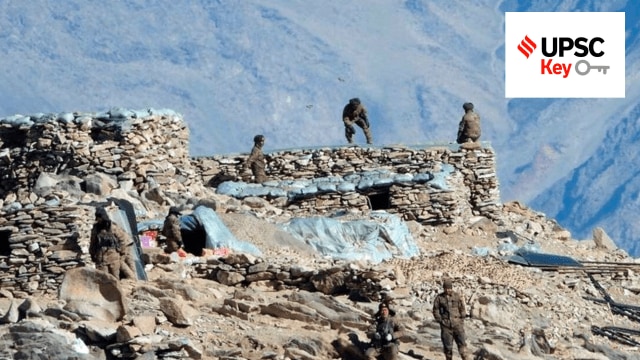 UPSC Key 2022: Here's what you should be reading from the December 13, 2022 edition of The Indian Express.
 Important topics and their relevance in UPSC CSE exam for December 13, 2022. If you missed the December 12, 2022 UPSC key from the Indian Express, read it here
FRONT PAGE
First time since Galwan, India and China troops clash in Tawang sector
Syllabus:
Preliminary Examination: Current events of national and international importance.
Mains Examination: General Studies II: India and its neighborhood- relations.
Key Points to Ponder:
• What’s the ongoing story-Indian and Chinese troops clashed in Arunachal Pradesh’s Tawang sector in the early hours of December 9, beating each other up with sticks and canes in their closest encounter since the deadly Galwan incident in eastern Ladakh in June 2020. The Indian soldiers who were injured in the clash are recuperating in a Guwahati hospital, sources said.
• How are relations between China and India currently?
• ‘China-India relations have been worse over recent months. Along their contentious border in the Himalayan area, the two nations are at odds with one another’-Discuss
• Map Work-Tawang and Line of Actual Control (LAC)
• What is the difference between Line of Actual Control (LAC) and McMahon Line?
• What has happened in Tawang, Arunachal Pradesh?
• What kind of “clash” was this on the LAC?
• Where exactly did the India-China clash take place, and how did it begin?
• Why did the Chinese soldiers cross over to the Indian side?
• Is there a larger context to the border clash?
• Meanwhile, what is happening along the LAC in Ladakh?
Other Important Articles Covering the same topic:
📍What we know about the clash between Indian and Chinese soldiers in Arunachal Pradesh
Industrial output hits 26-month low, retail inflation silver lining
Syllabus:
Preliminary Examination: Economic and Social Development
Mains Examination: General Studies III: Indian Economy and issues relating to planning, mobilization, of resources, growth, development and employment.
Key Points to Ponder:
• What’s the ongoing story- Industrial output, as measured by the Index of Industrial Production (IIP), slumped to a 26-month low of (-) 4 per cent in October on the back of a contraction in manufacturing and consumer goods, data released by the National Statistical Office (NSO) showed — indicating weak exports and sluggish consumption demand, alongside the continuing weakness of small and medium enterprises.
• By how much — and where — has industrial output declined?
• But why, the Industrial output, as measured by the Index of Industrial Production (IIP), slumped to a 26-month low of (-) 4 per cent in October?
• What does Industrial output mean?
• What is ‘Index For Industrial Production (IIP)’?
• Index For Industrial Production-Know its components
• Is ‘service sector’ part of Index For Industrial Production (IIP)?
• Who releases Index of Industrial Production (IIP) data?
• Who uses Index For Industrial Production (IIP) data?
• Do you Know-The base year for ‘Index For Industrial Production (IIP) was changed to 2011-12 from 2004-05 in the year 2017. The earlier base years were 1937, 1946, 1951, 1956, 1960, 1970, 1980-81, 1993-94 and 2004-05.
• Where is Index For Industrial Production (IIP) data sourced from?
• Index For Industrial Production (IIP) vs the Annual Survey of Industries (ASI)-Compare and Contrast
• Does the latest print run counter the government and RBI projections?
Other Important Articles Covering the same topic:
📍October IIP lowest in more than a year: Why has industrial output declined?
THE CITY
Why these winters are not wintry enough
Syllabus:
Preliminary Examination: Indian and World Geography-Physical, Social, Economic Geography of India and the World.
Mains Examination: General Studies I: Important Geophysical phenomena such as earthquakes, Tsunami, Volcanic activity, cyclone etc., geographical features and their location-changes in critical geographical features (including water-bodies and ice-caps) and in flora and fauna and the effects of such changes.
Key Points to Ponder:
• What’s the ongoing story-The days have been unusually warm for winter this December with the maximum temperature remaining above normal. The maximum temperature on Monday, for instance, was 27.1 degrees Celsius, four degrees above the normal for this time of the year. On Sunday, the maximum temperature was even higher at 28.4 degrees Celsius. This is the second-highest maximum temperature for December from 2015 onwards, India Meteorological Department (IMD) data shows.
• Why the days have been unusually warm for winter this December with the maximum temperature remaining above normal?
• What are western disturbances?
• What is the cause of western disturbances?
• What is the effect of western disturbances?
• What is the impact of western disturbances on the climate of India in general and on Delhi in particular?
• Do You Know-Western disturbances are storms that originate in the Mediterranean region. They bring easterly winds to Delhi, along with a spike in moisture and increased clouding or rainfall. They are regular features in winter. In monsoon and summer, they have more tropical characteristics and bring rain and thunderstorms. In winter, they bring rain and snow over the hills, and more moisture to the plains. The cloud cover results in higher minimum temperatures at night and lower day-time or maximum temperatures.
Other Important Articles Covering the same topic:
📍How western disturbances are keeping Delhi weather in a flux
GOVT & POLITICS
Bill to set up carbon credit trading scheme passed
Syllabus:
Preliminary Examination: General issues on Environmental ecology, Bio-diversity and Climate Change – that do not require subject specialization.
Mains Examination: General Studies III: Conservation, environmental pollution and degradation, environmental impact assessment.
Key Points to Ponder:
• What’s the ongoing story-Parliament on Monday passed the Energy Conservation (Amendment) Bill-2022 that enables the Union government to set up a carbon credit trading scheme and specify the minimum amount of non-fossil sources to be used by designated energy consumers.
• What is the carbon trading scheme?
• Energy Conservation (Amendment) Bill, 2022-Know the key highlights
• What is the main objective Energy Conservation Act?
• Why Energy Conservation Act 2001 is amended?
• What is India’s commitment to climate change under the United Nations Framework Convention on Climate Change?
• What is the difference between a carbon tax and a carbon trading scheme?
• What is Carbon Credit?
• How does carbon credit work?
• Carbon Trading and Carbon Credit-compare and contrast
• Difference between ‘Net Zero’ and ‘Carbon Neutral’?
• What is India’s New Renewables Energy Target?
• How can net zero be achieved?
• Public-Private partnership frameworks to achieve ‘net zero’-issues and challenges
• India’s emission Status-Present Scenario
Other Important Articles Covering the same topic:
📍Electricity Amendment Bill 2022: A mixed bag
THE EDITORIAL PAGE
Syllabus:
Preliminary Examination: Current events of national and international importance.
Mains Examination: General Studies II: India and its neighbourhood- relations.
Key Points to Ponder:
• What’s the ongoing story-Avinash Paliwal Writes: For the first time since 2009, Sheikh Hasina is on the back foot and a Sri Lanka-level macro-economic breakdown is a possibility. There is a dire need for calibrated behind-the-scenes intervention by regional powers, especially India
• Why are protests taking place in Bangladesh?
• “Bangladesh is at the cusp of a political shift that it has not witnessed since 2009”-Elaborate
• What is the current economic situation in Bangladesh?
• Bangladesh’s economy is-it in trouble?
• India’s Economy and Bangladesh’s economy-Compare
• “Bangladesh’s macroeconomic improvements, considerably important and celebrated the world over, don’t automatically translate into redistribution of wealth and institutional integrity”-Discuss.
• “The dual shock of the pandemic followed by Russia’s invasion of Ukraine dislocated Dhaka’s macroeconomic growth story”-How have the pandemic and Russia-Ukraine war impacted Bangladesh’s economy?
• For both Delhi and Dhaka, the reinvention of the bilateral relationship has been one of the most significant successes of their recent foreign policies-Know bilateral relationship between India and Bangladesh
• Know bone of contention between India and Bangladesh
• Why engagement with Bangladesh is of the immense benefits of deeper economic for the India’s north-eastern states?
• How India can help Bangladesh in this current situation?
Other Important Articles Covering the same topic:
THE IDEAS PAGE
Syllabus:
Preliminary Examination: Economic and Social Development and Indian Polity and Governance
Mains Examination:
• General Studies II: Functions and responsibilities of the Union and the States, issues and challenges pertaining to the federal structure, devolution of powers and finances up to local levels and challenges therein
• General Studies III: Inclusive growth and issues arising from it.
Key Points to Ponder:
• What’s the ongoing story- Trishali Chauhan , Christophe Jaffrelot Writes: When GST was launched, the question was “Is the country completely ready for single tax?” While this question remains relevant, there is a need to ask another: We have transitioned to “One nation, one tax”, but at what cost?
• The Goods and Services Tax which was introduced to replace the complex order of entry levies and sales tax in India has become a lot more than just being about “one nation, one tax”-Elaborate
• What changes GST brought in the India’s Tax regime?
• How has India’s tax system changed as a result of the GST?
• “The most welcome change that came along with GST is the e-invoice system”-What is e-invoice system?
• “GST is not just about tax collection anymore. It is important to note that the quantifiable parameters of GST success do not incorporate social and political costs, which have financial and administrative snowballing effects”- What social and political costs?
• What observations did the Supreme Court made on the GST Council and on country’s federal structure? (Hint: Recommendations of the Goods and Services Tax (GST) Council cannot be binding on the Centre and states and many more)
• What is The Goods and Services Tax (GST)?
• The Kelkar Task Force on the Fiscal Responsibility and Budget Management (FRBM) Act, 2003 and the Genesis of Goods and Services Tax (GST)
• Goods and Services Tax (GST) and 101st Amendment Act, 2016-Know in detail
• What are the different types of Goods and Services Tax (GST)?
• Know the differences between Central GST (CGST), State GST (SGST), Union territory GST (UTGST) and Integrated GST (IGST)
• How would a particular transaction of goods and services be taxed simultaneously under Central GST (CGST) and State GST (SGST)?
• What are the benefits of Goods and Services Tax (GST) in India?
• Goods and Services Tax (GST)-Issues and Challenges
• GST Council and Article 279A of the Constitution-Key Provisions
• GST Council and Members-Know in detail
• What is the role of GST Council?
• What is the nature of Federalism in India?
• Important features of Indian federalism-Know in detail
• The Constitution of India provides for a federal system of government, But the term ‘federation’ has nowhere been used in the Constitution-True or False?
• What Supreme Court of India said on Federalism in India in Union of India and Anr versus M/s Mohit Minerals Through Director case?
• Decode the quote in the context of GST- “Democracy and federalism are interdependent on each other for their survival such that federalism would only be stable in well-functioning democracies”.
• Competitive Federalism Cooperative Federalism and Fiscal Federalism are very much in news. What do you understand by these terms in Indian Scenario?
Other Important Articles Covering the same topic:
📍SC: GST panel proposals not binding, can disrupt fiscal federalism
EXPLAINED
Inflation under 6%; why RBI may still stick to hawkish stand
Syllabus:
Preliminary Examination: Economic and Social Development
Mains Examination: General Studies III: Indian Economy and issues relating to planning, mobilization, of resources, growth, development and employment
Key Points to Ponder:
• What’s the ongoing story-Retail inflation for November has fallen below 6%, the upper limit of the RBI’s extended comfort zone. According to data released by the National Statistical Office (NSO) under the Ministry of Statistics and Programme Implementation (MoSPI) on Monday (December 12), retail inflation for November stood at 5.88%. The inflation rate has moderated sharply over the past two months from 7.41% in September to 6.77% in October to under 6% now.
• What does this mean?
• Why is this significant?
• What contributed to the sharp deceleration in inflation rate?
• What was the geographical distribution of inflation in India?
• Does this mean the days of high inflation are past?
• Does this mean RBI can stop raising interest rates?
• What do you understand by Wholesale Price Index (WPI) and Consumer Price Index?
• What is CPI-based Inflation or Retail Inflation?
• The base year of Wholesale Price Index (WPI)?
• Base Year for Consumer Price Index (CPI)?
• Impact of increase in the REPO and CRR on Money Supply on an Economy-Inflation or Deflation?
• Know about these terms-Bank Rate, Reverse Repo Rate, Liquidity Adjustment Facility (LAF), Marginal Standing Facility (MSF) etc.
• New Standard for Measuring Inflation in India and Old Standard for Measuring Inflation-Key Differences
• What are the various Instruments of Monetary Policy to control Inflation?
• How Inflation is Measured in India?
Other Important Articles Covering the same topic:
📍CPI Inflation November, India IIP Data October 2022: Retail inflation eases to a 11-month low of 5.88% in Nov, IIP contracts 4% in Oct, shows Govt data
For any queries and feedback, contact priya.shukla@indianexpress.com
The UPSC KEY Indian Express is now on Telegram. Click here to join our channel and stay updated with the latest Updates.

Read UPSC Magazine