24 min read


© IE Online Media Services Pvt Ltd



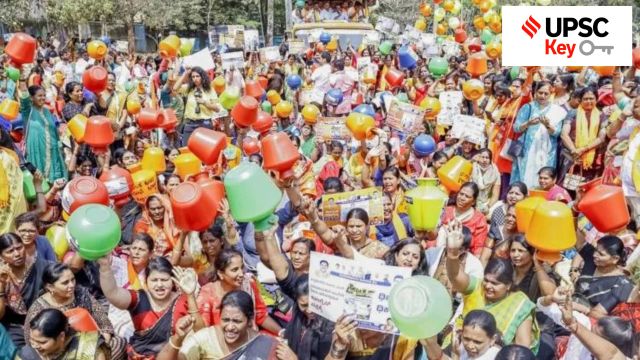 UPSC Key March, 2024: Here's what you should be reading from the March 20, 2024 edition of The Indian Express (Express photo by Jithendra M)
Important topics and their relevance in UPSC CSE exam for March 20, 2024. If you missed the March 19, 2024 UPSC CSE exam key from the Indian Express, read it here
FRONT PAGE
No stay on CAA Rules, SC tells Govt to respond to pleas
Syllabus:
Preliminary Examination: Indian Polity and Governance-Constitution, Political System, Panchayati Raj, Public Policy, Rights Issues, etc.
Main Examination: General Studies II: Indian Constitution—historical underpinnings, evolution, features, amendments, significant provisions and basic structure.
Key Points to Ponder:
• What’s the ongoing story- WHILE IT refused to stay the implementation of the Citizenship (Amendment) Act Rules notified earlier this month, the Supreme Court on Tuesday issued notice to the Centre, asking it to respond to petitions challenging the Rules.
• Why the Supreme Court issued notice to the Centre?
• What is the Citizenship Amendment Act, 2019?
• What is the current status of Citizenship Amendment Act, 2019?
• What are the concerns associated with Citizenship Amendment Act, 2019?
• What were the Indian ideas and rules of citizenship in the Constitution before the Citizenship Amendment Act (CAA), 2019?
• “The CAA had evoked widespread protests across the country”-why?
• Do You Know-The CAA presumes that members of these communities who entered India faced religious persecution in these countries. It stipulates that any member of these communities who entered India, legally or illegally, from the three countries before December 31, 2014 shall be eligible for Indian citizenship. The law has also reduced the period of citizenship by naturalisation from 11 years to five years.
The rules have virtually done away with the centrality of requiring a passport of Pakistan, Bangladesh or Afghanistan and a residential permit issued by India. Instead, birth or educational institution certificate; “identity document of any kind”; “any licence or certificate”; “land or tenancy records”, or “any other document” issued by these countries, which proves the applicant was their citizen, would suffice as proof of citizenship.
Any document that shows that “either of the parents or grandparents or great-grandparents of the applicant is or had been a citizen of one of the three countries” is also acceptable. Importantly, these documents will be admissible even beyond their validity period.
Earlier, the applicants required a copy of a valid foreign passport along with a copy of valid residential permit; a copy of bank challan in original amounting to Rs 1,500; an affidavit from self (applicant) and two affidavits from two Indians testifying to the character of the applicant; two newspaper cuttings of different dates or of different newspapers notifying his/ her intention to apply for citizenship among other documents.
The government has also done away with the requirement of producing a certificate from an educational institution that the applicant knows one of the languages mentioned in the Eighth Schedule of the Constitution. Now, a declaration to that effect and being able to speak the language will be enough. Similarly, to prove that the applicant entered India before December 31, 2014, a list of 20 documents has been given, any of which would be admissible.
These include a valid visa, residential permit issued by FRRO, slip issued by Census enumerators in India, driving licence, Aadhaar card, ration card, any letter issued by the government or court, Indian birth certificate, land or tenancy records, registered rent agreement, PAN card issuance document, document issued by Centre, state, PSU or bank, certificate issued by an elected member of any rural or urban body or officer thereof or a revenue officer; post office account; insurance policy; utility bills; court or tribunal records; EPF documents, school leaving certificate; academic certificate; municipality trade licence; and marriage certificate. The government has also tweaked the process of grant of citizenship in a manner that state governments would have limited participation in the process. This could deal with the possibility of state governments opposed to the legislation trying to stall the implementation of the law.
Earlier, citizenship applications were made to the district collector, who is under the administrative control of the state government. The new rules provide for an empowered committee and a district level committee to be instituted by the Centre for receiving and processing the applications, which are to be submitted electronically. The empowered committee would be headed by a director (census operations), with the deputy secretary or above officer of the Subsidiary Intelligence Bureau, the FRRO, state informatics officer of the National Informatics Centre, postmaster general of the state, as members. There would also be two invitees to the committee: a representative from the office of principal secretary (home) or additional chief secretary (home) of the state government or Union Territory concerned; and a representative of the Railways’ jurisdictional divisional railway manager.
• “CAA violates Article 14 of the Constitution”-Comment
Other Important Articles Covering the same topic:
📍CAA: issues in the legal challenge to the citizenship law
In Ladakh, astronomy ambassadors are trained to offer a tour of the night sky
Syllabus:
Preliminary Examination: Current events of national and international importance.
Mains Examination: General Studies III: Awareness in the fields of IT, Space, Computers, robotics, nano-technology, bio-technology and issues relating to intellectual property rights.
Key Points to Ponder:
• What’s the ongoing story-In October 2022, 24 ambassadors from Hanle, including 18 women, were handpicked as astronomy ambassadors and trained in basic astronomy to boost India’s first-ever astronomy tourism promotion in Ladakh. Each of the ambassadors has been equipped with an 8-inch telescope. Astronomy tourism is a joint initiative by the Ladakh union territory administration and Bengaluru-based Indian Institute of Astrophysics (IIA).
• What is dark reserve?
• How does a site become a ‘Dark Sky Reserve’?
• Who is developing India’s first Dark Sky Reserve?
• Why was Ladakh chosen for the project?
• Will this help boost tourism in Ladakh?
• Map Work– Ladakh
• For Your Information-A Dark Sky Reserve is public or private land with a distinguished nocturnal environment and starry nights that has been developed responsibly to prevent light pollution. According to the International Dark Sky Association (IDSA) website, these reserves “consist of a core area meeting minimum criteria for sky quality and natural darkness, and a peripheral area that supports dark sky preservation in the core.”
These reserves, it said, are formed through a “partnership of multiple land managers who have recognized the value of the natural nighttime environment through regulations and long-term planning”. Individuals or groups can nominate a site for certification to the International Dark Sky Association (IDSA). There are five designated categories, namely International Dark Sky parks, communities, reserves, sanctuaries and Urban Night Sky Places.
The certification process is similar to that of a site being awarded the UNESCO World Heritage Site tag or getting recognised as a Biosphere Reserve. Between 2001 and January 2022, there have been 195 sites recognised as International Dark Sky Places globally, the IDSA said. The IDSA considers a piece of land suitable for dark sky place only if it is either publicly or privately owned; is accessible to the public partially or entirely during the year; the land is legally protected for scientific, natural, educational, cultural, heritage and/or public enjoyment purposes; the core area of the land provides an exceptional dark sky resource relative to the communities and cities that surround it and the land offers prescribed night sky brightness either for a reserve, park or sanctuary.
The Ladakh Union Territory administration is leading the efforts in establishing the country’s first Dark Sky Reserve.
To be situated at a height of 4,500 metres above sea level, the Hanle Dark Sky Reserve (HDSR) will come up within the Changthang Wildlife Sanctuary. The Department of Science and Technology and experts from the Indian Institute of Astrophysics (IIA), Bengaluru, are providing scientific and technological support in developing this first-of-its-kind facility. The IIA already manages the Indian Astronomical Observatory (IAO) complex at Hanle, Ladakh.
Here, scientists have been carrying out astronomical observations using the existing gamma ray, an infrared and an optical telescope to study exoplanets, galaxies and stars through the pristine skies of Hanle. The formal decision to set up this Dark Sky Reserve was made through a Memorandum of Understanding (MoU) signed between officials from the IIA, Bengaluru, the Ladakh UT and the Ladakh Autonomous Hill Development Council in June this year.
Ladakh is a unique cold desert located about 3,000 metres above sea level with high mountainous terrains. Long and harsh winters with minimum temperatures dropping to minus 40 degrees Celcius make large parts of the UT highly inhabitable.
This aridity, limited vegetation, high elevation and large areas with sparse populations – all make it the perfect setting for long-term astronomical observatories and dark sky places.
But the primary objective of the proposed Dark Sky Reserve is to promote astronomy tourism in a sustainable and environment-friendly manner. Scientific methods will be used here to preserve the night sky from ever-increasing light pollution.
With metros, cities and peripheral areas experiencing light pollution and remaining constantly lit up, there are diminishing areas that offer a view of clear skies on cloudless nights, experts have noted.
• How locals are helping and gaining from astronomy tourism?
Other Important Articles Covering the same topic:
📍Coming up in Ladakh, India’s first dark sky reserve
THE CITY
Delhi tops the list — world’s most polluted capital city in 2023
Syllabus:
Preliminary Examination: Current events of national and international importance.
Mains Examination: General Studies III: Conservation, environmental pollution and degradation, environmental impact assessment.
Key Points to Ponder:
• What’s the ongoing story-Delhi was the most polluted capital city in the world last year, and the third most polluted city in India in terms of PM (Particulate Matter) 2.5 levels, according to the World Air Quality Report for 2023.
• World air quality Report 2023-know Key takeaways
• Who releases the World air quality Report 2023?
• What are the other reasons for Air pollution in Delhi?
• Why Delhi pollution is always in News?
• Know the Geographical location of Delhi
• Being landlocked makes Delhi’s air pollution worse-How far you agree with this?
• What are Initiatives taken by India for controlling Air Pollution?
• Know the Supreme Courts Judgments on Delhi Air Pollutions?
• Know the National Green Tribunal and Various Decisions given by NGT like modification in National Clean Air
Programme
• Air Quality Management in NCR Region-Role and Steps Taken so Far
• What is Graded Response Action Plan (GRAP)?
• What are the Steps taken By Central and Delhi Government to Curb Pollution like Car Rationing (Odd-Even Policy)
• Know the best International Practices to Curb Air Pollution in Urban Areas
• What is the Commission for Air Quality Management (CAQM)?
Other Important Articles Covering the same topic:
EXPRESS NETWORK
2023 warmest year on record, 2014-23 warmest decade: WMO
Syllabus:
Preliminary Examination: General issues on Environmental ecology, Bio-diversity and Climate Change – that do not require subject specialization.
Mains Examination: General Studies III: Conservation, environmental pollution and degradation, environmental impact assessment.
Key Points to Ponder:
• What’s the ongoing story-The World Meteorological Organisation (WMO) has made it official: 2023 was the warmest year on record, while the past decade (2014-23) was the warmest ever, the WMO said in its latest report on Tuesday.
• In its annual State of the Climate Report, what exactly the World Meteorological Organisation (WMO) said?
• “The year 2023 was the warmest year”-What are the reasons?
• What are the role of carbon dioxide, methane and nitrous oxide in an environment?
• What is the meaning of ocean heat content?
• For Your Information-In its annual State of the Climate Report, the WMO has said that global mean surface temperature in 2023 was 1.45 degrees Celsius higher than the average of the 1850-1900 pre-industrial period. This is significantly higher than the 1.29 degrees Celsius increase from pre-industrial times that was recorded in 2016. The decadal average of the global mean surface temperature between 2014 and 2023 was 1.2 degrees Celsius higher than the pre-industrial average, making it the warmest 10-year period on record.
The WMO report noted that the observed concentrations of three main greenhouse gases — carbon dioxide, methane and nitrous oxide — also touched new records in 2022, the last year for which consolidated global figures were available. Carbon dioxide concentrations in 2022 had reached 417.9 parts per million, 150 per cent of the levels seen in the pre-industrial times, while methane concentrations were 1,923 parts per billion, which was 264 per cent of pre-industrial levels. Nitrous oxide concentrations in 2022 were observed at 335.8 parts per billion, which was 124 per cent of pre-industrial level, the report said.
Much of this information had been released in November last year, using data till October, in a provisional report that WMO brings out to coincide with the annual climate change conference. The data till October was so strong that none of the trends were expected to change during the remaining two months of the year.
“Concentrations of greenhouse gases continued to rise (in 2022). Ocean heat content and sea level reached record observed highs and the rate of increase is accelerating. Antarctic sea ice extent hit record observed lows. Key glaciers suffered record losses. The climate crisis is the defining challenge that humanity faces,” said Celeste Saulo, Secretary-General, WMO, in a statement.
With 70 per cent of Earth’s area covered by water, the rising greenhouse gases generate excess energy, which remains accumulated in the form of heat and is absorbed by oceans. In addition to this heat, oceans absorb carbon dioxide, which together with warming of the sea waters result in ocean acidification, rising sea level and more. The ocean heat content in 2023 exceeded the 2022 value, thus reaching a 65-year high record, the WMO said. The Mediterranean Sea and Atlantic Ocean remained unusually warm, besides the Pacific Ocean warming owing to the El Nino conditions that commenced in June last year.
As like heatwave and coldwave on land, there are ocean-equivalent components in the oceans known as marine heat wave and marine cold wave. 2023 being an El Nino year — when there prevails higher than normal sea surface temperatures along the equatorial Pacific Ocean — marine heat wave persisted along the North Atlantic Ocean.
According to WMO, at least 32 per cent area of the total global oceans suffered from marine heatwave everyday last year (23 per cent area during the 2016 El Nino episode). On the contrary, just under 4 per cent oceanic area experienced marine cold wave, underlining the extent of ocean warming in 2023.
• “The world remains divided between the historically responsible and the contemporary accused who believe they are being asked to pay”-Analyse
• “The most important, and keenly awaited, outcome from the perspective of 1.5 degree Celsius target is an agreement on tripling of global renewable energy installed capacity by 2030”-Discuss
• What is the Kyoto Protocol?
• What were the key takeaways from the Kyoto Protocol?
• What is the Paris Agreement and its purpose?
• Paris Agreement and Kyoto Protocol-Know the difference
• What is ‘common but differentiated responsibilities’?
• Which agreement recognised ‘common but differentiated responsibilities’?
• What is the Carbon Border Adjustment Mechanism (CBAM)?
• Why 1.5 degrees Celsius temperature rise is considered an important threshold?
• What could happen now?
Other Important Articles Covering the same topic:
📍2023 is hottest year ever, says WMO report
EXPLAINED
Behind and beyond the water crisis in Bengaluru
Syllabus:
Preliminary Examination: Current events of national and international importance.
Mains Examination: General Studies III: Conservation, environmental pollution and degradation, environmental impact assessment.
Key Points to Ponder:
• What’s the ongoing story- An acute drinking water crisis in Bengaluru has been creating international headlines for the past few days. On Monday (April 18), Karnataka Chief Minister Siddaramaiah said Bengaluru was facing a shortage of 500 million litres of water every day, which is about a fifth of the city’s daily total demand. The CM said arrangements were being made for additional supplies for Bengaluru.
• “The entire state of Karnataka, as also the adjoining areas of Telangana and Maharashtra, are facing water scarcity”-Why?
• Why the shortage?
• What makes the difference in the case of Karnataka?
• For Your Information-During last year’s monsoon, Karnataka received rainfall that was 18 per cent below normal, the least since 2015. Even the post-monsoon period did not bring much rain to the state. Like most other parts of the country, Karnataka receives a bulk of its annual rainfall during the monsoon, and it is this water that fills up the reservoirs and recharges the aquifers. A rainfall deficit in the monsoon months almost inevitably results in water stress.
Karnataka was not the only state to receive below-normal rainfall last monsoon. Kerala, for example, finished the season with a 34 per cent deficit. Bihar, Jharkhand and eastern Uttar Pradesh had almost 25 per cent deficit each. However, what makes the difference in the case of Karnataka, as pointed out by Vimal Mishra, a professor of Civil Engineering and Earth Sciences at IIT Gandhinagar, is the nature of the underground aquifers in the area.
“South India has a very different kind of aquifer system. It is very rocky. The aquifers don’t hold a lot of water. They empty out quickly, and they also get recharged pretty quickly. What this means is that groundwater resources are not able to sustain for very long in the event of a prolonged dry spell. This is very different from the aquifers in north India, which have a much better capacity to hold water. This is why Bihar and Uttar Pradesh, which got even less rainfall last year than Karnataka, have not seen similar water scarcity,” Mishra, the Vikram Sarabhai Chair professor at IIT Gandhinagar, said. “Aquifers in north India, once full, can hold enough water to sustain the demand for a couple of years,” he said.
Another direct consequence of low rainfall has been the relatively low level of water in reservoirs. Latest data from the Central Water Commission shows that Karnataka reservoirs are currently holding water at only 26 per cent of their full capacity, which is at least ten percentage points lower than what is expected at this time of the year. Instead of the nearly 8.8 billion cubic meters of water that is expected in Karnataka’s reservoirs at this time of the year, only 6.5 billion cubic meters is currently available. And this is depleting steadily. A month earlier, the state’s reservoirs were holding 7.78 billion cubic meters of water, CWC data shows.
Again, it is not just Karnataka’s reservoirs that have below-normal water levels. Other states in south India are facing the same problem, with Telangana being in a far worse situation. But the demands in Karnataka are different, and its reservoirs are depleting faster than those of the neighbouring states. Clearly, the state is being forced to draw more from the reserves even before the start of the summer season.
“Roughly about half of Bengaluru gets its drinking water through piped supply. The remaining half mostly uses groundwater for drinking purposes. The areas that have piped supply are not facing much disruption because this water is coming from the reservoirs. In these kinds of situations, when the rainfall has been scanty and reservoir levels are low, the tendency of the governments is to prioritise drinking water needs, especially in the urban areas. It is in parts of Bengaluru that are dependent on groundwater that the drinking water problem seems most acute,” Mishra said.
• “There are a lot of long-term structural issues”-What are they?
Other Important Articles Covering the same topic:
📍Karnataka govt pegs water shortage in Bengaluru at 500 MLD, around a fifth of the demand
Syllabus:
Preliminary Examination: Current events of national and international importance.
Mains Examination: General Studies II: Parliament and State legislatures—structure, functioning, conduct of business, powers & privileges and issues arising out of these.
Key Points to Ponder:
• What’s the ongoing story- A day after announcing the schedule for elections to Lok Sabha and four state Assemblies, the Election Commission of India (ECI) on Sunday brought forward the date of counting of votes in two states — Sikkim and Arunachal Pradesh — to June 2 because “the term of both the Legislative Assemblies…is due to expire on 02.06.2024”.
• What was the original schedule for the election and counting in these two states?
• So what has changed now?
• What exactly does the Constitution say about the terms of state Assemblies and Lok Sabha?
• How does this apply to the Assemblies of Arunachal Pradesh and Sikkim?
• What are the things that the ECI looks at while fixing the election schedule?
• Has something similar occurred earlier too?
• Do You Know-Under the Constitution, the terms of both state Assemblies and Lok Sabha last for five years from the first sitting of the House. Article 172(1) states: “Every Legislative Assembly of every State, unless sooner dissolved, shall continue for five years from the date appointed for its first meeting and no longer and the expiration of the said period of five years shall operate as a dissolution of the Assembly”.
The term of the Assembly “may, while a Proclamation of Emergency is in operation, be extended by Parliament…for a period not exceeding one year at a time and not extending in any case beyond a period of six months after the Proclamation has ceased to operate”.
For Lok Sabha, Article 83(2) states: “The House of the People, unless sooner dissolved, shall continue for five years from the date appointed for its first meeting and no longer and the expiration of the said period of five years shall operate as a dissolution of the House.”
Other Important Articles Covering the same topic:
📍Lok Sabha election dates are in: Voting begins April 19, results on June 4
WHAT DOES HONGKONG’S NEW STRINGENT SECURITY LAW SAY?
Syllabus:
Preliminary Examination: Current events of national and international importance.
Mains Examination: General Studies II: Effect of policies and politics of developed and developing countries on India’s interests, Indian diaspora.
Key Points to Ponder:
• What’s the ongoing story-The Hong Kong legislature on Tuesday passed a new national security law unanimously, granting the government more power to curb dissent. The passing of the ‘Safeguarding National Security Bill’ comes in the wake of a political crackdown sparked by the 2019 pro-democracy protests, wherein hundreds of thousands of protesters dressed in white marched in the streets of Hong Kong Sunday in the biggest protest since the Umbrella Revolution of September-December 2014.
• Did Hong Kong have a security law before this?
• Map Work-Hong Kong
• What is the ‘Safeguarding National Security Bill’?
• Why has a new law been imposed?
• Who will the new law affect?
• Why were there protests in Hong Kong in 2014?
• Why is it called the Umbrella Revolution?
• What is “One country, two systems”?
• What is the ‘One China’ policy?
• Hong Kong is a Special Administrative Region of China.
• ‘One country, two systems’ and ‘One China’ policy’-Compare and Contrast
• How Hong Kong is different from Taiwan?
• In 2020, China introduced a new national security law (NSL) for Hong Kong-What was that?
• For Your Information-Hong Kong was a British colony from 1841 until its handover to Chinese rule in 1997, with the exception of Japanese occupation from 1941 to 1945. Its colonial status was the result of a pair of 19th century treaties signed at the end of the first and second Opium Wars, along with the granting of a 99-year lease in 1898 to the New Territories, which greatly expanded the size of the colony.
China’s Communist Party, which seized power during a civil war in 1949, says it never recognized what it calls the “unequal treaties” that the former Qing Dynasty was compelled to sign following military defeats. In the late 20th century with China unwilling to extend the lease on the New Territories, and the colony not viable without them — Britain entered into protracted and often contentious negotiations with Beijing over conditions for the return of Hong Kong to Chinese rule. Ultimately, China took control of Hong Kong in 1997 under a “one country, two systems” arrangement that would keep the city’s economic, political and judicial systems distinct from those in mainland China for 50 years. That was laid out in a 1984 Sino-British Joint Declaration registered with the United Nations, although China now refuses to recognize the agreement.
• What is the relationship between Hong Kong and India?
• How does India see Hong Kong?
Other Important Articles Covering the same topic:
📍Timeline of Hong Kong under 25 years of Chinese rule
Does retweeting allegedly defamatory content amount to defamation?
Syllabus:
Preliminary Examination: Indian Polity and Governance-Constitution, Political System, Panchayati Raj, Public Policy, Rights Issues, etc.
Mains Examination: General Studies II: Indian Constitution—historical underpinnings, evolution, features, amendments, significant provisions and basic structure.
Key Points to Ponder:
• What’s the ongoing story-The Supreme Court this week restrained a trial court from proceeding with a defamation case against Delhi Chief Minister Arvind Kejriwal for retweeting a YouTube video against the BJP’s IT cell. A Bench of Justice Sanjiv Khanna and Justice Dipankar Datta said retweeting need not always mean endorsement. “If it is an endorsement, then it may have its own consequences,” Justice Khanna said. “The other way to look at it is, you found something on the Internet or the website, and you are just sharing that information.”
• What is this case, and what is the issue involved?
• What is Defamation?
• What Law in India says about defamation?
• What is reputation in defamation?
• What about the right to free speech?
• So does retweeting allegedly defamatory content amount to defamation?
Other Important Articles Covering the same topic:
📍Better to be sorry, and safe?: In fifth defamation case, Arvind Kejriwal pleads ‘mistake’
For any queries and feedback, contact priya.shukla@indianexpress.com
The Indian Express UPSC Key is now on Telegram. Click here to join our channel and stay updated with the latest Updates.

Read UPSC Magazine