9 min read
© IE Online Media Services Pvt Ltd
Latest Comment
Post Comment
Read Comments



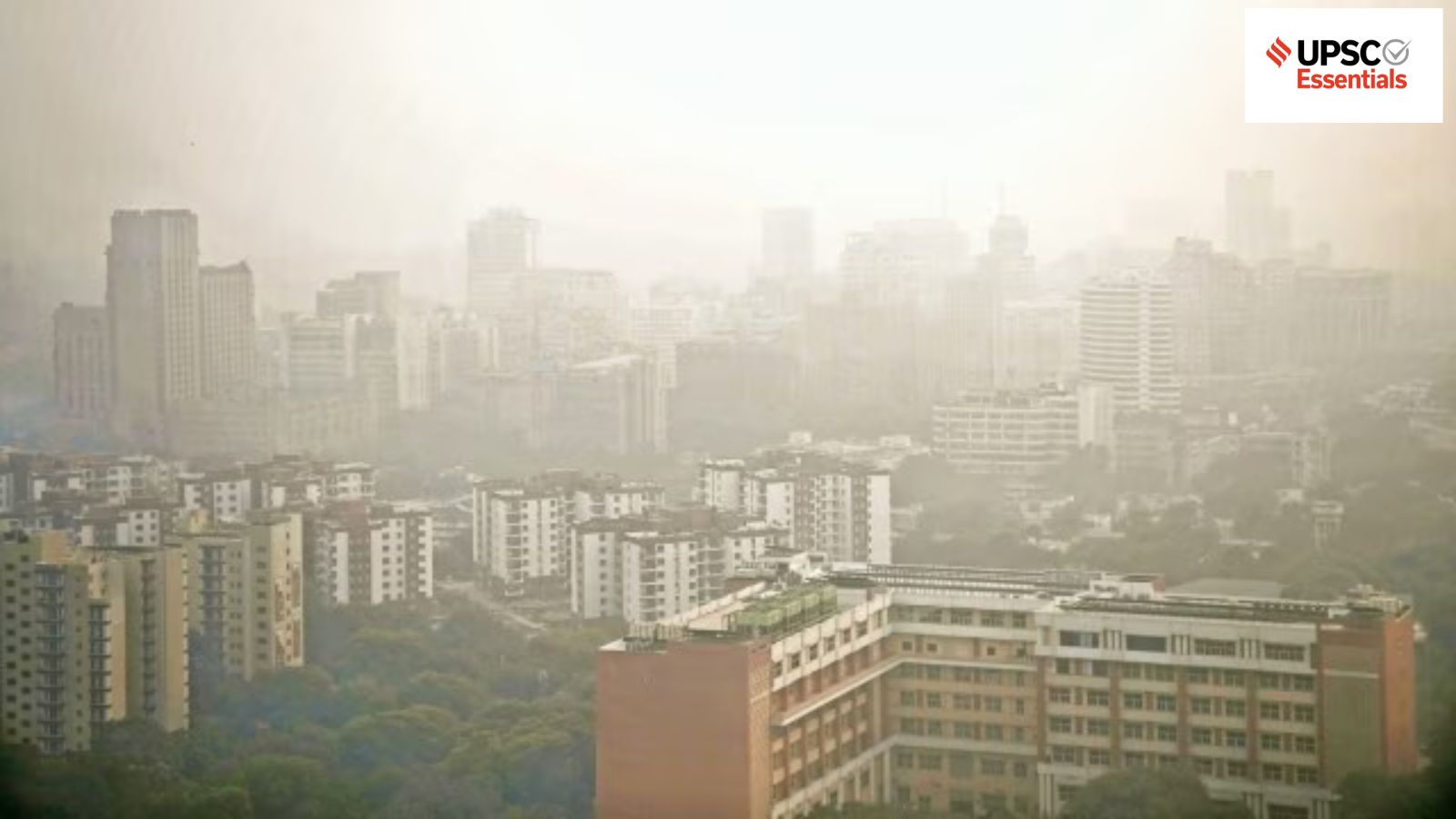 Air pollution harms babies even before birth, increasing risks of low birth weight and respiratory illness. (file)
UPSC Essentials brings to you its initiative for the practice of Mains answer writing. It covers essential topics of static and dynamic parts of the UPSC Civil Services syllabus covered under various GS papers. This answer-writing practice is designed to help you as a value addition to your UPSC CSE Mains. Attempt today’s answer writing on questions related to topics of GS-1 to check your progress.
🚨 Click Here to read the UPSC Essentials magazine for November 2025. Share your views and suggestions in the comment box or at manas.srivastava@indianexpress.com🚨
Urban air quality across Indian cities has shown a consistent deterioration over the past decade, with northern plains experiencing the highest pollution burden. Discuss how physiographic features, winter inversion, and regional pollution transport aggravate air quality in these regions.
The tropical forests of Africa, once considered major global carbon sinks, are now emitting more carbon than they absorb. Discuss the geographical and ecological factors driving this transformation.

QUESTION 1: Urban air quality across Indian cities has shown a consistent deterioration over the past decade, with northern plains experiencing the highest pollution burden compared to western and southern cities. Discuss how physiographic features, winter inversion, and regional pollution transport aggravate air quality in these regions.
Note: This is not a model UPSC answer. It only provides you with thought process which you may incorporate into the answers.
Introduction:
— No major urban cities in India recorded safe air quality levels between 2015 and November 2025, with Delhi being the most polluted city during this period, according to a new analysis. It also found that while northern cities experienced the most severe and persistent levels of pollution, southern and western cities comparatively saw better air quality levels.
— The analysis, ‘Air Quality Assessment of Major Indian Cities (2015–2025)’, was released by Climate Trends, a Delhi-based climate research organisation. The annual mean AQI levels were highest in 2016 (more than 250) in the national capital, and since 2019, have seen a dip. However, they remain far from safe levels. In 2025, the AQI stood at 180. Delhi is followed by Lucknow, Varanasi, Ahmedabad, and Pune, all of which witnessed prolonged periods of elevated AQI.
Body:
You may incorporate some of the following points in your answer:
— Due to the topography of the area, northern towns like Delhi, Lucknow, and Varanasi have lower air quality than western and southern cities like Chennai, Chandigarh, Visakhapatnam, Mumbai, and Bengaluru, especially in the winter.
— The issue is that these northern cities are landlocked because the Indo-Gangetic Plain is bounded by the Himalayas. As a result, contaminants become trapped and are unable to dissipate. Furthermore, “within cities, dense urban structures create additional “surface roughness,” a frictional effect that further slows wind speeds and limits dispersion,” according to the study.
— Rain and strong westerly winds assist in dispersing pollution during the summer monsoon, but the situation worsens throughout the winter. Delhi is especially vulnerable during this time since it is located in the middle of a huge, flat basin bordered by the Himalayas to the north.
— “During the winter (December–February), the air in the planetary boundary layer (the lowest section of the atmosphere) is thinner because the cooler air near the Earth’s surface is denser. Cooler air is trapped beneath the warm air above, forming an atmospheric ‘lid’. This condition is known as winter inversion. According to the analysis, because vertical mixing of air occurs only inside this layer, the pollutants emitted do not have enough space to disperse in the atmosphere.
— In winter, warmer air above traps denser, colder air that settles close to the ground. Farmers in Punjab, Haryana, and Uttar Pradesh burn stubble after the monsoon, creating a large smoke cloud that greatly increases pollution in the IGP.
— Vehicles, coal plants, brick kilns, and ongoing garbage burning are examples of local sources that contribute to the load, which is subsequently distributed throughout the region.
Conclusion:
— The distinctive topography of the Indo-Gangetic Plain, where the Himalayas serve as a barrier to stop pollutants from spreading, is the cause of the severe air pollution issue in northern India. Temperature inversions in the winter confine particle matter by trapping cold, stagnant air near the ground. Pollution levels are further increased by transboundary aerosol movements, which include emissions from dense industrial clusters, smoke from stubble burning, and dust transported from western regions. As a result, PM2.5 and PM10 levels continue to rise, which significantly lowers urban air quality and shortens average life expectancy.
(Source: Why northern cities are more polluted than southern and western cities in India)
Points to Ponder
Read more about urban pollution
Read about other types of pollution
Related Previous Year Questions
Mumbai, Delhi and Kolkata are the three mega cities of the country but the air pollution is much more serious problem in Delhi as compared to the other two. Why is this so? (2015)
What is oil pollution? What are its impacts on the marine ecosystem? In what way is oil pollution particularly harmful for a country like India? (2023)
QUESTION 2: Africa’s tropical forests, once considered major global carbon sinks, are now emitting more carbon than they absorb. Discuss the geographical and ecological factors driving this transformation.
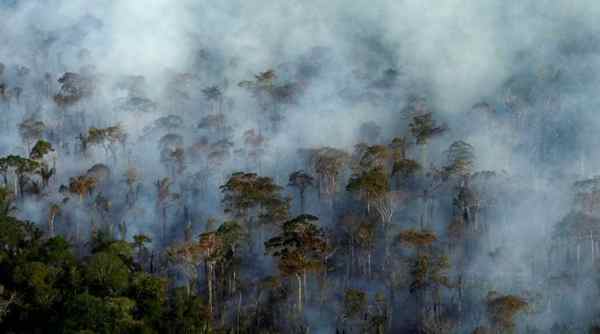 (Reuters)
Note: This is not a model UPSC answer. It only provides you with thought process which you may incorporate into the answers.
Introduction:
— Africa’s forests, once an instrumental player in the fight against climate change, have transformed from a carbon sink into a carbon source, according to a new study. The world’s three major rainforest regions — South American Amazon, Southeast Asia, and Africa — are now adding carbon into the atmosphere, exacerbating global warming. The new study, ‘Loss of tropical moist broadleaf forest has turned Africa’s forests from a carbon sink into a source’, was published in the journal Scientific Reports.
Body:
You may incorporate some of the following points in your answer:
— Historically, Africa’s forests and wooded savannas played an important part in the global carbon cycle, absorbing atmospheric carbon dioxide (CO2) through photosynthesis. For example, tropical forests in Africa absorb more than one billion tonnes of CO2 per year, according to a 2023 study published in the journal Nature.
— However, forests are currently emitting more carbon than they absorb. This has been mostly caused by human activities such as forest cover loss from agricultural and fuelwood burning, as well as shifting agriculture. Researchers stated that infrastructure developments and mining have worsened vegetation loss and global warming, reducing ecosystem resilience. Wildfires have also added carbon to the atmosphere.
— The researchers utilised satellite-derived maps of aboveground woody biomass to reconstruct how much carbon was stored in the region’s major forest and savanna biomes between 2007 and 2017.
— The researchers discovered that, whereas Africa gained carbon between 2007 and 2010, extensive forest loss in tropical rainforests has now altered this. According to the study, African forests lost over 106 billion kg of biomass per year between 2010 and 2017, comparable to the weight of almost 106 million automobiles. The tropical moist broadleaf forests of the Democratic Republic of the Congo, Madagascar, and West Africa were the most severely affected.
— The average global temperature has already increased by at least 1.2 degrees Celsius above pre-industrial levels. Several reports have said that if the world does not dramatically slash carbon emissions, the temperature could reach an estimated 2.8 degrees Celsius to 3.1 degrees Celsius above pre-industrial levels by the end of this century.
Conclusion:
— The study’s co-author, Dr. Pedro Rodríguez-Veiga, stated that if Africa’s forests become a long-term carbon source, it will be challenging to accomplish global climate targets.
— According to the researchers, the study’s findings demonstrate the urgent need to extend and implement projects like the Tropical Forest Forever Facility (TFFF). The TFFF debuted earlier this month at the COP30 in Brazil. It seeks to raise and spend $125 billion, with proceeds going to underdeveloped countries that protect their forests.
(Source: Africa’s forests transformed from carbon sink to carbon source: Why does it matter?)
Points to Ponder
Read about tropical forests
Read about other types of forests throughout the world
Related Previous Year Questions
Identify and discuss the factors responsible for diversity of natural vegetation in India. Assess the significance of wildlife sanctuaries in rain forest regions of India. (2023)
Examine the status of forest resources of India and its resultant impact on climate change. (2019)
UPSC Essentials: Mains answer practice — GS 3 (Week 130)
UPSC Essentials: Mains answer practice — GS 3 (Week 131)
UPSC Essentials: Mains answer practice — GS 2 (Week 130)
UPSC Essentials: Mains answer practice — GS 2 (Week 131)
UPSC Essentials: Mains answer practice — GS 1 (Week 129)
UPSC Essentials: Mains answer practice — GS 1 (Week 130)
Subscribe to our UPSC newsletter and stay updated with the news cues from the past week.
Stay updated with the latest UPSC articles by joining our Telegram channel – IndianExpress UPSC Hub, and follow us on Instagram and X.


Read UPSC Magazine