11 min read
© IE Online Media Services Pvt Ltd



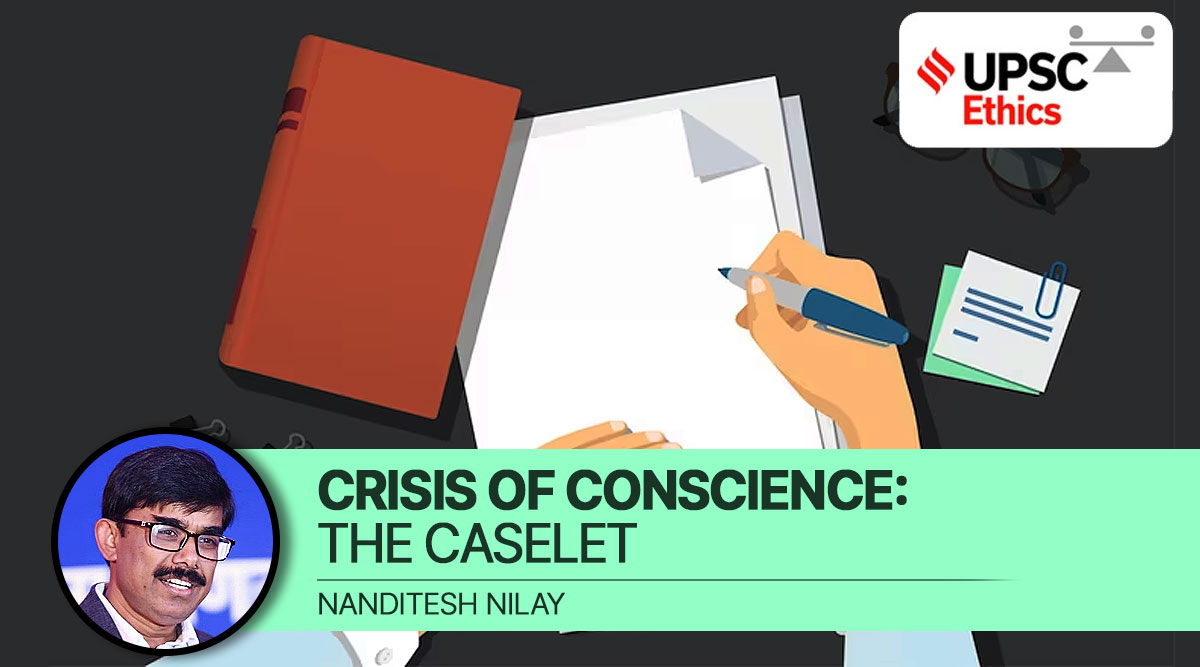 "Emerge from this crisis and listen to that eternal voice. The Voice of Conscience. It will save you from the Crisis of Conscience," reads the letter of Saurabh's teacher in our caselet today.
 🚨 This story is part of our special initiative for UPSC and other competitive exams. Look out for UPSC KEY and UPSC Essentials on weekdays, Weekly news express with MCQs, Key Terms of the past week, Quizzes as well as The Indian Express 360° Upsc Debate, Society & Social Justice, UPSC Mains Practice, Art and Culture with Devdutt Pattanaik, UPSC Ethics Simplified, Experts Talk, and more. 🚨
Dear Aspirants,
Thank you for joining us for LIVE sessions. Every day we receive your emails and messages, in large numbers, with queries revolving around news and UPSC preparation in general. Each letter and text makes us feel that we need to do more to make your journey for examination preparation simpler. You will be happy to know that we will be LIVE every week on Wednesdays, take up your queries, provide you with cues from the news, and discuss a relevant theme revolving around news and UPSC preparation in general.
The popular question for the coming week: How to read News, Editorials and Explainers from the ‘5Ws and 1H’ perspective, and more… (Other general queries will also be taken up)
You can send your queries at manas.srivastava@indianexpress.com or join Telegram: The Indian Express UPSC Hub or ask me Live!
UPSC Ethics Simplified takes you to a situation of crisis of conscience in the form of a caselet. This caselet is an extension of the concept discussed on May 28 (The crisis of conscience — the concept). It is advisable to revisit the concept article before reading the caselet below.
Relevance: The topic is a part of UPSC CSE General Studies Paper-IV Ethics syllabus. Caselets are particularly relevant in the Case Study section. Aspirants will also find the article useful for their Essay paper and situation-based questions in personality tests.
Moreover, the essence of the article will help aspirants in their professional lives or in life in general. Nanditesh Nilay writes for UPSC Ethics Simplified fortnightly on Sundays. The first article will be a concept while the second article will be a caselet based on the concept. Don’t miss the Post Read Questions and Express Inputs below.
Saurabh was already in a state of depression. Life was becoming a closed story for him. He failed to qualify the Preliminary Test (PT) of UPSC and that failure in the exam was making enough noise for him. Saurabh was unwilling to listen to his parents’ words or see the worth of life. The Voice of conscience to live with honour was distancing away from his reasoning. Saurabh was crying and simultaneously throwing things here and there. All of a sudden the doorbell rang. The postman was there with a letter. It was a letter from his teacher, after a quite long time.
My dear student,
After a long time, I am writing to you. Your parents informed me about your PT result. I got to know that you are not talking to anyone. Are you sad? Are you feeling like an all-time loser? If yes, please read this letter once. There is always a chance of a U-turn.
What do you mean by ” not qualified?” Is PT so dreamy or so disastrous? What about becoming a civil servant in a world where power is synonymous with qualifying PT first and later mains and interviews? If one is willing to chase power then this first step failure is disastrous. But those willing to see civil services as a greater podium of human service will return or take a U-turn. Either with those remaining chances or doing something better in other fields in society. But a service oriented heart is a higher self rather than a baser one. Such individuals take a U-turn. Are you one of them?
My first innate message of this letter is to see yourself as a respected person and grateful too. Such kind of ethical virtues will have an attitude of maximum rather than minimum. A minimum approach will get the answers most of the time in a negative tone i.e. “I am not going to do anything apart from becoming an IAS officer or I am mediocre and can not qualify for any other exam..” These two extremes are the minimum approach and are highly dangerous and negative. Even if a person qualifies, he or she will be more obsessed with the aura and luxury of a profile. And those who couldn’t, would be treating themselves and their surroundings with a heavy place to live with. The minimum approach disengages a person from self-improvement and empathy. There is an Aham Brahamsi approach or seeing oneself bigger than others. And those who missed all chances, they forget even to take U-Turn.
You have been my silent student who never failed in listening to me. Now time is ripe to listen to your reasoning. It will help you to listen to your conscience rather than confusion and failures. Emerge from this crisis and listen to that eternal voice. The Voice of Conscience. It will save you from the Crisis of Conscience. You treated me as your voice. Don’t put that voice into crisis. Emerge and evolve through your values.
Best of luck!
Yours
Sir
Post Read Questions
1. Why do you think the voice of the teacher can be important for Saurabh? Do you think values play a huge role in saving oneself from a crisis of conscience?
2. If you are Saurabh, what is the greatest message you would have taken from the letter?
— This caselet is unique as it is a letter and provides you with many hints for your answers. For example:
The Voice of conscience to live with honour was distancing away from his reasoning.
But those willing to see civil services as a greater podium of human service will return or take a U-turn. Either with those remaining chances or doing something better in other fields in society. But a service oriented heart is a higher self rather than a baser one. Such individuals take a U-turn.
The minimum approach disengages a person from self-improvement and empathy. There is an Aham Brahamsi approach or seeing oneself bigger than others. And those who missed all chances, they forget even to take U-Turn.
Emerge from this crisis and listen to that eternal voice. The Voice of Conscience. It will save you from the Crisis of Conscience. You treated me as your voice. Don’t put that voice into crisis. Emerge and evolve through your values.
These are some clear building blocks of your answers. Moreover, it is asking your opinion or view. It is not asking for any solution as such. So, you have to apply your ethical- theoretical knowledge.
— For starters, know what is a crisis of conscience and what is the voice of conscience.
— You may try to add something on the role of a teacher as a ‘role model’.
— Do not forget to mention about objectives and aim of life. (Know the difference)
— Write about failure in a positive light.
— Mention what values will help you or Saurabh to get out of the crisis and listen to your voice of conscience.
Dr. Ajay Phadke, CEO & Founder of Type a Thought in The Indian Express, wrote:
Feeling of disappointment and unhappiness are normal but jumping to extreme measures should be avoided.
Here’s what parents and children can do to deal with this stress better.
For parents: Support unconditionally
It is very important for parents and teachers to remain calm and take the results in the right stride – whether the score is good or bad. Parents need to make sure that the child understands that he can approach them no matter how he performs.
This ensures that he does not take any drastic steps, does not stress out unhealthily, and also keeps the door open for collaboration or working on things in the future. Parents need to look at their child beyond just marks.
Give time to process failure Parents need to give adequate time to children to process and accept the truth regarding exam results. Family members should not make it more difficult for the child by constantly reminding him of his failure. Take time to plan the road map ahead.
Watch the advice Parents should constantly tell their children that everyone gets bad grades and that it isn’t the end of the world. The advice should also include how children can find their footing and bounce back stronger.
Avoid discussing results quantitatively The child might feel that he would be loved and valued only if he achieves the set target. Instead, parents can use phrases like “I believe you have tried your best and I will be there no matter what.”
Unrealistic expectations are disturbing Recheck the expectations set for your child’s performance. All students cannot be toppers or first rankers, and that’s completely okay, because academics are just one aspect of life.
What negatively impacts a child’s mental health is your act of comparison of their results with any other student.
The best way to see if your child is doing well is to compare with their past performance.
Failure in exams is not equal to failure in life Remind the child to not take extreme measures like locking oneself in room, attempting suicide or quitting food. Mend child’s thoughts in a way that failure in exams does not mean failure in life.
Even the most successful people in the world have failed at something in their lives.
For students: Reach out to talk to someone
Your parents want to see you happy and want what’s best for you. So don’t worry about letting them down since they will love you no matter what happens in one exam. Talk to someone who makes you feel better.
You can even approach a counsellor for a third party perspective about the situation. Remember, exams are not the end of the road.
Replace self-criticism with self-correction
Judging yourself harshly now won’t help you perform better in the future. Take the position of an observer. Learn from your mistakes and move on.
Relook at your studying methods
Bad or undesired results imply to take a serious look at your studying techniques. Change your study pattern and concentrate more on what you are weak at. Don’t compare yourself with your friends or anyone else.
Point to ponder: Suggest ways how parents, teachers, and students can cope with the stress of failure. What is important to understand about ‘failure and success’? (Answer in the comment box or through your email)
(The writer is the author of ‘Being Good and Aaiye, Insaan Banaen’. He teaches courses on and offers training in ethics, values and behaviour. He has been the expert/consultant to UPSC, SAARC countries, Civil services Academy, National Centre for Good Governance, Central Bureau of Investigation (CBI), Competition Commission of India (CCI), etc. He has PhD in two disciplines and has been a Doctoral Fellow in Gandhian Studies from ICSSR. His second PhD is from IIT Delhi on Ethical Decision Making among Indian Bureaucrats. He writes for the UPSC Ethics Simplified (Concepts and Caselets) fortnightly.)
Share your views, answers and suggestions in the comment box or at manas.srivastava@indianexpress.com

Read UPSC Magazine