7 min read
© IE Online Media Services Pvt Ltd
Latest Comment
Post Comment
Read Comments



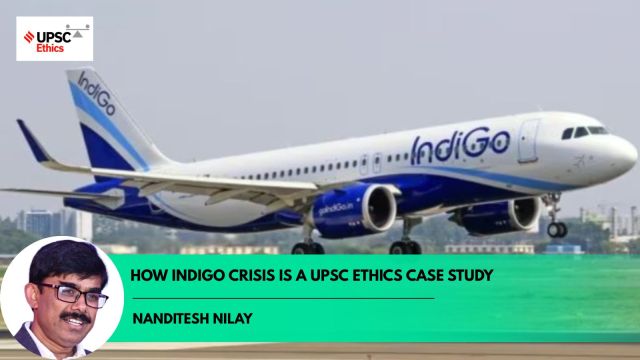 The view from above may be stunning, but a passenger truly feels at ease only when the aircraft lands safely. And if it arrives on time, nothing more is required.
(UPSC Ethics Simplified is a special series under UPSC Essentials by The Indian Express. It examines news and syllabus themes from an ethical perspective, integrates real-life or hypothetical case studies, and revisits static concepts of ethics. The series aligns current affairs with core ethical principles for an ethical understanding of life, helping aspirants build clarity, application skills, and value-based understanding for GS-IV. In this article, Nanditesh Nilay, our ethicist, discusses the burning issue of the IndiGo crisis from an ethics perspective.)
The recent crisis created by multiple factors in aviation breaks our slumber with a fundamental question: Who is a customer, and what is customer service in the aviation sector? Desatnick (1994) was of the view that the twenty-first century is going to be either the era of customer sovereignty or the era of customer rebellion and revolt. We are witnessing the frustration and angst of passengers every day at airports. However, sometimes airlines forget that the quality of service is driven in part by the behaviour of the service provider. And here, Indigo was the service provider. Usually service providers fail because they do not realise that customer service is not lip service but ethics in action.
Let us examine how airlines, in general, have approached the issue of safety for both travellers and pilots. In aviation, the well-being of pilots is as critical as the sophistication of the aircraft itself, since passenger safety is inseparably linked to the physical and mental fitness of those operating the flight. Yet, there are instances where this interconnectedness has not been fully appreciated.
By overlooking the necessity of adequate rest and treating it as a negotiable factor, safety risks are handled too casually. Further, when pilots are viewed merely as operational resources rather than as human beings entrusted with the lives of hundreds of passengers, it reflects a deeper insensitivity within management practices, especially in the shadow of major aviation accidents that should have prompted greater caution and empathy.
As Adam Smith notes in An Inquiry into the Nature and Causes of the Wealth of Nations, trust in systems and institutions is built on self-interest aligned with responsibility. When travellers place their trust in an airline, they expect that safety and human considerations will not be compromised. A failure to recognise this can leave a lasting dent in public confidence, one that often becomes evident only when it is too late.
Today, many are asking why an airline would treat its pilots in such an insensitive manner. Why has customer trust been broken repeatedly? In a democracy, such a brazen attitude creates distance between profit-seekers and the spirit of ethics. At times, it appears as though flights are treated no differently from road transport, with pilots and passengers reduced to mere units in an operational system. Profit seems to take precedence over everything else, even safety.
Nations may project power through wealth and arms, but true greatness lies in ethical conduct in everyday social life. India, too, has struggled against exploitation and deep-rooted corruption. Yet, as citizens, we cannot drift away from the enduring voice of values and ethics that underpin the country’s development journey. Business ethics and social responsibility must guide both public and private institutions. Money without the moral reasoning of public welfare is ultimately just a number.
The German writer Goethe, in Faust, wrote, “We feel and we know what it is that holds this world together at its inner core.” Perhaps it is the hope for life itself. Yet life today feels increasingly insecure at that very core. A world recovering from a pandemic could hardly have imagined that air travel would become so unsettling, or that routine journeys might turn fatal, or that even the bridges connecting lives could collapse.
In moments like these, institutions must pause and reflect. The time has come to place the value of safety above all else. In an era dominated by balance sheets, targets, and revenues, the pressure to maximise profits is immense. Yet ensuring strict safety compliance matters far more than counting flights operated or profits earned. True responsibility lies in refusing to compromise on safety, even if it means cancelling operations or enforcing strict rules uniformly, from top management to the lowest worker.
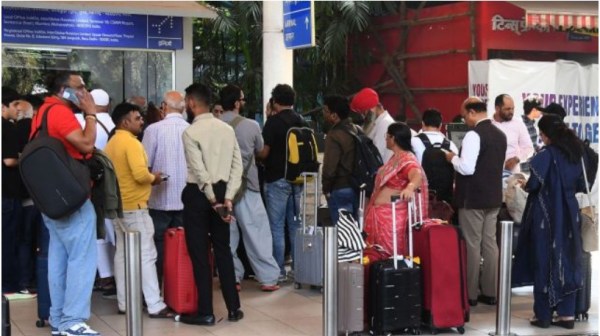 Passengers at airport waiting for their flight information. (Express file photo)
This is an age in which customer service is being replaced by customer experience, and money by value. The question is whether airline management is truly listening. When a carrier enters the national aviation space, passengers choose it not merely for punctuality but also for safety. No one boards a flight for coffee or a sandwich. The view from above may be stunning, but a passenger truly feels at ease only when the aircraft lands safely. And if it arrives on time, nothing more is required.
As Hale and Hovden have observed, we are living in the “third age of safety,” one that moves beyond purely technical solutions or organisational controls. Safety today must be embedded in culture and reflected in human behaviour. When this dimension is ignored, it represents a failure not just of operations, but of business ethics and the broader spirit of social responsibility.
‘This is an age in which customer service is being replaced by customer experience, and money by value.’ Discuss.
(The writer is the author of ‘Being Good’, ‘Aaiye, Insaan Banaen’, ‘Kyon’ and ‘Ethikos: Stories Searching Happiness’. He teaches courses on and offers training in ethics, values and behaviour. He has been the expert/consultant to UPSC, SAARC countries, Civil services Academy, National Centre for Good Governance, Central Bureau of Investigation (CBI), Competition Commission of India (CCI), etc. He has PhD in two disciplines and has been a Doctoral Fellow in Gandhian Studies from ICSSR. His second PhD is from IIT Delhi on Ethical Decision Making among Indian Bureaucrats. He writes for the UPSC Ethics Simplified (concepts and caselets) fortnightly.)
Gen Z in UPSC : What happens to civil services values?
Can compassion bridge the gap between humans and animals?
How and why Civil Servants should be ‘enablers’ of growth, not mere ‘regulators’
Politicians, Athletes, UPSC Aspirants: Do Results Matter? Aristotle has an answer
How must a police officer choose between a VVIP and a common man at ‘Ram Lalla’ Darshan?
Subscribe to our UPSC newsletter and stay updated with the news cues from the past week.
Stay updated with the latest UPSC articles by joining our Telegram channel – Indian Express UPSC Hub, and follow us on UPSC section of The Indian Express on Instagram and X.
For your queries and suggestions write at manas.srivastava@indianexpress.com

Read UPSC Magazine