8 min read
© IE Online Media Services Pvt Ltd
Latest Comment
Post Comment
Read Comments



 Attempt a question on the AI governance in India in today's answer writing practice. (Representational Image)
UPSC Essentials brings to you its initiative for the practice of Mains answer writing. It covers essential topics of static and dynamic parts of the UPSC Civil Services syllabus covered under various GS papers. This answer-writing practice is designed to help you as a value addition to your UPSC CSE Mains. Attempt today’s answer writing on questions related to topics of GS-2 to check your progress.
🚨 Click Here to read the UPSC Essentials magazine for November 2025. Share your views and suggestions in the comment box or at manas.srivastava@indianexpress.com🚨
What is the six-pillar framework proposed by the Ministry of Electronics and Information Technology (MeitY) for AI governance in India? What are its strengths and potential limitations?
Trace the evolution of the African Union (AU)–European Union (EU) partnership. Discuss how it aims to address the shared challenges of Africa and Europe.
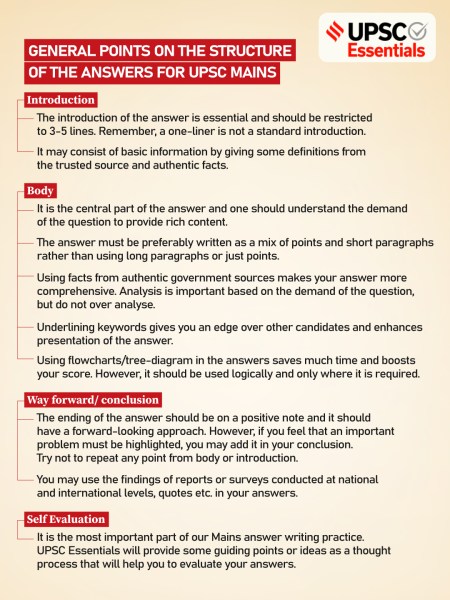
QUESTION 1: What is the six-pillar framework proposed by the Ministry of Electronics and Information Technology (MeitY) for AI governance in India? What are its strengths and potential limitations?
Note: This is not a model answer. It only provides you with thought process which you may incorporate into the answers.
Introduction:
— The Ministry of Electronics and Information Technology (MeitY) has unveiled governance guidelines for Artificial Intelligence (AI), which could serve as a blueprint for how India regulates the technology, balancing innovation with accountability and growth with safety.
— The technology could help flourish an innovative economy in the country. As such, the guidelines recommend an India-specific risk assessment framework, a national AI incident database, and the use of voluntary frameworks and techno-legal measures, such as embedding privacy or fairness rules directly into system design.
Body:
You may incorporate some of the following points in your answer:
— The report’s key recommendations are organised around six pillars: infrastructure, capacity building, policy & regulation, risk mitigation, accountability, and institutions.
— The guidelines do, however, flag the need to carry out effective “content authentication”, as synthetically generated images, videos and audio flood the Internet. Here, the government has already proposed legal amendments to a key legislation, which would require companies like YouTube and Instagram to add visible labels to AI-generated content.
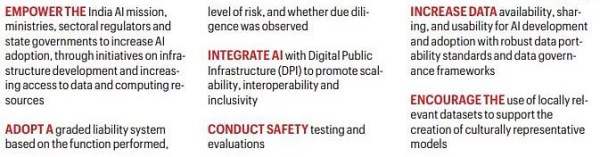 Action Plan on AI
— The guiding principle that defines the spirit of the framework is… ‘Do No Harm’. We focus on creating sandboxes for innovation and on ensuring risk mitigation within a flexible, adaptive system.
Conclusion:
— The launch of the guidelines comes ahead of the India–AI Impact Summit 2026, which will be the first-ever global AI summit hosted in the Global South.
— According to Abhishek Singh, Additional Secretary, MeitY, and CEO IndiaAI, “The committee went through extensive deliberations and prepared a draft report, which was opened for public consultation. The inputs received is a clear sign of strong engagement across sectors. As AI continues to evolve rapidly, a second committee was formed to review these inputs and refine the final guidelines.”
(Source: What govt’s AI guidelines mean for tech regulation in India)
Points to Ponder
Read more about the guidelines
How AI can improve the governance of India?
Related Previous Year Questions
e-governance projects have a built-in bias towards technology and back-end integration than user-centric designs. Examine. (2025)
e-governance, as a critical tool of governance, has ushered in effectiveness, transparency and accountability in governments. What inadequacies hamper the enhancement of these features? (2023)
QUESTION 2: Trace the evolution of the African Union (AU)–European Union (EU) partnership. Discuss how it aims to address the shared challenges of Africa and Europe.
 (AP Photo, File)
Note: This is not a model answer. It only provides you with thought process which you may incorporate into the answers.
Introduction:
— The seventh AU–EU Summit in Luanda unfolded at a moment when global governance is undergoing a subtle but significant transformation, and when Africa–Europe relations are being reframed by forces far larger than bilateral diplomacy.
— After the G20 Johannesburg Summit, it was revealed how interlinked global and inter-regional diplomacy have become, and how Africa and Europe are now navigating their partnership in a world where climate change, debt, supply chains, energy security and institutional reform are no longer matters for isolated forums but interconnected parts of a larger political landscape.
Body:
You may incorporate some of the following points in your answer:
— The G20’s agenda in Johannesburg, framed around “Solidarity, Equality, Sustainability”, became an important backdrop. Its themes, development finance, debt sustainability, critical minerals, clean energy transition, climate action and global governance reform resurfaced almost identically in Luanda. But this resemblance was not a coincidence. The European and African Union’s leadership at the G20 were central actors in both forums, helping ensure policy continuity.
— The African Union, which participated in the G20 Sherpa process during South Africa’s presidency, used that forum to advance African interests, which later determined the AU-EU Summit negotiating agenda. This synergy represents a larger trend. African states are increasingly using global venues to further their own agendas, which are subsequently embedded in interregional relationships.
— The passive, donor-recipient dynamic that once defined Africa-Europe ties is making way to a more assertive African agency, made possible by shifting global power balances and Africa’s growing strategic relevance. Europe, faced with its own needs for critical minerals, secure supply chains, green technologies, and geopolitical stability, now sees Africa as a strategic partner whose cooperation is critical to Europe’s long-term security and economic resilience, rather than as a source of development assistance.
— The AU–EU Summit sought to build precisely such a partnership. Leaders reaffirmed their commitment to a rules-based international order, economic integration, multilateral cooperation and sustainable development. But more importantly, they pledged deepened cooperation on trade, infrastructure, energy, critical minerals, migration and security, hard issues that will define Africa–Europe relations over the next decade.
— Trade and investment were central to the summit’s outcomes. The EU is the top trading partner of African countries collectively and their largest export market, ahead of China, India and the United States. The EU has preferential trade agreements with 19 African countries. Ninety per cent of African exports enter the EU market free of import duties.
Conclusion:
— The EU reiterated support for the African Continental Free Trade Area (AfCFTA). The AfCFTA, once fully implemented, could create the world’s largest free-trade area by number of countries, opening new pathways for industrialisation and value-added production. The EU’s Global Gateway initiative with €120 billion already mobilised for African infrastructure, digital connectivity and clean energy was presented as Europe’s long-term commitment to supporting African development.
— Energy and climate action formed another pillar of the summit. Africa’s need for reliable, affordable energy is enormous; Europe’s need for green partnerships is equally urgent.
— The cooperation on critical minerals was perhaps the most geopolitically charged element of the summit. Through the RESourceEU initiative, Europe seeks a reliable, ethically sourced supply of cobalt, lithium, rare earths and other minerals necessary for electric vehicles, batteries and renewable-energy technologies.
(Source: From G20 to Luanda: How global shifts are transforming the African Union–EU partnership)
Points to Ponder
Read more about G20
Read about Africa-Europe relations
Read about African Union and European Union
Related Previous Year Questions
India-Africa digital partnership is achieving mutual respect, co-development and long-term institutional partnerships. Elaborate. (2025)
‘The expansion and strengthening of NATO and a stronger US-Europe strategic partnership works well for India.’ What is your opinion about this statement ? Give reasons and examples to support your answer. (2023)
UPSC Essentials: Mains answer practice — GS 3 (Week 130)
UPSC Essentials: Mains answer practice — GS 3 (Week 131)
UPSC Essentials: Mains answer practice — GS 2 (Week 130)
UPSC Essentials: Mains answer practice — GS 2 (Week 129)
UPSC Essentials: Mains answer practice — GS 1 (Week 129)
UPSC Essentials: Mains answer practice — GS 1 (Week 130)
Subscribe to our UPSC newsletter and stay updated with the news cues from the past week.
Stay updated with the latest UPSC articles by joining our Telegram channel – IndianExpress UPSC Hub, and follow us on Instagram and X.

Read UPSC Magazine