9 min read
© IE Online Media Services Pvt Ltd
Latest Comment
Post Comment
Read Comments



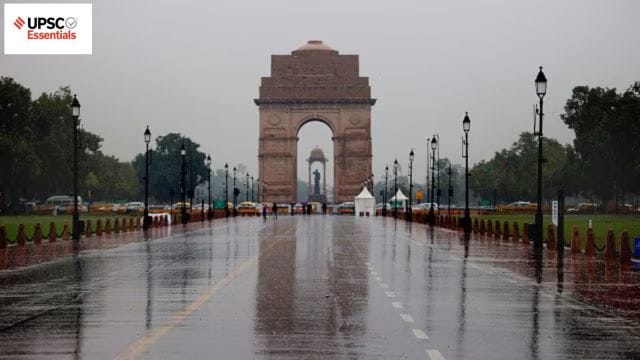 Attempt a question on the implications of cloud-seeding in densely populated urban areas in today's answer writing practice. (Express photo by Praveen Khanna)
UPSC Essentials brings to you its initiative for the practice of Mains answer writing. It covers essential topics of static and dynamic parts of the UPSC Civil Services syllabus covered under various GS papers. This answer-writing practice is designed to help you as a value addition to your UPSC CSE Mains. Attempt today’s answer writing on questions related to topics of GS-3 to check your progress.
🚨 Click Here to read the UPSC Essentials magazine for October 2025. Share your views and suggestions in the comment box or at manas.srivastava@indianexpress.com🚨
Discuss the environmental implications of using chemical cloud-seeding agents in densely populated urban areas. What are the potential applications of such weather-modification techniques?
Discuss the meteorological conditions that lead to the formation of tropical cyclones. Why does the Bay of Bengal often witness cyclones?
Introduction
— The introduction of the answer is essential and should be restricted to 3-5 lines. Remember, a one-liner is not a standard introduction.
— It may consist of basic information by giving some definitions from the trusted source and authentic facts.
Body
— It is the central part of the answer and one should understand the demand of the question to provide rich content.
— The answer must be preferably written as a mix of points and short paragraphs rather than using long paragraphs or just points.
— Using facts from authentic government sources makes your answer more comprehensive. Analysis is important based on the demand of the question, but do not over analyse.
— Underlining keywords gives you an edge over other candidates and enhances presentation of the answer.
— Using flowcharts/tree-diagram in the answers saves much time and boosts your score. However, it should be used logically and only where it is required.
Way forward/ conclusion
— The ending of the answer should be on a positive note and it should have a forward-looking approach. However, if you feel that an important problem must be highlighted, you may add it in your conclusion. Try not to repeat any point from body or introduction.
— You may use the findings of reports or surveys conducted at national and international levels, quotes etc. in your answers.
Self Evaluation
— It is the most important part of our Mains answer writing practice. UPSC Essentials will provide some guiding points or ideas as a thought process that will help you to evaluate your answers.
QUESTION 1: Discuss the environmental implications of using chemical cloud-seeding agents in densely populated urban areas. What are the potential applications of such weather-modification techniques?
Note: This is not a model answer. It only provides you with thought process which you may incorporate into the answers.
Introduction:
— The proposed cloud seeding exercise in Delhi has already faced multiple reschedules due to unfavourable weather and the wait for appropriate cloud development. Since Diwali, the air quality in Delhi-NCR has deteriorated, and the government pressed-in GRAP 2 levels of restrictions recently.
— Every winter, the air quality in the capital region and the surrounding areas deteriorates over a few kilometers. Smog and polluted air threaten public life, especially those with compromised lungs and respiratory conditions. Smog affects vehicular visibility, leading to cancellations of flights and disruption in other transport services.
Body:
You may incorporate some of the following points in your answer:
Environmental implications of using chemical cloud-seeding agents in densely populated urban areas
— The India Meteorological Department (IMD) classifies October to December as the period of the post-monsoon season. This means that the rain-bearing, moisture-laden monsoon clouds and the associated synoptic systems, like monsoonal low pressures or depressions (which trigger rainfall), would be largely absent.
— The winds are calm, and atmospheric conditions largely favour dry weather conditions during this season, unless triggered by the passing western disturbances at lower latitudes. Western disturbances cause rain and snow over north and northwest India during the post-monsoon/winter seasons.
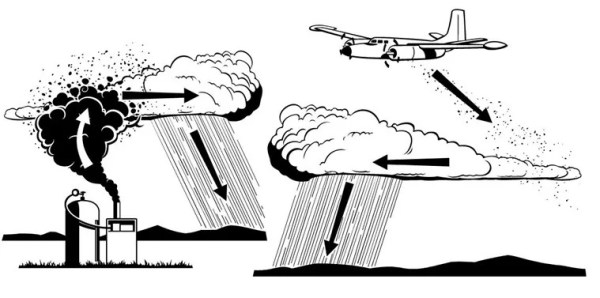 (Wikimedia Commons)
— Cloud seeding, hence, cannot be performed with these quintessential rain-bearing clouds remaining absent. Even if seeding attempts are made onto visible clouds, these may not necessarily lead to rain.
— “The Delhi government seems to have been misadvised about cloud seeding to be done in the post-monsoon / winter season. There will be no use of it as the season is dominated by western disturbances, making the seeding difficult in the absence of mature clouds,” said a senior official at the Ministry of Earth Sciences.
Conclusion:
— The potential applications could include:
(i) A targeted cloud seeding effort for catchment-scale applications to enhance rainfall.
(ii) The suppression of rainfall by overseeding.
(iii) Other relevant targeted weather modification aspects include fog suppression, hail suppression, marine cloud brightening, etc.
(Source: Why cloud seeding experiments planned over Delhi during post-monsoon season may not work)
Points to Ponder
Read more about artificial rain
Read about chemical used in cloud seeding
Related Previous Year Questions
Industrial pollution of river water is a significant environmental issue in India. Discuss the various mitigation measures to deal with this problem and also the government’s initiatives in this regard. (2024)
Describe the key points of the revised Global Air Quality Guidelines (AQGs) recently released by the World Health Organisation (WHO). How are these different from its last update in 2005? What changes in India’s National Clean Air Programme are required to achieve revised standards? (2021)
QUESTION 2: Discuss the meteorological conditions that lead to the formation of tropical cyclones. Why does the Bay of Bengal often witness cyclones?
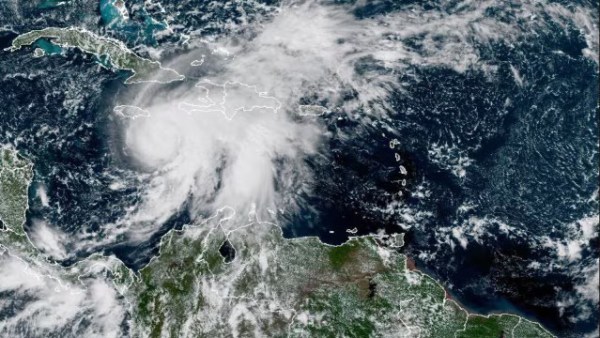 (NOAA via AP)
Note: This is not a model answer. It only provides you with thought process which you may incorporate into the answers.
Introduction:
— A cyclone is a large-scale system of air that rotates around the centre of a low-pressure area. It is usually accompanied by higher temperatures, violent storms and bad weather.
— As per the National Disaster Management Authority (NDMA), a cyclone is characterised by inward spiralling winds that rotate anticlockwise in the Northern Hemisphere and clockwise in the Southern Hemisphere.
Body:
You may incorporate some of the following points in your answer:
Formation of tropical cyclones
— It is also called a hurricane or typhoon in other parts of the world. India often witnesses tropical cyclones, known as such because they develop in the regions between the Tropics of Capricorn and Cancer.
— They are the most devastating storms on Earth. Such cyclones develop when “thunderstorm activity starts building close to the centre of circulation, and the strongest winds and rain are no longer in a band far from the centre,” the US National Oceanic and Atmospheric Administration (NOAA) website said.
— The core of the storm turns warm, and the cyclone gets most of its energy from the “latent heat” released when water vapour that has evaporated from warm ocean waters condenses into liquid water. On the other hand, extratropical cyclones form outside of the tropic. They have “cold air at their core, and derive their energy from the release of potential energy when cold and warm air masses interact”, according to the NOAA.
Why does the Bay of Bengal often witness cyclones?
— The Bay of Bengal is prone to large storm surges, in part because of its funnel-like shape that concentrates atmospheric activity, and its unique topography.
— An academic paper titled ‘Effect of landfall location and coastal topography on surge response in the Northern Bay of Bengal’, published in 2020, mentions that the destruction caused by storm surges also depends on the shape of the coastline. “A storm surge is highly dependent on local features and barriers that affect the flow of water. The Bay of Bengal has a complex coastal geometry, including estuary deltas, pocket-like bays, and straight coasts.”
— Another important factor is temperature. Warmer the water, more intense the cyclone, and the Bay of Bengal has generally recorded higher temperatures than the Arabian Sea. Although, due to climate change-related disruptions of late, the western coast of India is also witnessing more frequent and stronger cyclones.
Conclusion:
— A group of nations called WMO/ESCAP (World Meteorological Organisation/United Nations Economic and Social Commission for Asia and the Pacific), which comprised Bangladesh, India, the Maldives, Myanmar, Oman, Pakistan, Sri Lanka and Thailand, decided to start naming cyclones in the region on a rotational basis. After each country sent in suggestions, the WMO/ESCAP Panel on Tropical Cyclones (PTC) finalised the list.
— The WMO/ESCAP expanded to include five more countries in 2018 — Iran, Qatar, Saudi Arabia, United Arab Emirates and Yemen.
(Source: Cyclone Montha likely to hit east coast: How do tropical storms occur, and who names them?)
Points to Ponder
Read about hurricanes and typhoons
Read about difference between tropical and temperate cyclones
Related Previous Year Questions
The frequency of urban floods due to high intensity rainfall is increasing over the years. Discussing the reasons for urban floods, highlight the mechanisms for preparedness to reduce the risk during such events. (2016)
What is sea surface temperature rise? How does it affect the formation of tropical cyclones? (2024)
UPSC Essentials: Mains answer practice — GS 3 (Week 124)
UPSC Essentials: Mains answer practice — GS 3 (Week 125)
UPSC Essentials: Mains answer practice — GS 2 (Week 124)
UPSC Essentials: Mains answer practice — GS 2 (Week 125)
UPSC Essentials: Mains answer practice — GS 1 (Week 125)
UPSC Essentials: Mains answer practice — GS 1 (Week 122)
Subscribe to our UPSC newsletter and stay updated with the news cues from the past week.
Stay updated with the latest UPSC articles by joining our Telegram channel – IndianExpress UPSC Hub, and follow us on Instagram and X.


Read UPSC Magazine