8 min read
© IE Online Media Services Pvt Ltd
Latest Comment
Post Comment
Read Comments



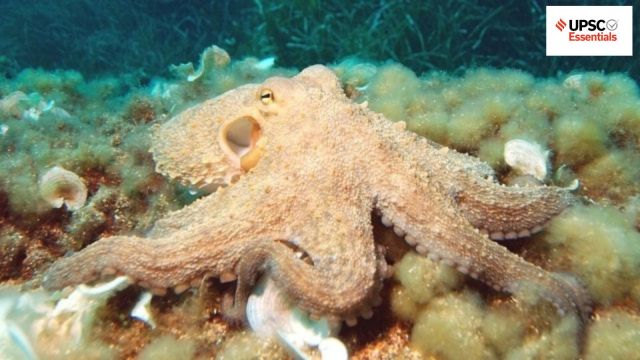 Check your progress and revise your topics through this quiz on Environment and Geography. Find a question on the Octopus in today's quiz. (Photo: Wikipedia)
UPSC Essentials brings to you its initiative of subject-wise quizzes. These quizzes are designed to help you revise some of the most important topics from the static part of the syllabus. Attempt today’s subject quiz on Environment and Geography to check your progress.
🚨 Click Here to read the UPSC Essentials magazine for December 2025. Share your views and suggestions in the comment box or at manas.srivastava@indianexpress.com🚨
The principles of Common but Differentiated Responsibilities and Respective Capabilities (CBDR-RC) refer to:
(a) the responsibilities of nations to fight climate change in proportion to their historic contributions in emitting planet-warming greenhouse gases.
(b) equal climate obligations for all countries regardless of development status.
(c) voluntary climate action determined solely by national economic growth rates.
(d) responsibility of only developed countries to address environmental degradation.
Explanation
— Stressing on the importance of accessible finance and technology transfer for developing countries, India said the plenary of United Nations Environment Assembly’s (UNEA) seventh session that the outcome of the conference should aim to complement existing multilateral agreements, and should be implementable for all member states.
— The UNEA is the world’s apex decision-making body on environmental matters consisting of all UN member states, and the seventh session’s theme is ‘Advancing sustainable solutions for a resilient planet’.
— India approaches UNEA-7 with the conviction that environmental solutions must remain centred on people and that global action must be guided by the principles of equity, Common but Differentiated Responsibilities and Respective Capabilities (CBDR-RC), and respect for national circumstances. The principles of CBDR-RC refers to the responsibilities of nations to fight climate change in proportion to their historic contributions in emitting planet-warming greenhouse gases.
Therefore, option (a) is the correct answer.
With reference to the Octopuses, consider the following statements:
1. They are soft-bodied molluscs that crawl along the seafloor instead of swimming long distances.
2. They pump blood directly to the gills, where oxygen is absorbed from seawater.
3. They have four hearts.
4. When an octopus swims, it uses jet propulsion by quickly pushing water out through a siphon.
How many of the statements given above are correct?
(a) Only one
(b) Only two
(c) Only three
(d) All four
Explanation
— Octopuses are soft-bodied molluscs that live in parts of the ocean where there isn’t much oxygen. To survive, they developed a circulatory system that enables them to obtain as much oxygen as possible. Octopuses usually crawl along the seafloor instead of swimming long distances. Hence, statement 1 is correct.
— Two of their hearts are known as branchial hearts. These are located near the gills and have a specialised role: they pump blood directly to the gills, where oxygen is absorbed from seawater. The third heart, known as the systemic heart, then pumps the oxygen-rich blood from the gills to the rest of the body. Octopuses have three hearts. Hence, statement 2 is correct and statement 3 is not correct.
— The systemic heart, which sends blood around the body, temporarily stops beating when the octopus swims. When an octopus swims, it uses jet propulsion by quickly pushing water out through a siphon. This action raises the pressure inside its body, making it hard for the systemic heart to pump blood well. Because of this, less oxygen moves through the body, and the octopus gets tired quickly. That’s why swimming uses a lot of energy for octopuses, so they usually only do it to escape from predators. Hence, statement 4 is correct.
— Octopus blood is blue instead of red, which makes them even stranger. Their blood is blue because it contains hemocyanin, a copper-based molecule that carries oxygen, rather than the iron-based hemoglobin found in humans.
Therefore, option (c) is the correct answer.
The Rajmachi Trek, Chembra Peak, and Tadiandamol Trek are located on the:
(a) Eastern Ghats
(b) Western Ghats
(c) North-Eastern Himalayas
(d) Andaman and Nicobar Islands
Explanation
— Trekking in the Himalayas is a given, but the Western Ghats offer an equally enthralling landscape. As a UNESCO World Heritage Site, the Western Ghats offer some of India’s most accessible and rewarding trekking experiences for first-time hikers. Stretching along the western edge of the country, this ancient mountain range is known for its rich biodiversity, misty hills, and scenic trails that require no technical expertise.
— Rajmachi Trek is situated in the Sahyadri range of the Western Ghats. The trek is one of the most beginner-friendly and scenic trails near Mumbai and Pune. The route leads to the twin forts of Shrivardhan and Manaranjan.
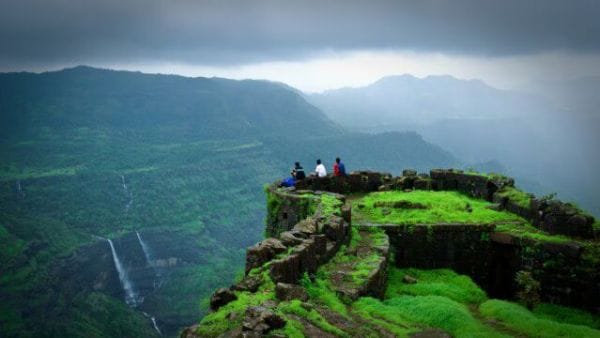 (Photo: Wikipedia)
— Chembra Peak is located near Wayanad. It is an excellent introduction to trekking in the southern Western Ghats. Known for its heart-shaped lake—believed never to dry up—the trek is short, well-marked, and guided, making it ideal for beginners and families.
— Tadiandamol, the highest peak in Coorg (Kodagu), is an ideal beginner’s trek for those seeking adventure. The trail starts near Kakkabe village and gradually ascends through shola forests, streams, and open grasslands.
Therefore, option (b) is the correct answer.
The Al Maszhabiya region is a:
(a) coastal lagoon in eastern Oman
(b) desert in southwestern Qatar
(c) mountainous plateau in northern Iran
(d) river basin in southern Iraq
Explanation
— Years later, in the early 2000s, a new group of scientists from the Smithsonian Institution and Qatar Museums decided to re-examine the region and the bones to resolve this mystery fully. “The area was called ‘dugong cemetery’ among the members of our authority,” recalls Ferhan Sakal, an archaeologist and head of excavation and site management at Qatar Museums. “But at the time, we had no idea just how rich and vast the bonebed actually was.”
— This new examination revealed that this vast site is actually a 21-million-year-old bonebed, filled with the remains of sea cows, sharks, barracuda-like fish, prehistoric dolphins, and sea turtles. More than 170 fossil-rich spots were identified, making it one of the richest marine fossil deposits in the world. Some experts even compared it to Chile’s famous Whale Hill, where dozens of whale skeletons were found.
— Recently, a new finding from the region, published in the journal PeerJ., has surfaced. A new species of sea cow, named Salwasiren qatarensis, has been discovered. It is named after Qatar. The animal looks a lot like the dugongs, which still live just 10 miles away today.
Therefore, option (b) is the correct answer.
The Ratle Hydro Electric Project has been developed on:
(a) Chenab River
(b) Jhelum River
(c) Ravi River
(d) Beas River
Explanation
— Ratle Hydroelectric Project (850 MW) is a Run-of-river scheme located on the River Chenab at the village Drabshalla, district Kishtwar, Union Territory of Jammu and Kashmir.
Therefore, option (a) is the correct answer.
Daily Subject-wise quiz — History, Culture, and Social Issues (Week 135)
Daily subject-wise quiz — Polity and Governance (Week 141)
Daily subject-wise quiz — Science and Technology (Week 141)
Daily subject-wise quiz — Economy (Week 141)
Daily subject-wise quiz — Environment and Geography (Week 140)
Daily subject-wise quiz – International Relations (Week 140)
Subscribe to our UPSC newsletter and stay updated with the news cues from the past week.
Stay updated with the latest UPSC articles by joining our Telegram channel – IndianExpress UPSC Hub, and follow us on Instagram and X.

Read UPSC Magazine