


© IE Online Media Services Pvt Ltd
Tags:


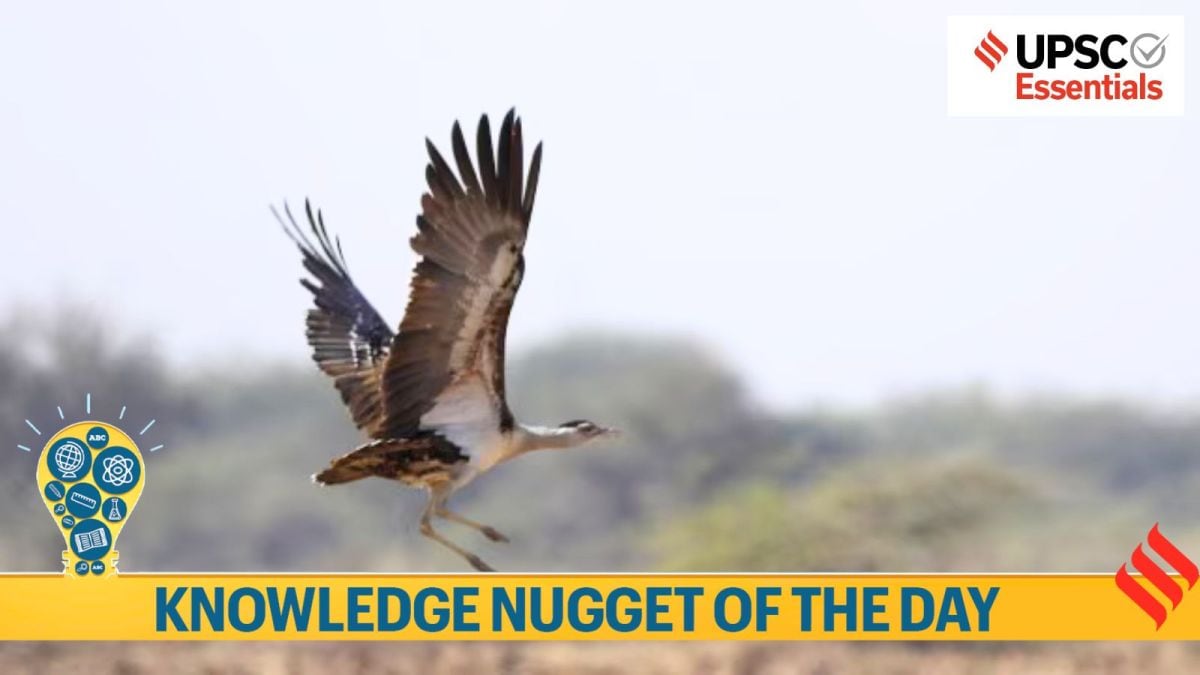
Take a look at the essential events, concepts, terms, quotes, or phenomena every day and brush up your knowledge. Here’s your UPSC Current Affairs knowledge nugget for today on the Great Indian Bustard.
(Relevance: UPSC has previously asked questions on various species. Therefore, it is essential to keep a tab on species in the news, as their chances of being asked in the examination increase. The Great Indian Bustard is one such species that holds great significance. Hence, knowing its characteristics and conservation status becomes important.)


1. The Great Indian Bustard (GIB) is a flagship species of the Thar Desert and the state bird of Rajasthan. Notably, Rajasthan has the largest remaining population of the GIBs.
2. It is a large bird found only in India. GIBs are the largest among the four bustard species found in India, the other three being MacQueen’s bustard, lesser florican and the Bengal florican.
3. Among the heaviest birds with flight, GIBs prefer grasslands as their habitats. Being terrestrial birds, they spend most of their time on the ground with occasional flights to go from one part of their habitat to the other.
4. GIBs feed on insects, lizards, grass seeds etc. They are considered the flagship bird species of grassland and hence barometers of the health of grassland ecosystems.
5. GIBs’ historic range included much of the Indian sub-continent but it has now shrunken to just 10 per cent of it. Due to the species’ smaller population size, the International Union for Conservation of Nature (IUCN) has categorised GIBs as critically endangered, thus on the brink of extinction from the wild.
6. Over the past four decades, its population has declined steadily. The estimated population of the GIB — once considered a candidate for national bird — is below 150.
7. Loss of their habitat to rising farmlands in semi-arid regions of Rajasthan, depredation of eggs by other predators such as dogs, monitor lizards and humans and more recently, death due to overhead power lines have caused their numbers to decline.
1. The court appointed an expert committee in 2024 to find a “delicate balance” between practical and environmental challenges in the conservation and protection of the GIB.
2. While accepting the recommendations of the committee, the bench formally designated 14,013 square kilometer in Rajasthan and 740 square kilometer in Gujarat as “revised priority areas”. These zones are considered essential for the GIB.
3. Notably, the court paid homage to the Bishnoi community and late Radheshyam Bishnoi, known as the “godawan man”, underscoring their tradition of eco-veneration was a classic example of harmony with nature that modern development must now emulate.
Directions
— The revised priority area for Rajasthan, as recommended by the Expert Committee, shall be 14,013 sq. kms., and the revised priority area for Gujarat, as recommended by the committee, shall be 740 sq. kms.
— The measures recommended by the committee for in-situ and exsitu conservation of GIB within the priority areas of Rajasthan and Gujarat shall be implemented forthwith.
— Recommendation of the committee for the conduct of long-term studies on the effects of climate change on GIB must be conducted.
— Recommendations of the committee for providing a power corridor of up to 5 km width, which will be at a distance of 5 km or more to the south of the southern-most enclosure of Desert National Park, are accepted.
— Recommendations of the committee negating the necessity for Mitigation of existing and future power lines of 11 kV and below voltage in the 100-metre buffer around the settlement is accepted.
— Restrictions as stipulated by the committee on future renewable energy projects within the Revised Priority Areas of Rajasthan are approved.
1. IUCN Red List status of Great Indian Bustard: Critically Endangered
2. Wildlife Protection Act, 1972: Schedule I
4. Convention on the Conservation of Migratory Species of Wild Animals (CMS): Appendix I
4. Convention on International Trade in Endangered Species of Wild Fauna and Flora (CITES): Appendix 1
1. The first steps to address the decline of the bustard population were taken between 2012-2013, when the Rajasthan government as well as the Environment Ministry began a long-term Bustard and Lesser Florican recovery project. The recovery project firmed up more in the year 2016 when it received a funding outlay of Rs 33.85 crore for seven years. This money was sanctioned to improve the bird’s habitat and start a conservation breeding program.
2. The Compensatory Afforestation Fund, which consists of money collected for afforestation in lieu of diversion of forests for non-forest uses, funded this project. Later, in July 2018, a tripartite agreement was signed between the Ministry of Environment, Forest and Climate Change, Rajasthan Forest Department and Wildlife Institute of India (WII).
3. This involved opening long-term conservation breeding centres (CBC) in Ramdevra and Sorsan, implementing field research projects such as telemetry-based bird tracking and population surveys, habitat management as well as outreach to local communities.
4. While the total length of the next phase of the GIB and Lesser Florican conservation is 2024-2033, the immediate next phase will run till 2029. The target of the project would be to complete the upgradation of the CBC at Ramdevra and development of the Lesser Florican CBC at Sorsan, both in Rajasthan. The Ramdevra facility would also include a new lab for artificial insemination, which the WII plans to use from 2026 onwards.
With reference to the Great Indian Bustard, consider the following statements:
1. It is known to be a key indicator species of the grassland habitat.
2. It is classified as vulnerable under the IUCN Red List.
3. The population of GIB has steadily increased in the past four decades.
How many of the statements given above are correct?
(a) Only one
(b) Only two
(c) All three
(d) None
| Answer Key |
| (a), statements 2 and 3 are incorrect. |
Subscribe to our UPSC newsletter. Stay updated with the latest UPSC articles by joining our Telegram channel – Indian Express UPSC Hub, and follow us on Instagram and X.
🚨 Click Here to read the UPSC Essentials magazine for December 2025. Share your views and suggestions in the comment box or at manas.srivastava@indianexpress.com


