9 min read

© IE Online Media Services Pvt Ltd



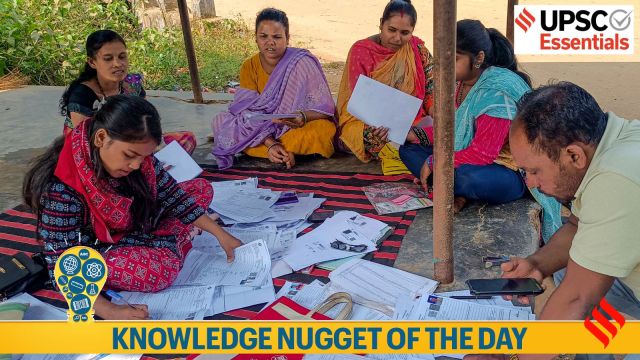 Booth Level Officers (BLOs) assist voters in filling out the enumeration forms for the special intensive revision (SIR) of electoral rolls, at Burundwada Semra village in Bastar district, Chhattisgarh, Tuesday, Nov. 25, 2025. (PTI Photo)
Take a look at the essential concepts, terms, quotes, or phenomena every day and brush up your knowledge. Here’s your current affairs knowledge nugget on the role and responsibilities of Booth Level Officers (BLOs).
(Relevance: BLOs have been in the news for quite some time. They are the representative of the Election Commission of India (ECI) at the grassroots level. Therefore, understanding their role and duties is important from your exam perspective.)
Currently, the Special Intensive Revision (SIR) of electoral rolls is underway in nine states and three Union Territories (UTs). Concerns have been raised with several BLO deaths have been reported from the states undergoing SIR.
As per the schedule announced by the EC on October 27, the SIR process started on November 4, and all electors in the 12 states / UTs have to submit their enumeration forms by December 4, in order to be on the draft electoral rolls to be published on December 9.
1. BLO is a representative of the Election Commission of India (ECI) at the grass-root level. They are local government/semi-government officials who are familiar with the local electors and enrolled as voters in the same polling area. Teachers, Anganwadi workers, Panchayat Secretary, Village Level Workers, Electricity Bill Readers, etc are mainly appointed as BLOs.
2. They play a significant role in the process of roll revision and collecting actual field information with regard to the roll corresponding to the polling area assigned to them. They maintain accuracy and fidelity of the electoral roll at the polling booth level. The major task in the revision of the SIR falls on these BLOs.
3. BLOs are not full-time electoral officials. Section 13B (2) of the Representation of People Act, 1950, states that “an electoral registration officer may, subject to any prescribed restrictions, employ such persons as he thinks fit for the preparation and revision of the electoral roll for the constituency.” This provision paved the way for the introduction of appointing a BLO for the first time in August 2006.
4. ECI established a clear line of accountability in preparation of the electoral roll by making BLOs as its custodians at the polling booth level. Earlier, voter identification slips were distributed by the contesting candidates of various political parties, a practice that often invited complaints. With the appointment of BLOs, voter confidence and the credibility of the election process have increased.
5. Amidst mounting work pressure and increased responsibilities for preparing revised electoral rolls, the Election Commission has decided to double the annual remuneration for BLOs and also enhanced the remuneration of BLO Supervisors involved in the preparation and revision of electoral rolls. The last such revision was done in 2015. The increased remuneration for BLOs is Rs. 12,000. Besides, a special incentive of Rs 6,000 is also provided to BLOs for Special Intensive Revision (SIR) starting from Bihar.
(i) Revision of Electoral Roll – SIR: One of the essential roles of BLOs is the preparation of an error-free electoral roll. It is the BLOs who are revising the electoral roll, which is being called the Special Intensive Revision. they have the responsibility of including all the eligible voters in the list and deleting the duplication of voters by following the guidelines provided by the ECI.
|
What is Special Intensive Revision (SIR)? Under Section 21(3) of The Representation of the People Act, 1950, the ECI “may at any time… direct a special revision of the electoral roll for any constituency or part of a constituency in such manner as it may think fit”. Story continues below this ad The Registration of Electors’ Rules, 1960, says the revision of rolls can be carried out “either intensively or summarily or partly intensively and partly summarily, as the [ECI] may direct”. In an intensive revision, the electoral roll is prepared afresh; in a summary revision, the roll is amended. |
(ii) Distribution of Voter Slips: An important role of the BLO is the distribution of Voter Slips to the voters’ households before the poll day. It is BLOs responsibility to ensure 100% distribution of Voter Slips in their area so that the voter is aware of all the important details such as the polling station name, part of the polling booth and date of polling day.
(iii) Messenger and Facilitator of ECI guidelines: BLOs promote Assured Minimum Facilities at each polling station to encourage voters to feel confident to come in large numbers to the polling station to vote and face no difficulties. It is their responsibility to ensure all persons with disabilities and senior citizens are identified and tagged to their respective Polling Stations.
(iv) Informing eligible voters for Postal Ballot: Last year, the government hiked the minimum age of senior citizens from 80 to 85 who can opt for postal ballots. BLOs must inform the eligible Electors (senior citizens above 85 years & PwDs with benchmark certificate) about availing Home Voting Facility and Postal Ballot Facility by filling Form 12D.
(v) Assistance at Polling Booths: The BLOs are available at the Help Desk on the day of the polling to provide any assistance required by the voter and make them feel welcomed at their respective polling booth.
(vi) Promote use of Election Commission’s IT applications: It is the responsibility of BLOs to promote applications launched by the ECI to facilitate voting and ensure an accurate electoral roll. The popular voter oriented apps like Voter Helpline App, eVIGIL app, Know you candidate app, Saksham-ECI. The BLO must inform voters and the general public in their respective areas about these applications.
* The ongoing Special Intensive Revision (SIR) of electoral rolls in nine states and three Union Territories is unfolding differently from the earlier exercise in Bihar.
* In Bihar, anyone not found on the 2003 intensive revision roll had to submit during enumeration one of 11 documents mandated by the Election Commission. The EC altered the process for the rest of the country.
* The new form asks electors to provide details of themselves or any adult relative in the last intensive revision roll of their state, but BLOs have been instructed not to collect documents at this stage. Instead, they must physically search the last intensive revision rolls (from any state or UT) to trace electors or their relatives and write the corresponding serial number on the form.
* Though BLOs in Bihar were also tasked with searching the 2003 rolls to match the electors, the difference in SIR 2 is that the matching is required for a greater number of electors, as all electors or their parents, aunts, uncles or grandparents needed to be traced to the old rolls.
* This makes the first phase lighter for electors, but increases the workload for BLOs. And if the section – with details of the elector or her family members on the last intensive role – is left blank, they will get notices after the draft roll is published on December 9, when documents will be sought.
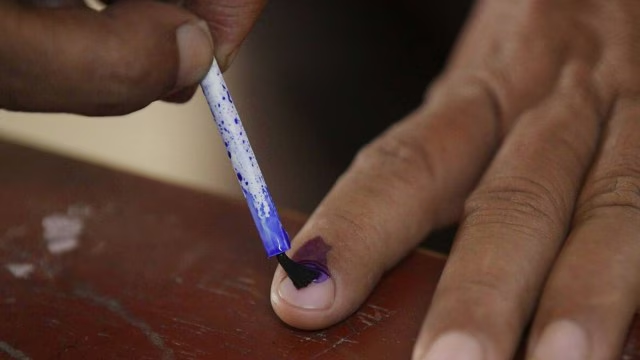 The Indelible Ink was developed by the National Physical Laboratory (NPL), New Delhi. (Representative image)
1. After a voter has cast their vote, an indelible ink is applied to their finger to prevent a person from casting more than one vote. It is mentioned in the Representation of the People Act (RoPA) of 1951. The ink contains silver nitrate. It is a colourless compound which becomes visible when exposed to ultraviolet light, including sunlight.
2. The Indelible Ink was developed by the National Physical Laboratory (NPL), New Delhi a constituent laboratory of CSIR in 1961 and issued the license to Mysore Paints and Varnish Limited (MPVL) (a Govt. of Karnataka undertaking) in 1962.
3. Since 1962, Mysore Paints & Varnish Ltd. has manufactured the ink. Earlier called Mysore Lac & Paint Works Ltd, it was established in 1937 by Nalwadi Krishnaraja Wodeyar, then the Maharaja of Mysore.
Consider the following statements:
1. The Representation of People Act 1951 provides for the appointment of the Booth Level Officers.
2. BLOs are permanent electoral officials.
3. The Indelible Ink is mentioned in the Representation of People Act 1950.
Which of the above-mentioned statements is/are correct?
(a) 1 and 2 only
(b) 2 only
(c) 2 and 3 only
(d) None of the above
| Answer key |
| (d) |
(Sources: ‘Depression, stress, suicide’: Now, RSS-linked teachers’ body writes to Election Commission with SIR concerns, https://ceodelhi.gov.in, BLO Handbook ECI,The story of indelible ink, a lasting symbol of Indian elections, and who makes it)
Subscribe to our UPSC newsletter. Stay updated with the latest UPSC articles by joining our Telegram channel – IndianExpress UPSC Hub, and follow us on Instagram and X.
🚨 Click Here to read the UPSC Essentials magazine for November 2025. Share your views and suggestions in the comment box or at manas.srivastava@indianexpress.com🚨

Read UPSC Magazine