© IE Online Media Services Pvt Ltd
Latest Comment
Post Comment
Read Comments
 9 min read


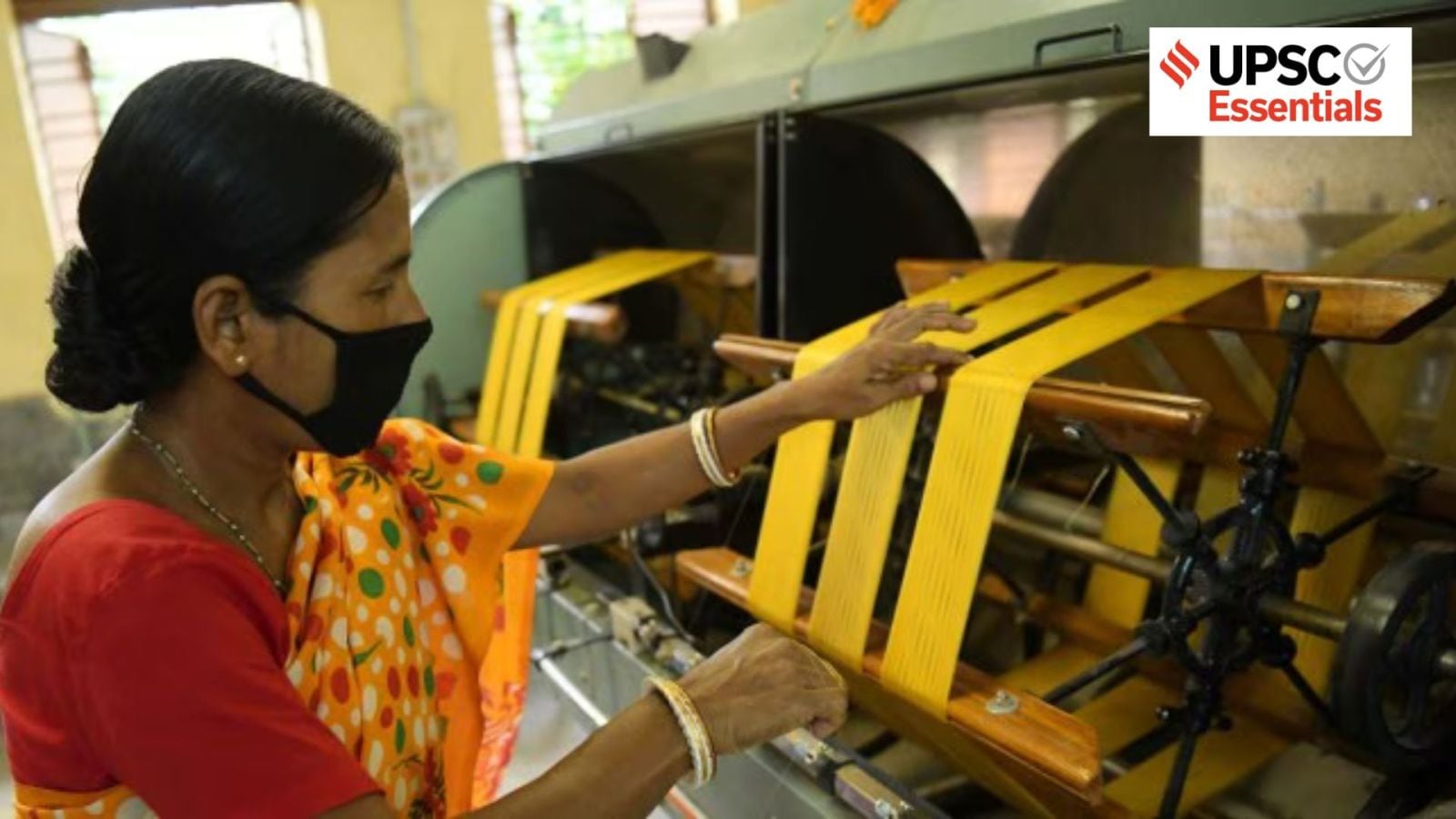 Female worker at a silk factory after the government eased Covid induced lockdown restrictions in Agartala. (Express file photo by Abhishek Saha)
— Ritwika Patgiri
Kerala’s Right to Disconnect Bill and Karnataka’s Bill for paid menstrual leave are among some of the progressive labour reforms seen as addressing the need for work-life balance and rising demands for employee well-being.
Alongside such efforts, the expansion of digital technologies and flexible work arrangements have helped create new opportunities for women’s participation in the workforce. However, the reality remains more complex, as women continue to juggle paid employment with a disproportionate share of unpaid domestic care work. It raises a pertinent question: do flexible work arrangements actually ease women’s work burdens?
The Kerala Government’s proposed Right to Disconnect Bill 2025 aims to help private sector workers navigate their work-life balance better. According to the bill, private sector employees have the right not to attend online meetings, calls, emails, video conferences, and messages once the official working hours are over. The bill further adds that the employee shall not face any disciplinary action for choosing to log off after work hours. If enacted, this would make Kerala the first state to introduce such legislation.
It must be mentioned here that countries like France, Spain, Italy, Germany, and Belgium have implemented similar bills and measures to help workers have a better work-life balance. For instance, trial runs of a four-day workweek in France have shown that improved work-life balance helps in reducing stress, lowering fatigue, greater happiness, and higher productivity.
Parallel to discussions around the Right to Disconnect, the Ministry of Labour and Employment has implemented four new labour codes in India. The new codes have been highlighted as important reforms for women workers: they are permitted to work at night in all types of work across all establishments (subject to their consent and required safety measures); they will also get equal opportunities to earn higher incomes in high-paying jobs.
These labour codes are intended to increase women’s labour force participation. India has one of the world’s lowest female labour force participation rates (FLFPR). Since 2004-05, the FLFPR has witnessed a downward trend.
Economists have tried to explain this trend through the U-shaped relationship between education and women’s workforce participation. The U-shaped hypothesis states that women with poor education levels are usually part of households that are facing economic distress, which compels them to participate in the workforce.
On the other hand, women with higher education levels are absorbed in high-paying jobs, leading to a rise in their workforce participation. Thus, as the education level goes up, FLFPR increases.
Another argument explaining the decline in FLFPR is that the nature of growth and employment creation in India has been skewed against sectors that traditionally employ women. Recent labour market data, however, indicates an increase in the FLFPR. This increase has largely been driven by the rise in self-employment among rural women, particularly in agriculture.
India has seen an increase in internet access and digitisation between 2015 and 2022. During the same period, the FLFPR has also shown an upward trend. A few recent studies have illustrated a positive relationship between digitalisation and FLFPR. For instance, evidence suggests that the adoption of Information and Communication Technology (ICT) increases the likelihood of female employment. However, studies also indicate that such an impact can be limited to only regular salaried women workers or self-employed female workers.
Further, ICT tends to benefit women, who have more autonomy in work-related decisions. Digital technologies can also provide women with better information about suitable jobs. Other studies from other parts of the world show that ICT can also influence women’s decision to participate in the workforce by offering greater flexibility, increasing productivity, and enabling the choice of work-from-home.
In the case of India, women workers are overrepresented in agriculture. One of the biggest challenges of the Indian economy has been the creation of adequate non-farm jobs for women. For instance, the gig economy, often portrayed as flexible and liberating for women due to its reliance on digital platforms, is seen as offering a solution to inadequate job creation for women.
Studies highlight that the gig economy has seen an increased participation of women across the Global South, along with income gains, particularly among women with low education levels. Such jobs provide women with flexibility to better balance paid employment with unpaid domestic and care responsibilities.
Another sector in which women can benefit from digitalisation is e-commerce and digital entrepreneurship. India is home to around 7,000 women-led start-ups, which is around 7.5 per cent of all start-ups in the country. Further, close to 14 per cent of India’s entrepreneurs are women. Digital and e-commerce platforms have helped women to promote their goods and services, access the markets, and build networks.
Across the developing world, women entrepreneurs are often concentrated in micro-enterprises and operate largely in the informal sphere. The United Nations Development Programme, in a recent policy brief, found that women entrepreneurs in India can leverage digital technology to navigate several challenges.
In the corporate sector, the role of digital infrastructure became particularly evident during the Covid-19 lockdown, when remote work and “work from home” (WFH) became popular. Studies find that such flexibility can lead to a rise in women’s employment. Women in India have historically been working from home, managing family-owned enterprises and existing as invisible labour. They are often unpaid and not seen as “workers.”
In addition, there are home-based women workers. They are contracted by firms and industries, paid a piece-rate wage, and form the lowest rung of the labour hierarchy. Examples of such workers include women workers in the garment industry, bidi industry, etc. In contrast, contemporary corporate (or government and other formal sectors) WFH arrangements are largely carried out by women from middle-class families.
These formal sector women workers may or may not have domestic helpers and are expected to carry out their formal jobs along with domestic responsibilities. Studies have also indicated that women engaged in WFH are often overburdened with both domestic as well as paid work. Childcare and other forms of care work remain the primary responsibility of women due to gender-based expectations. Such a “double burden of work” frequently pushes women to opt for flexible jobs, which do not necessarily reduce the burden of unpaid labour.
A recent report has found that corporate workers in India have reported the highest rates of burnout symptoms. Around 60 per cent of corporate workers experience chronic exhaustion, anxiety, and job insecurity. A 14-hour workday is often considered “normal”.
Both WFH and digitalisation of work have blurred the boundaries between office and personal space, a trend seen in the aftermath of the pandemic induced lockdown. Workers are expected to remain “available”, “online”, and “logged-in”.
Additionally, because numerous multinational companies have their primary offices located outside India, employees frequently participate in meetings and calls scheduled according to foreign time zones. This often results in late-night or early-morning work schedules, irregular sleep cycles, and work-life imbalance.
In this context, women in the corporate sector face additional challenges. They are expected to navigate both the demanding expectations of the always-connected corporate environment as well as the disproportionate burden of unpaid care work at home.
Economist Claudia Goldin has argued that when women perform care work alongside paid work (under WFH arrangements), their productive work time is often reduced as a result of frequent interruptions. She further underlines that both the care sector and the market economy are interrelated. Women’s participation in paid employment directly shapes the distribution of care responsibilities within households.
Whether in the formal sector or the informal sector, the burden of care work continues to fall disproportionately on women. Therefore, it may be argued that the Right to Disconnect Bill represents a potentially significant intervention for formal sector workers seeking to balance paid work and care responsibilities. Both parents can, thus, pay attention to childcare and other domestic duties.
However, the effectiveness of such a measure depends on complementary progressive policies like subsidised childcare, affordable crèches, and paid parental leave. Without these structural supports, the burden of balancing work and care will continue to fall disproportionately on women despite formal protections.
To what extent can legal interventions like the Right to Disconnect address work–life balance issues in the digital economy? Substantiate with examples.
Digitalization has altered the nature of work but not necessarily the distribution of unpaid labour. Comment with reference to work-from-home arrangements.
Discuss the implications of blurred boundaries between work and personal life for labour productivity and mental health.
Despite increased digital access, women continue to face a ‘double burden’ of work. Discuss the structural factors responsible for this phenomenon.
What complementary policy measures are required to ensure that digitalization and flexible work arrangements translate into real gains for women workers?
(Ritwika Patgiri is a doctoral candidate at the Faculty of Economics, South Asian University.)
Share your thoughts and ideas on UPSC Special articles with ashiya.parveen@indianexpress.com.
Click Here to read the UPSC Essentials magazine for December 2025. Subscribe to our UPSC newsletter and stay updated with the news cues from the past week.
Stay updated with the latest UPSC articles by joining our Telegram channel – IndianExpress UPSC Hub, and follow us on Instagram and X.


Read UPSC Magazine