3 min read
© IE Online Media Services Pvt Ltd



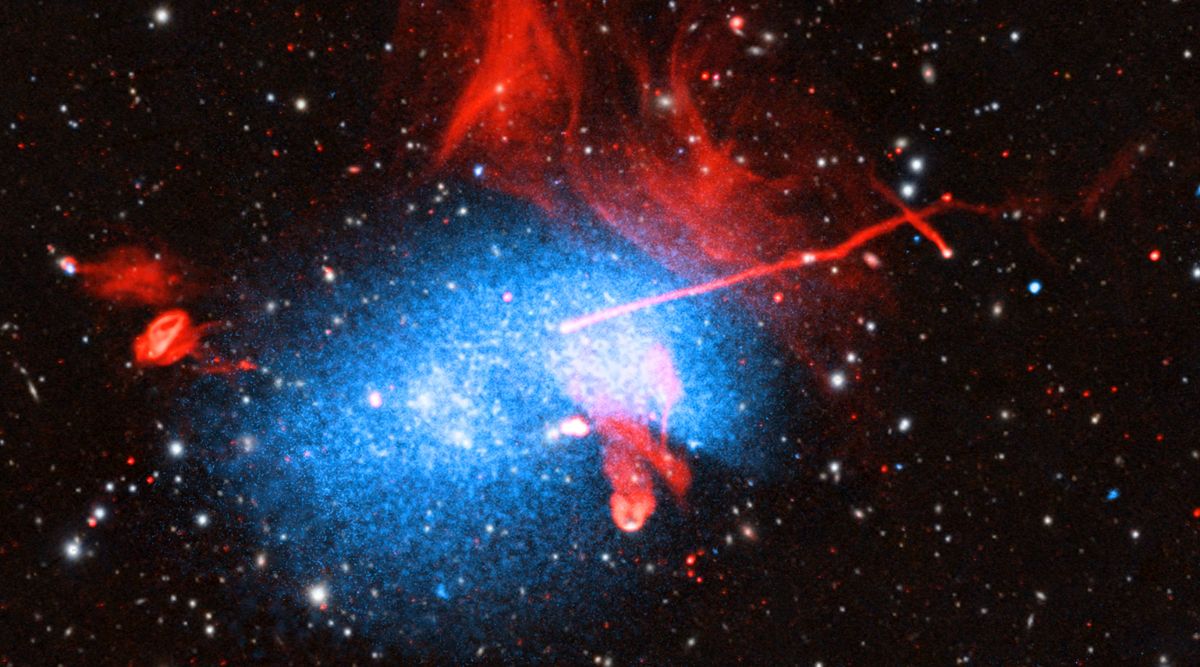 This knot-like structure is the ongoing collision of at least three galaxy clusters. (Image credit: NASA)
 It is not very often that you get to see a spectacular ongoing collision between multiple galaxy clusters, so you should make the most of the opportunity whenever it appears. In this image released by NASA, you can see the knot-like collision of at least three galaxy clusters.
Apart from forming breathtaking views like this one, galactic collisions and mergers help galaxies grow into the massive cosmic behemoths that we get to see in the sky. They also form some of the largest “particle accelerators” in the universe. Astronomers studying this huge cosmic event created this composite image using data from multiple telescopes. The study analysing this structure has been published in The Astrophysical Journal.
This image is of the giant galaxy cluster Abell 2256, which is located around 780 million light-years away from our planet. It combines X-ray data (blue)from NASA’s Chandra X-ray Observatory and the European Space Agency’s (ESA) XMM-Newton telescope; radio data (red) collected by the Giant Metrewave Radio Telescope (GMRT), the Low Frequency Array (LOFAR), and the Karl G. Jansky Very Large Array (VLA) in red; and optical and infrared data (white and pale yellow) from Pan-STARRS.
Creating a composite image using data from different telescopes is important because each telescope tells a different part of the story. Galaxy clusters often contain hundreds or even thousands of individual galaxies, and they consist of massive reservoirs of superheated gases with temperatures measured in millions of degrees. This superheated gas is only visible in X-ray data depicted in blue.
While it is easy to trace the X-ray emissions in the system, that is far from the truth with the radio data since they arrive from a complex set of sources. One source is the galaxies themselves, where radio signals are generated when particles blast away from the supermassive black holes at their centre.
Another source for the radio waves is the “filamentary” structure in the image, which is mostly located to the north of radio-emitting galaxies. According to NASA, these emissions are likely generated when shockwaves created by the collision accelerate gas particles across a distance of more than two light years.
Another source of radio emissions is located near the centre of the collision, but it is not properly visible in this image because it overlaps with the X-ray emissions from the filamentary structures and the galaxies.