“The dual-screen tech has not expanded because it has not found a mass as far as the use case is concerned,” admits Dinesh Nair, Director – Consumer Business, Lenovo India. But Nair says Lenovo could succeed where other dual-screen devices have failed before, and the early reception seems promising.
“If you look at what’s happening today, especially post-pandemic, and the way consumers have evolved, and what people are using things for whether it’s their hybrid work, the need to connect, the need to create and the need to multitask, suddenly these devices are starting to seem very relevant,” Nair tells indianexpress.com in an interview on the sidelines of the launch of the dual-screen Yoga Book 9i.

The Yoga Book 9i is a dual-screen touchscreen laptop with a second touchscreen on the bottom, replacing the keyboard and touchpad. It’s essentially two 13.3-inch, 16:10, 2.8K OLED screens stacked on top of each other with a hinge in the middle and a detachable keyboard, similar to the now-dead Microsoft Surface Neo. You can also fold this device at 90 degrees and use it like a regular 13-inch laptop.
There are multiple ways of using the Lenovo Yoga Book 9i. (Image credit: Anuj Bhatia/Indian Express)
“You have to be able to build in the use case. Yes, there will be a bunch of consumers in the market, especially early adopters who love new tech but finally, something has to pick a mass… it has to have a solid use case and it has to then kind of fit into that sweet spot where consumers can actually afford the product,” he says.
The PC giant Lenovo isn’t new to experimental laptop design, having launched notebooks with e-ink displays and foldable screens over the years. However, the Yoga Book 9i is the company’s best attempt at making dual-screen form factor work with the right blend of both software and hardware.
“The concept behind the Yoga Book 9i actually started four years ago and was revisited in the past two years,” Gregory Beh, Category Manager Lenovo Asia Pacific, chimes in, adding that the company spent a lot of time studying the usage behaviour of the targeted demography as well as got real-time feedback of existing products to create the Yoga Book 9i that meets the needs of the user. “The Yoga Book 9i is the end product of many years of research and development.”
As Beh observed, there are consumers out there who would like to mimic a setup similar to a dual screen at home but in a compact device they can carry with them all the time. Think about designers, illustrators and coders who are the target consumers for a device like the Yoga Book 9i. “Productivity is not going to be deskbound whether you are at home or in the office…people will be working from every corner,” he says.
Story continues below this ad
Having two screens available both at the same time offers new types of use cases that traditional laptops can’t achieve with the current form and design. The hinge between the two screens still creates separation, but Lenovo’s clever software skills make this work.
“If you look at the usage patterns for someone who is into coding or creating content, think about what they can do if it’s a seven or eight-inch screen, there’s only so much you can do. But with a dual-screen display laptop, which can work in different modes, it’s practically a lot easier for you to actually get your work done,” Nair explains the rationale behind going with two large 13.3-inch, OLED panels with 16:10 aspect ratios over smaller screens one would find on a tablet.
[From left to right] Dinesh Nair, Director-Consumer Business, Lenovo India Suyash Singh, Product Manager, Consumer Business, Lenovo India Gregory Beh, AP Category Manager. (Image credit: Lenovo)
The Yoga Book 9i doesn’t come cheap at Rs 2,24,990, but then Lenovo is targeting consumers who understand what they can do with a dual-screen laptop form factor. “It’s got the best of the hardware, the software, whether it’s the features inside it or the fact that practically it is something that has never been seen in the market before.”
Story continues below this ad
Getting the dual-screen form factor hasn’t been easy for Lenovo, and as a new product category, the company is committed to refining the design of the Yoga Book 9i going forward. “We are not looking at a one-time device. We are still improving on the software,” says Beh. ”I think you will clearly see a lot more innovation and a lot many more improvements on these product lines in the next few months,” Nair reassures, underlining that the dual-screen form factor is here to stay.


 5 min read


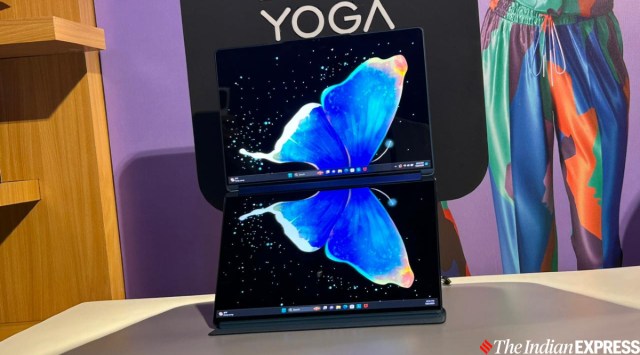

 There are multiple ways of using the Lenovo Yoga Book 9i. (Image credit: Anuj Bhatia/Indian Express)
 The Yoga Book 9i uses an i7 U-series CPU from Intel’s 13th Gen Core mobile CPU series. (Image credit: Anuj Bhatia/
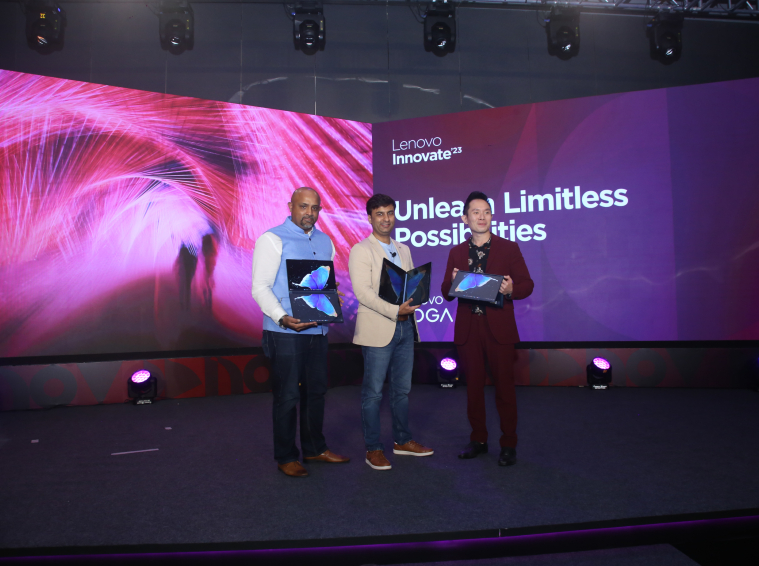 [From left to right] Dinesh Nair, Director-Consumer Business, Lenovo India Suyash Singh, Product Manager, Consumer Business, Lenovo India Gregory Beh, AP Category Manager. (Image credit: Lenovo)