


© IE Online Media Services Pvt Ltd
Tags:


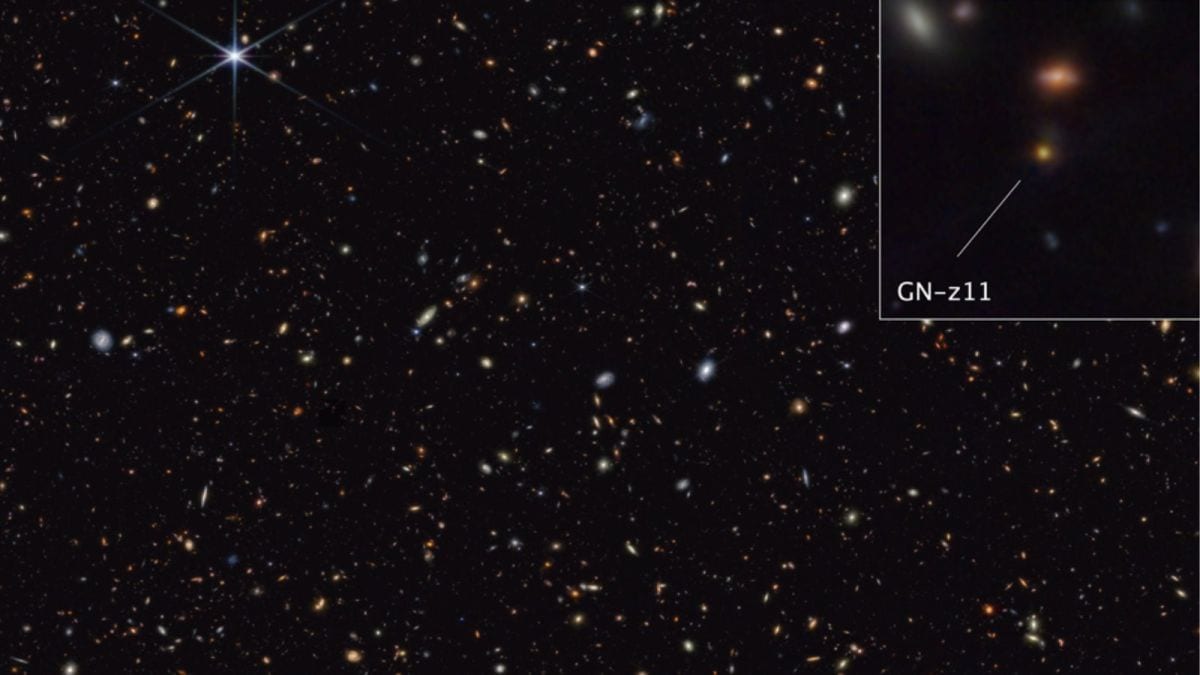
The James Webb Space Telescope has helped scientists discover GN-z11, a galaxy that is one of the youngest and most distant ever observed, announced the Space Telescope Science Institute on Monday. Scientists have also found evidence for the existence of the first kind of stars to “bring light to the universe.”
The galaxy was observed as it existed when our 13.8 billion-year-old universe was 420 million years old. That is how long it took the light from the galaxy to reach Webb.


A team of researchers observing GN-z11 found a gaseous clump of helium in the halo that surrounds the galaxy.
“The fact that we don’t see anything else beyond helium suggests that this clump must be fairly pristine. This is something that was expected by theory and simulations in the vicinity of particularly massive galaxies from these epochs — that there should be pockets of pristine gas surviving in the halo, and these may collapse and form Population III star clusters,” said Roberto Maiolino of the Cavendish Laboratory and the Kavli Institute of Cosmology at the University of Cambridge in the United Kingdom, in a press statement.
Population III stars are considered the first generation of stars and finding them is one of the most important goals of modern astrophysics, according to NASA. Scientists believe them to be very massive, very bright and very hot and also expect the presence of ionised helium and the absence of other chemical elements heavier than helium.


