3 min read
© IE Online Media Services Pvt Ltd



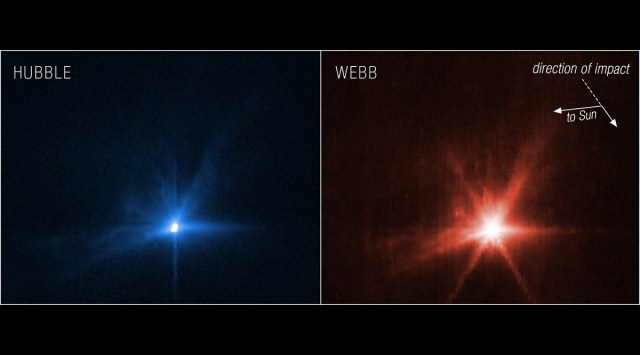 DART asteroid collision: The Hubble Space Telescope captured the image on the left and the James Webb Space Telescope captured the image on the right. (Image credit: NASA)
NASA’s Double Asteroid Redirection Test (DART) spacecraft successfully collided with the asteroid Dimorphos at 4.44 AM IST on September 27. We have already seen some images of the crash taken by the LICIACube but NASA has released detailed views of the DART crash taken by the Webb and Hubble telescopes.
These observations of DART’s intentional crash with Dimorphos mark the first time that the James Webb Space Telescope and Hubble Space Telescope simultaneously observed the same target.
“Webb and Hubble show what we’ve always known to be true at NASA: We learn more when we work together. For the first time, Webb and Hubble have simultaneously captured imagery from the same target in the cosmos: an asteroid that was impacted by a spacecraft after a seven-million-mile journey. All of humanity eagerly awaits the discoveries to come from Webb, Hubble, and our ground-based telescopes – about the DART mission and beyond,” said NASA administrator Bill Nelson in a press statement.
Observations of the DART collision made by Webb and Hubble will give scientists insight into the nature of Dimorphos, how much material was ejected by the crash and how fast it was ejected. Also, Hubble and Webb captured the impact in different wavelengths of light. Webb captured it in infrared and Hubble in the visible spectrum.
These observations across different wavelengths will reveal the sizes of the particle in the expanding dust cloud, helping scientists understand whether the collision threw off lots of big chunks of material or mostly fine dust. This information will be combined with observations from ground-based telescopes to understand how effectively a kinetic impact can modify an asteroid’s orbit.
The Webb telescope took one observation of the location of impact before the collision took place before taking several observations of the collision in the next few hours. The images from the telescope’s NIRCam (Near-Infrared Camera) show a tight, compact core with wisps of material streaming away from the impact location.
In the coming months, scientists will observe the system using Webb’s MIRI (Mid-Infrared Instrument) and NIRSpect (NIRSpec). The spectroscopic data will help scientists learn about the asteroid’s chemical composition.
Just like Webb, Hubble also captured observations of the binary system before the impact, then did it again 15 minutes after the DART spacecraft hit Dimorphos. Hubble’s Wide Field Camera 3 took images of the impact in visible light. In these images, ejected materials appear as rays stretching out from the asteroid.