3 min read
© IE Online Media Services Pvt Ltd



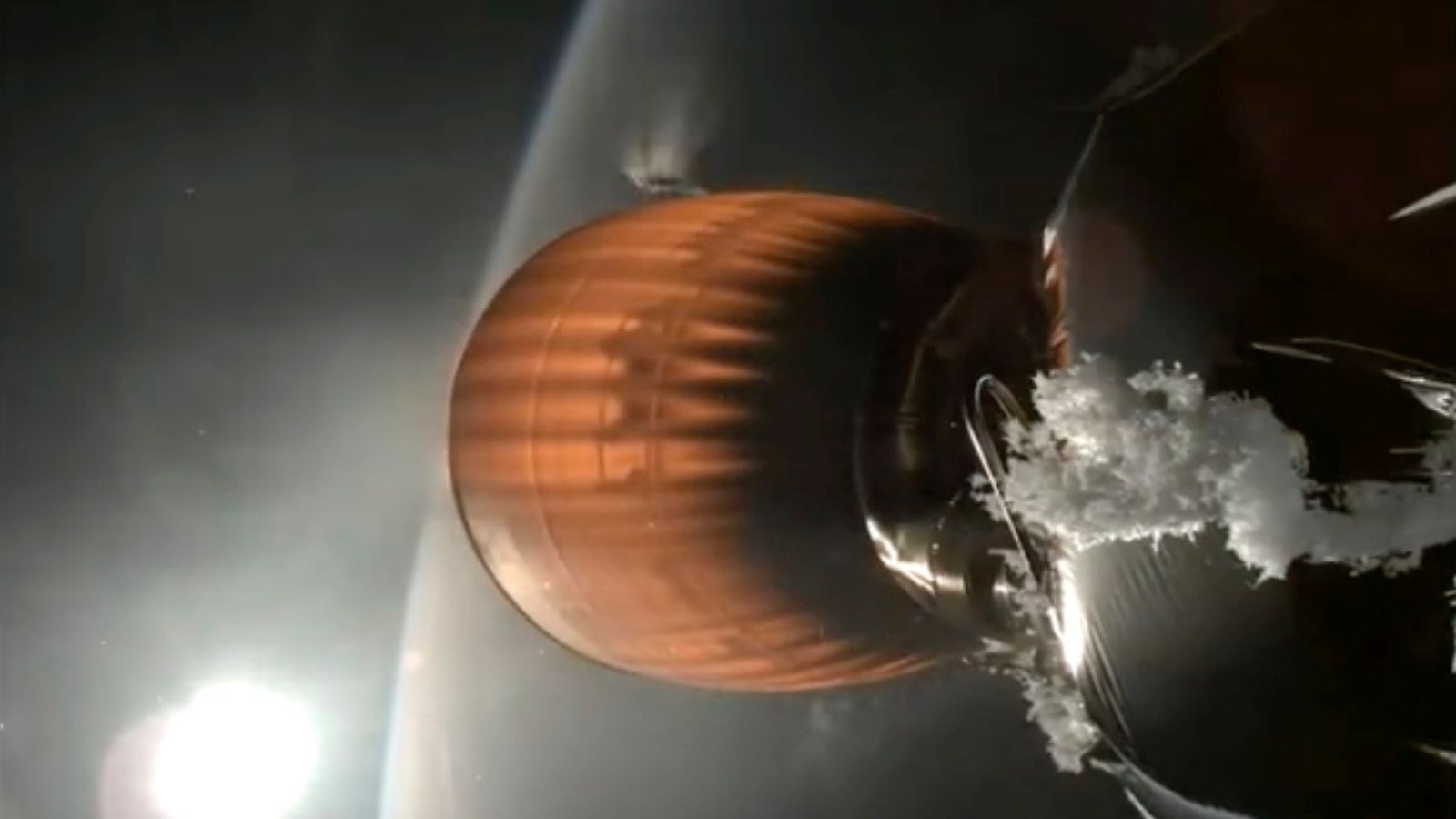 This image from video provided by SpaceX shows the upper stage engine of a SpaceX Falcon 9 rocket, which blasted off from California on Thursday, July 11, 2024. (AP)
A SpaceX rocket has experienced its first failure in nearly a decade, leaving the company’s internet satellites in an orbit so low that they are destined to fall through the atmosphere and burn up.
The Falcon 9 rocket was launched from Vandenberg space force base in Santa Barbara county, California on Thursday night, carrying 20 Starlink satellites. However, Approximately an hour into the flight, the upper stage engine malfunctioned. SpaceX attributed the failure to a liquid oxygen leak.
On Friday, the company informed that flight controllers were able to contact half of the satellites and attempted to boost them to a higher orbit using onboard ion thrusters. Despite these efforts, with the low end of their orbit only 84 miles (135 kilometers) above Earth — less than half the intended altitude — “our maximum available thrust is unlikely to be enough to successfully raise the satellites,” SpaceX said in a post on X.
As a result, the satellites will reenter the atmosphere and burn up. The company did not specify when this might occur. Currently, more than 6,000 Starlink satellites orbit the Earth, providing internet service to some of the most remote corners of the world.
“SpaceX has made contact with 5 of the satellites so far and is attempting to have them raise orbit using their ion thrusters,” the company added.
The SpaceX founder, Elon Musk, who also owns X, provided a highly technical explanation about ion thrusters, a type of electric propulsion used in spacecraft.
“We’re updating satellite software to run the ion thrusters at their equivalent of warp 9. Unlike a Star Trek episode, this will probably not work, but it’s worth a shot,” he said.
In a separate post on X, Musk stated: “Upper stage restart to raise perigee resulted in an engine RUD for reasons currently unknown,” referring to a rapid unscheduled disassembly – a euphemistic industry acronym for explosion. He added: “Team is reviewing data tonight to understand root cause.”
The Federal Aviation Administration stated that the problem must be resolved before Falcon rockets can fly again.
It remains unclear how this accident might impact SpaceX’s upcoming crew flights. A billionaire’s spaceflight is scheduled for July 31 from Florida, which includes plans for the first private spacewalk. Additionally, an astronaut flight to the International Space Station for NASA is planned for mid-August.
Jared Isaacman, the tech entrepreneur leading the private flight, expressed confidence in SpaceX’s Falcon 9, calling its track record “incredible” and noting the presence of an emergency escape system.
The last launch failure for SpaceX occurred in 2015 during a cargo run to the space station, with another rocket explosion happening the following year during ground testing.